Source Custom Motorcycle Piston Gasket Kit for repair, assembly, and replacement
Find 30 listings for Custom Motorcycle Piston Gasket Kit options including rubber materials and standard sizes. Buyers can compare specifications, MOQs, and delivery times from verified Chinese manufacturers offering electric or kick-start compatible parts.
Key considerations
Products List






Comprehensive Sourcing Guide
Strategic Sourcing Guide for Custom Motorcycle Piston Gasket Kits
The global motorcycle aftermarket relies heavily on precision-engineered components that ensure engine integrity and performance longevity. For procurement professionals seeking a Custom Motorcycle Piston Gasket Kit, the sourcing landscape requires a rigorous understanding of technical specifications, regulatory compliance, and supply chain dynamics. This guide synthesizes observed market data and industry standards to provide a disciplined framework for evaluating suppliers and products. The focus remains on evidence-based attributes, ensuring that buyers make decisions grounded in verified facts rather than unconfirmed marketing claims.
Technical Specifications and Component Compatibility
The foundation of a successful procurement strategy lies in matching the exact technical specifications of the gasket kit to the target engine architecture. In the observed market, piston gasket kits are frequently categorized by specific engine models, such as the CG200, CG250, GY6-125, GY6-150, YBR250, and DL650. These model identifiers are critical because the dimensions and sealing requirements vary significantly between engine types. For instance, the "Standard Size" specification is a common baseline, yet the physical dimensions can differ; one observed standard is listed as 15x15x15, while others rely on model-specific compatibility like the CB200 or JJ-OMG200.
Buyers must verify the material composition of the gasket kit. The supply chain data indicates that rubber is a primary material used in these assemblies, likely for the sealing elements within the kit. However, the overall assembly may include metal components depending on the engine design. The thermal characteristics are equally vital; the engines associated with these kits are predominantly "Internal Combustion Type" with a "Four Stroke" principle. The compression stroke is a specific operational phase that dictates the pressure and temperature the gasket must withstand. Furthermore, the cooling method is a key differentiator; observed products are frequently "Air-Cooled," which influences the thermal expansion rates the gasket material must accommodate.
When evaluating a custom kit, the buyer should confirm the cylinder configuration. The data points to a "1 Cylinder" configuration as a standard for many of these units. The fuel system type is also a relevant attribute, as the gasket must seal against the specific pressure dynamics of the engine's fuel delivery and exhaust systems. A "Motorcycle Engine Assembly" or "Engine gasket" classification suggests that the product may be sold as a complete unit or a specific component within a larger assembly. The condition of the product is consistently listed as "New," ensuring that the buyer receives a pristine component ready for installation.
Compliance and Certification Verification
Navigating the regulatory landscape is essential for international trade, particularly when sourcing from major manufacturing hubs. The observed market data highlights specific certifications that suppliers may possess, including "CCC" (China Compulsory Certification) and "ISO9001." These certifications are critical indicators of a supplier's adherence to quality management systems and product safety standards. The presence of ISO9001 suggests that the manufacturing process follows a standardized quality control protocol, which is vital for ensuring consistency in gasket thickness and material density.
However, buyers must exercise caution and verify these certifications on a per-shipment basis. The data shows that while some listings explicitly mention "CCC" and "ISO9001," others may only list one or the other, or include variations such as "ISO9001: Cold Style." It is the buyer's responsibility to request current, valid certificates for the specific batch of gasket kits being ordered. Relying on a general supplier claim without verification can lead to compliance issues, especially when importing into markets with strict regulatory requirements.
The "Standard Size" designation also implies adherence to industry norms, but it does not replace the need for specific dimensional verification. Buyers should request dimensional drawings or sample measurements to ensure the "Standard Size" aligns with the specific requirements of their motorcycle models. Additionally, the "Place of Origin" is frequently listed as "China," with specific regions like "Jiangsu" noted. Understanding the origin helps in assessing the logistical route and potential trade tariffs, but it does not inherently guarantee quality without the supporting certification documentation.
Cost Drivers and Pricing Dynamics
Understanding the cost structure of custom motorcycle piston gasket kits requires an analysis of several variables. The observed price range in the market spans from 0.2 USD to 22.28 USD. This wide variance suggests that pricing is heavily influenced by factors such as the complexity of the kit, the specific engine model compatibility, and the volume of the order. A kit for a high-performance model like the DL650 or a specialized assembly like the YBR250 may command a higher price point compared to a standard kit for a CG200.
The Minimum Order Quantity (MOQ) is a significant driver of unit cost. The data indicates an MOQ range of 100 to 1000 units, with specific listings showing an MOQ of 100 pieces or 10 sets. Purchasing at the lower end of the MOQ spectrum typically results in a higher per-unit cost, while larger orders often benefit from economies of scale. The "Selling Units" are listed as "Single item" in some contexts, which may refer to the packaging unit rather than the transactional minimum. Buyers must clarify whether the price quoted is for a single gasket or a complete kit to avoid budget miscalculations.
Other cost factors include packaging and shipping. The "prod_packing" options vary from "Paper Box" to "Carton, Blister Card, Bag," and "Carton Box." More robust packaging, such as a sturdy carton box, may add to the cost but is essential for preventing damage during transit. The "Weight" of the product is also a factor; one observed item weighs 3kg, which will impact freight charges, especially when shipping "by Sea." The "One-Stop Source" advantage mentioned in the market data can also influence cost, as it may reduce the administrative and logistical overhead of sourcing multiple components from different suppliers.
Typical Applications and Market Segmentation
The application of custom motorcycle piston gasket kits is diverse, catering to various market segments and engine types. The "Main Market" data reveals a split between "North America" and "South America," indicating that these components are in high demand across the Americas. This geographic distribution suggests that the kits are designed to meet the specific needs of motorcycles popular in these regions, which often include off-road, commuter, and touring models.
The "Purpose" of these kits is explicitly stated as "for replace/repair," highlighting their role in the maintenance and overhaul sector. Whether for a "Motorcycle Carburetor" related assembly or a standalone "Engine gasket," the primary function is to restore engine compression and prevent fluid leaks. The "Color" options, ranging from "Grey / Green / Yellow / Blue" to "Silver," may be cosmetic or indicative of different material grades or sealing properties. Buyers should verify if color coding correlates with specific performance ratings or material compositions.
The "Customization" availability is a key feature for this product category. The "OEM: Accept" attribute confirms that suppliers are willing to produce kits tailored to specific brand requirements or non-standard dimensions. This is particularly relevant for niche motorcycle models or custom builds where off-the-shelf parts may not fit. The "Warranty" period of "1 YEAR" provides a baseline assurance of product durability, though the specific terms of this warranty should be reviewed in the supplier agreement.
Supplier Evaluation and Selection Criteria
Selecting the right supplier requires a multi-faceted evaluation process that goes beyond price and basic specifications. The "Advantage" of "One-Stop Sourse" suggests that some suppliers offer a comprehensive range of motorcycle parts, which can streamline the procurement process. However, buyers should verify the depth of this inventory to ensure it covers all necessary components for a complete engine rebuild.
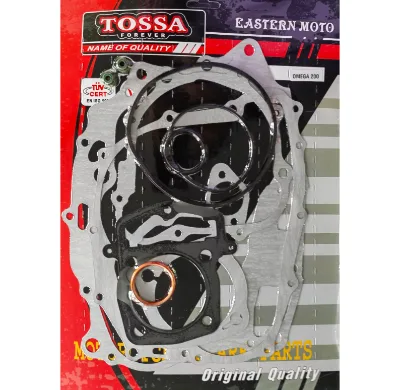
The "Brand Name" is another factor to consider. While "Tossa" is observed as a brand in the market, buyers should not limit their search to a single name. Instead, they should evaluate the reputation of various brands based on their certification status and customer feedback. The "Quality" attribute is listed as "a" in the data, which is vague; buyers must request detailed quality reports or third-party test results to substantiate this claim.
Lead time is a critical operational metric. The "Delivery Time" is observed to be between 15 and 30 days. This window must be factored into the production schedule to avoid delays. Buyers should also consider the "Shipping" method, with "by Sea" being a common option. For urgent orders, air freight might be necessary, though it will increase costs. The "Start" method of the engine, listed as "Electric/Kick," is an operational detail that the gasket kit must support, ensuring that the engine can be reliably started after the gasket replacement.
Quality Control and Long-Term Procurement
Implementing a robust quality control (QC) regime is essential for mitigating the risks associated with mechanical components. Given that the "Energy Transformation" is listed as "Power Machine" for some items and "Wind Turbine" for others, buyers must ensure that the specific product they order is intended for motorcycle engines and not mislabeled. The "Thermal Machine" classification as "Internal Combustion Type" confirms the intended application, but verification is necessary.
For long-term procurement, establishing a consistent relationship with suppliers who offer "Customization" and "OEM" services is beneficial. This allows for the development of tailored solutions that can improve engine performance and reliability over time. The "Condition" of the product being "New" is a standard expectation, but buyers should implement incoming inspection protocols to verify this upon receipt.
The "Material" of "Rubber" requires specific attention to aging and degradation. Buyers should inquire about the rubber compound's resistance to heat and oil, as these are critical factors in the lifespan of a piston gasket. The "Standard Size" and "15x15x15" specifications should be cross-referenced with the actual engine requirements to ensure a perfect fit. Finally, the "Warranty" of "1 YEAR" serves as a benchmark for expected product life, but actual performance may vary based on usage conditions and maintenance practices.
Summary of Key Procurement Parameters
To facilitate a clear comparison of the observed market data, the following table summarizes the critical parameters for sourcing custom motorcycle piston gasket kits. This summary consolidates the technical, logistical, and compliance factors discussed in the previous sections.
| Parameter | Observed Values / Options | Verification Requirement |
|---|---|---|
| Certification | CCC, ISO9001 | Request valid certificates per batch |
| Engine Type | Four Stroke, Internal Combustion | Confirm compression stroke compatibility |
| Cooling Style | Air-Cooled | Verify thermal expansion ratings |
| Cylinder Count | 1 Cylinder | Match to target engine specs |
| MOQ Range | 100 - 1000 pcs | Negotiate based on volume needs |
| Delivery Time | 15 - 30 days | Align with production schedules |
| Origin | China (Jiangsu) | Assess logistics and tariff implications |
| Material | Rubber | Check compound resistance to heat/oil |
| Warranty | 1 YEAR | Review terms and exclusions |
| Customization | Available / OEM Accept | Define specific dimensional needs |
| Packing | Paper Box, Carton, Blister Card | Ensure protection during transit |
| Price Range | $0.20 - $22.28 USD | Validate against volume and specs |
By adhering to these evidence-based guidelines, procurement professionals can navigate the complexities of sourcing custom motorcycle piston gasket kits with confidence. The focus on verified specifications, rigorous certification checks, and clear cost drivers ensures that the final selection meets both technical and commercial objectives.
FAQs
What certifications are available for custom motorcycle piston gasket kits?
Products often carry CCC and ISO9001 certifications to ensure quality management. Buyers must verify these certificates for each specific batch before ordering to confirm compliance with safety standards.
Which engine models are compatible with these gasket kits?
Kits are designed for specific models like CG200, CG250, GY6-125, and YBR250. The standard size may vary, so matching the exact model number is essential for proper fitment.
Can suppliers offer customization for custom motorcycle piston gasket kits?
Yes, customization is available and OEM services are accepted by many vendors. This allows buyers to request specific dimensions or branding tailored to their unique engine requirements.
How long is the delivery time for these motorcycle parts?
The standard delivery time ranges from 15 to 30 days after order confirmation. Buyers should plan their inventory accordingly to avoid delays in engine repair schedules.
What is the minimum order quantity for custom motorcycle piston gasket kits?
The minimum order quantity typically starts at 100 pieces or 10 sets depending on the supplier. Ordering larger volumes may help reduce the per-unit cost through economies of scale.
Where are these custom motorcycle piston gasket kits manufactured?
Products originate from China, with specific manufacturing hubs noted in Jiangsu. Knowing the origin helps in assessing logistics routes and potential import tariffs for international buyers.
What warranty is provided for these engine gasket components?
A standard warranty of 1 year is typically offered for new condition parts. This coverage ensures protection against manufacturing defects during the initial period of engine operation.