Source Custom Sublimation Cycling Jersey for Racing, Cycling, and Gym
Compare 30 listings for Custom Sublimation Cycling Jersey options featuring quick-drying, moisture-wicking, and breathable fabrics. Buyers can evaluate OEM services, sublimation printing techniques, and sizing from kids to adults for racing, cycling, and gym use; compare the available evidence and request quotations based on your requirements.
Key considerations
Products List


Custom-Made Design Cycling Jersey Sublimation Printing Bicycle Sportswear
$8.00 - $16.50
MOQ: 10 piece
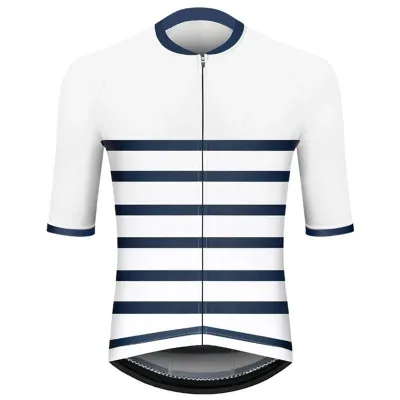


Custom Sublimation Quick-Drying Men Cycling Jersey with Suspender Trousers
$20.00 - $30.00
MOQ: 10 Pieces


Men's Short Sleeve Sublimation Printed Fitted Cycling Clothes Bike Jersey
$13.60 - $14.10
MOQ: 300 Pieces


Comprehensive Sourcing Guide
Custom Sublimation Cycling Jersey Sourcing Guide
Custom sublimation cycling jerseys occupy a well-defined niche in performance apparel: dyed-sublimated polyester tops used for racing, cycling, and related ball or team sports where full-color, pattern-driven designs must survive repeated washing and sun exposure. Buyers sourcing this category from Chinese suppliers—typically concentrated in Guangdong—face a market of small-batch OEM producers whose listings advertise customization, sample production, and flexible order quantities. The evidence from observed product pages shows models such as NSCY17, NSCY31, NSCY41, DPCW-008, and DP2208, with MOQs ranging from a single piece to hundreds of units and observed prices between roughly $4.90 and $39 per unit.
This guide is written for procurement teams, sports clubs, and brand owners commissioning made-to-order cycling apparel. It focuses on what observed listings actually state—materials, features, printing methods, size ranges, lead times, and packing details—and on the verification steps a professional buyer should complete before committing to a production run. Where a claim is not supported by the available evidence, the guide flags it as an item to confirm directly with the supplier rather than asserting a value.
Product Scope and Observed Listing Signals
The observed listings describe two product types that matter for scoping decisions. Some listings identify the item as a "Suit" covering racing, cycling, and bicycle wear in kids, youth, and adult sizes, while others describe a "Top" or "Uniform" for adults in S through XXL, with additional use cases spanning soccer, rugby, gym, basketball, and hockey. Buyers should treat these as supplier-side descriptions of capability, not guarantees that a single model covers every size or sport. Fabric weight ranges appear in some listings as 150–220gsm, and models such as NSCY01, NSCY32, NSCY67, and DPCW-0012 confirm a broad catalog rather than a single SKU.
Listing signals also reveal the commercial model behind these products. Unisex sizing, patterned designs, white base colors, zip-up styles, and dye-sublimation printing are recurring attributes, and customization is consistently listed as available with designs produced "as your artwork." Observed pricing from $4.90 to $39 and MOQs from 1 piece to 600 suggest suppliers positioned for both sample orders and mid-volume team runs. Buyers should map their own volume band against this range early, because it determines which suppliers can serve them and how sample economics work.
Technical Specifications to Verify
Fabric composition is the first specification to pin down. Observed listings reference polyester/spandex blends as well as 100% polyester fabric at 150–220gsm, and these choices directly affect stretch, print clarity, and durability. Buyers should request the exact blend percentage, grammage, and knit structure for their chosen model rather than accepting a generic "polyester" label. Feature claims—quick-drying, moisture-wicking, breathable, anti-UV, and anti-static—appear across listings, but each should be tied to a measurable test result or at minimum a documented fabric performance report before being written into a purchase contract.
Construction and printing details form the second verification cluster. Confirm that "full sublimation" applies to the entire garment, including sleeves and collar, since partial printing changes both cost and design limits. Verify zipper type and placement for zip-up styles, stitching method at hems and seams, and which accessories are included—observed listings mention brand labels, wash labels, and size labels, which matters for buyers planning retail packaging. Finally, confirm the size specification in writing: whether the supplier will grade from your tech pack, work from a customized size chart, or only offer a fixed S–XXL run.
Compliance and Safety Documentation
Documented quality credentials in the observed listings are limited but specific: one listing cites an SGS factory audit, and another references a customized standard alongside a 150–220gsm fabric specification. Buyers should not extrapolate these into broader compliance claims. Chemical safety for dyed polyester—particularly azo dyes, formaldehyde residues, and heavy metals in sublimation inks—should be verified through supplier-supplied test reports or independent lab testing on production samples, especially when garments will be sold into markets with mandatory textile safety requirements. Ask which testing the factory can arrange and who bears the cost.
Traceability documentation should be gathered alongside compliance evidence. Request the production origin in writing (observed listings cite China and Guangdong, China specifically), the packing standard—listings mention one piece per polybag and a 30cm x 25cm x 1.5cm carton dimension reference—and the label content required for your destination market, since wash and size labels are listed as available accessories. Buyers selling to children's sizes should apply heightened scrutiny, as kids' garments typically face stricter chemical and mechanical safety rules than adult apparel, and none of the observed evidence establishes that such testing has been completed.
Cost Drivers and Commercial Terms
Unit price in this category is driven primarily by order quantity, fabric weight, print coverage, and garment complexity. The observed $4.90–$39 spread reflects that variation: lightweight tops at high volume sit near the low end, while multi-panel suits with full sublimation at small MOQ command the high end. Fabric selection within the 150–220gsm band, zipper inclusion, and the number of printed panels all move cost. Buyers should request a tiered quotation showing price breaks at several quantity levels rather than negotiating from a single listed figure, and should ask whether sample fees are credited against production orders.
Commercial terms beyond unit price deserve equal attention. Observed lead times range from 15–20 days to 3–4 weeks, with sample time of 7–10 days—a meaningful window for teams on fixed event calendars. Confirm shipping methods (listings cite DHL, FedEx, UPS, and EMS), whether freight is included, and the per-unit shipping weight, which observed listings place at 0.3–0.8kg. Verify payment terms, whether MOQ of 1 piece applies only to samples or to production, and what happens if a proofing round fails; re-print costs after approval should be contractually allocated before deposit.
Supplier Qualification and Quality Control
Qualification should begin with evidence rather than claims. The SGS factory audit referenced in one observed listing is a useful data point, but buyers should request the audit scope and date, not just the badge. Ask for sublimation printing capability evidence—sample garments showing color registration, gradient quality, and wash fastness—since dye-sublimation quality varies significantly between factories even when equipment lists look identical. Confirm OEM service terms in writing, including whether your artwork, brand labels, and design files remain exclusive to your order, as observed listings advertise "as your artwork" production and brand label accessories.
Quality control during production should follow a structured sequence. Approve a pre-production sample that uses the final fabric weight, print files, and construction, then hold that sample as the acceptance standard for bulk. Define an inspection protocol covering print alignment, size conformance against the agreed chart (S–XXL or your custom grading), seam strength, and zipper function, and decide whether to inspect in person, through a third party, or via photo-based checks. For first orders, staged payment tied to inspection results reduces exposure. Document defect thresholds and rework responsibilities before the production run begins.
Long-Term Procurement Checks
Repeat ordering changes the risk profile from one-off sourcing to supply reliability. Track whether lead times of 15–20 days or 3–4 weeks hold across seasons, since cycling and racing apparel demand clusters around event calendars and suppliers may prioritize larger customers in peak months. Confirm that fabric batches remain consistent—the 150–220gsm range leaves room for drift that affects fit and drape between orders. Maintain archived print files, size charts, and approved samples with the supplier, and verify they are referenced on every new purchase order to prevent silent specification changes.
Long-term relationships should also be tested on scalability and continuity. Reassess periodically whether the supplier can handle volume growth beyond your current band, whether the observed MOQ flexibility of 1 to 600 pieces extends upward, and whether new models—beyond those already seen, such as the NSCY and DPCW series—are available for range extension. Renegotiate pricing at meaningful volume milestones rather than rolling over original terms indefinitely. Finally, keep compliance documentation current: re-test fabrics when suppliers change mills or ink systems, and confirm that any certifications claimed at onboarding remain valid for each new production cycle.
FAQs
What is the typical lead time for custom sublimation cycling jerseys?
Typical lead time is 3-4 weeks after order confirmation, with some listings quoting 15-20 days delivery. Sample production usually takes 7-10 days before mass production begins. Exact timing depends on design complexity, order quantity, and the manufacturer's current production schedule, so confirm the schedule with each supplier before placing your order.
Can I customize the design and size of a sublimation cycling jersey?
Yes, customization is available and most products are produced by full sublimation printing based on your artwork. Sizes can be customized or ordered in standard S to XXL ranges, with some listings covering kids, youths, and adults. Submit your design file to receive pricing and a sample before committing to production.
What is the minimum order quantity for custom cycling jerseys?
Minimum order quantities vary widely by supplier, ranging from 1 piece for sample or trial orders up to several hundred pieces for bulk production. Some listings explicitly state an MOQ of 1 piece, which suits team testing. Confirm the specific MOQ, unit pricing at your quantity, and sample availability with each manufacturer.
What materials are used in sublimation cycling jerseys?
Most jerseys use 100% polyester or polyester-spandex blends, with fabric weights typically between 150 and 220 gsm. These fabrics support full sublimation printing and provide quick-drying, moisture-wicking, breathable performance, with some items adding anti-UV and anti-static features. Check the exact fabric composition and weight with the supplier for your chosen model.
Which printing technique is used for custom cycling jerseys?
Dye sublimation printing is the standard technique, often described as full sublimation. The design is printed into the fabric so patterns stay vibrant and durable through repeated washing. Production is based on your artwork, so provide print-ready files and request a pre-production sample to verify color accuracy before bulk manufacturing.
How are cycling jerseys packed and shipped?
Packaging is typically one piece per polybag, with optional brand, wash, and size labels included. Shipping is handled through international couriers such as DHL, FedEx, UPS, and EMS, depending on the supplier. Confirm courier costs, delivery windows, and any packing requirements with the manufacturer before finalizing your order.
Can I order jerseys for kids, youths, and adults from one supplier?
Yes, several listed products cover kids, youths, and adults in one size range, while others offer standard adult sizing from S to XXL. Unisex patterning applies to many designs, making mixed team orders straightforward. Verify that your chosen model supports all required size tiers and confirm per-size pricing with the supplier.
What features should I look for in a racing or cycling jersey?
Prioritize quick-drying, moisture-wicking, and breathable fabric, since these are standard features across listed products. Anti-UV and anti-static treatments add value for outdoor racing and cycling. Also check fabric weight, zipper style such as zip-up fronts, and whether the supplier offers OEM service to match your team branding requirements.