Source Fixed Polished Electrical Switch Socket for Home Hotel Lighting
Explore 30 listings for the Fixed Polished Electrical Switch Socket, comparing models like 118T-22R and B303 across residential, commercial, and hotel applications. Buyers can evaluate certifications, ratings, and customization options to find the right component for their projects.
Key considerations
Products List


Wall Socket and Switch Switch Electric Plugs and Sockets Switch Hotel Switch
$0.80 - $3.00
MOQ: 500 pieces
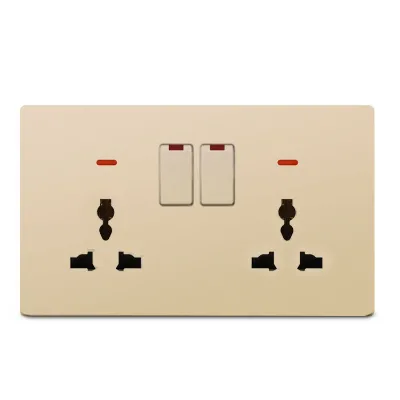
Comprehensive Sourcing Guide
Strategic Sourcing Guide for Fixed Polished Electrical Switch Sockets
The global market for fixed polished electrical switch sockets is characterized by a diverse array of components designed for residential, commercial, and industrial environments. Buyers seeking these products must navigate a complex landscape where "polished" refers to the aesthetic finish of the housing, while "fixed" denotes the mounting mechanism, and "switch socket" implies an integrated unit combining power distribution with control functionality. This guide provides a disciplined framework for procurement professionals to evaluate suppliers, verify technical specifications, and ensure compliance without relying on unverified market claims. The focus remains strictly on observable product attributes and established industry practices derived from available data.
Technical Specifications and Component Architecture
Understanding the technical architecture of fixed polished electrical switch sockets is the first step in defining procurement requirements. The product data indicates a wide spectrum of configurations, ranging from simple single-pole on-off switches to complex multi-control units. A critical observation in the current market is the variation in contact types. While some units utilize Type C contacts, others are designed with specific wiring requirements such as "Null Line and Live Line" configurations. Buyers must verify the specific contact type against their regional electrical standards, as Type C is common in specific international markets but may not be suitable for all jurisdictions without adaptation.
The internal principle of operation also varies significantly. Capacitive detection methods are noted for certain models, offering a modern, touch-sensitive interface, whereas other units rely on traditional mechanical breaking forms like the "Single Type" or "Normal Open" configurations. The structure of these units is predominantly "Power Built-in Type," suggesting that the switching mechanism is integrated directly into the socket housing rather than being a separate external component. This integration is crucial for space-constrained applications in hotels or commercial buildings.
Furthermore, the physical dimensions and mounting standards are non-negotiable for fixed installations. Data points reveal specific standard dimensions such as 64.52936 mm and 118*75 mm. These measurements dictate the cutout size required in walls or panels. Buyers must ensure that the selected model matches the physical infrastructure of the installation site. The "Ultra Small Size" category represents a niche segment for compact electronics, while standard models cater to general-purpose residential and commercial needs. The operating force and travel are also critical; specifications indicate an operating force range of 1-3N and a travel distance of 0.4-1.2mm, though these values are often customizable. This flexibility allows for tailored tactile feedback, which is essential for high-end applications where user experience is a priority.
Compliance, Certification, and Safety Standards
In the electrical components sector, compliance is not merely a regulatory formality but a fundamental safety requirement. The product data highlights several key certifications that buyers should prioritize when evaluating potential suppliers. The presence of CE (Conformité Européenne) and CCC (China Compulsory Certification) marks indicates that the products have undergone testing for electrical safety and electromagnetic compatibility. The ISO certification mentioned in the data further suggests adherence to quality management systems, which is a strong indicator of a supplier's commitment to consistent production standards.
However, buyers must exercise caution. The presence of a certification mark on a product listing does not automatically guarantee that every unit in a batch meets the standard. Verification should involve requesting valid, current certificates from the supplier and cross-referencing them with the specific model numbers, such as 118T-22R or 118Z-55. The data also references an environment rating of less than 250℃, which is a critical thermal limit for the insulation and housing materials. Exceeding this temperature can lead to material degradation or fire hazards.
Additionally, the IP Rating (Ingress Protection) is a vital metric for environmental resistance. While the data notes "IP Number of Holes: Porous," this phrasing requires clarification. In standard industry practice, an IP rating (e.g., IP44, IP54) defines the level of protection against solid objects and liquids. A "porous" description might imply ventilation requirements or a specific design limitation rather than a standard IP rating. Buyers must explicitly request the numerical IP rating to ensure the socket is suitable for its intended environment, whether it is a dry residential room or a damp commercial area. The rated current of 16A is a standard specification for general-purpose sockets, but verifying the actual load capacity against the specific application is necessary to prevent overheating.
Cost Drivers and Pricing Dynamics
The pricing of fixed polished electrical switch sockets is influenced by a complex interplay of factors, including material costs, customization levels, and order volume. The observed price range in the market spans from $0.10 to $5.50 USD. This wide disparity is not arbitrary; it reflects differences in component quality, certification depth, and feature sets. The lower end of the spectrum typically corresponds to basic models with standard finishes and minimal customization, while the higher end includes units with advanced features like capacitive sensing, custom levers, or specialized certifications.
Minimum Order Quantity (MOQ) is another significant cost driver. The data indicates an MOQ range of 100 to 3000 units. Suppliers with higher MOQs often offer lower per-unit costs due to economies of scale, whereas suppliers accommodating smaller orders may charge a premium. For buyers with large-scale projects, negotiating based on the 3000-unit threshold can yield substantial savings. Conversely, for prototyping or small commercial renovations, the 100-unit threshold provides flexibility, albeit at a higher unit cost.
Customization is a primary factor influencing price. The product attributes confirm that customization is available for various elements, including the operating force, travel distance, lever types (roller, short, long), and color. Each customization request adds to the production complexity and tooling costs, thereby increasing the final price. Buyers must balance the need for specific aesthetic or functional requirements against the budget constraints. The "polished" finish itself may also be a cost variable, depending on the material used (e.g., high-grade ABS plastic vs. metal alloys) and the finishing process employed.
Typical Applications and Usage Scenarios
The versatility of fixed polished electrical switch sockets allows them to be deployed across a wide range of sectors. The product data explicitly lists applications in Home, Commercial, Hotel, Lighting, Electronics, and Home Appliance environments. In residential settings, these units serve as the primary interface for controlling lighting and powering appliances, requiring a balance of aesthetics and safety. The "polished" finish is particularly valued in modern home design, where the visual appeal of the switch plate is as important as its function.
In commercial and hotel environments, the durability and reliability of the switch are paramount. The "Durable" protection attribute noted in the data suggests that these units are designed to withstand frequent use. The "Single Control Switch" and "Multi Control Switch" options allow for different control schemes, such as single-point control for a specific light or multi-point control for complex lighting scenes. The "Normal Open" and "Normal Closed" configurations provide flexibility in circuit design, ensuring that the switch behaves correctly in the event of a power failure or specific operational sequence.
Industrial applications demand even higher standards. The data mentions "Industrial" as a specific application category, implying that the sockets must handle higher currents and more rigorous environmental conditions. The "Micro-Current" breaking capacity noted in the data is particularly relevant for sensitive electronic equipment, where precise switching is required to prevent damage. The "Spdt/Normal Closed/Normal Open" function indicates the ability to handle complex circuit routing, which is essential in industrial automation and control panels.
Supplier Evaluation and Verification Protocols
Evaluating a supplier for fixed polished electrical switch sockets requires a rigorous due diligence process. Buyers should not rely solely on marketing claims but must verify the supplier's ability to meet the specific technical and compliance requirements outlined in the product data. The first step is to confirm the origin of the products. The data indicates that the products originate from China, a major manufacturing hub for electrical components. However, the specific location within China can impact logistics and lead times. Buyers should request detailed information on the factory location to assess shipping costs and delivery reliability.
Quality control is another critical aspect of supplier evaluation. The data mentions various packing standards, such as "1PC/Plastic Bag, 10PCS/Inner Box, 200PCS/CTN" or "1PC/Poly Bag, 10PCS/Inner Box, 100PCS/Outer Carton." These packing specifications reflect the supplier's attention to detail and their ability to protect products during transit. A supplier that offers robust, standardized packaging is more likely to have a mature quality management system. Additionally, the availability of "Customization" suggests that the supplier has the engineering capacity to adapt products to specific buyer needs. Buyers should request samples to verify the quality of the polished finish, the smoothness of the switch operation, and the accuracy of the dimensions.
Certification verification is perhaps the most critical step. Buyers must ensure that the CE, CCC, and ISO certifications are valid and applicable to the specific models being ordered. This involves checking the certificate numbers against the issuing bodies' databases. The supplier should also provide test reports that verify the rated current, breaking capacity, and environmental limits. A supplier that is transparent about their testing procedures and willing to share documentation is a more reliable partner.
Quality Control and Long-Term Procurement Considerations
Ensuring long-term reliability requires a proactive approach to quality control. The product data highlights several attributes that are prone to wear and tear, such as the "Operating Force" and "Operating Travel." Over time, the mechanical components of the switch may degrade, leading to increased operating force or inconsistent travel. To mitigate this risk, buyers should specify materials and manufacturing processes that ensure longevity. The "Durable" protection attribute is a good starting point, but buyers should also inquire about the specific materials used for the contacts and the housing.
The "Pins" and "Terminal" specifications, such as "2pin/3pin" and various PCB sizes (1.30.5mm, 3.20.5mm, 7*0.6mm), are critical for integration. Inconsistent terminal dimensions can lead to poor connections and increased resistance, which can cause overheating. Buyers should insist on strict tolerances for these dimensions and request dimensional inspection reports for the first article of production. The "Pich" (pitch) of 7.5mm is a specific dimension that must be maintained to ensure compatibility with standard PCBs.
Long-term procurement also involves managing the supply chain. The observed MOQ range of 100-3000 units suggests that buyers need to plan their inventory carefully. For large projects, ordering in bulk can reduce costs, but it requires accurate forecasting. For smaller projects, the flexibility of lower MOQs is beneficial. Buyers should also consider the lead time, which is not explicitly provided in the data but is a critical factor in project planning. Establishing a relationship with a supplier who can provide consistent lead times and reliable stock levels is essential for maintaining project schedules.
Finally, the "Color" customization option allows for brand alignment and aesthetic consistency. However, color matching can be challenging, especially if the order is split across multiple batches. Buyers should request color swatches and ensure that the supplier has a robust color control process to maintain consistency over time. By focusing on these technical, compliance, and supply chain factors, buyers can secure a reliable supply of fixed polished electrical switch sockets that meet their specific project requirements.
Comparative Analysis of Product Models
To assist buyers in making informed decisions, the following table compares key attributes of the models identified in the product data. This comparison highlights the differences in specifications, certifications, and applications, providing a clear basis for selection.
| Product Model | Key Certification | Rated Current | Structure | Application Focus | Customization Options |
|---|---|---|---|---|---|
| 118T-22R | CE, ISO | Not Specified | Power Built-in Type | Home, Commercial, Hotel | Available (Color, Lever) |
| 118Z-55 | CCC, CE | 16A | Power Built-in Type | Residential, General-Purpose | Available (Color, Lever) |
| B303 | CCC, CE, ISO | Not Specified | Power Built-in Type | Home Appliance, Electronics | Available (Color, Lever) |
| EU05 | CCC, CE | Not Specified | Power Built-in Type | Commercial, Industrial | Available (Color, Lever) |
| VT202 | CCC, CE, ISO | Not Specified | Power Built-in Type | Lighting, Electronics | Available (Color, Lever) |
| DK4-DT-017 | CCC, CE | Not Specified | Power Built-in Type | Home, Commercial | Available (Color, Lever) |
This table illustrates that while all models share the "Power Built-in Type" structure and offer customization, the specific certifications and rated currents vary. The 118Z-55 model explicitly lists a 16A rated current, making it a strong candidate for high-load residential applications. The other models may have different current ratings that need to be verified with the supplier. The presence of multiple certifications across the models suggests a high level of compliance, but buyers must confirm the specific scope of each certification for their intended use case.
In conclusion, sourcing fixed polished electrical switch sockets requires a meticulous approach that balances technical specifications, compliance requirements, and cost considerations. By leveraging the available data and adhering to rigorous verification protocols, buyers can identify suppliers that deliver high-quality, reliable products tailored to their specific needs. The diversity of models and customization options available in the market provides ample opportunity to find the perfect solution for any application, from residential lighting to industrial control systems.
FAQs
What certifications are available for these switch sockets?
Available certifications include CE, CCC, and ISO marks for safety and quality compliance. These marks indicate the product meets specific regional electrical standards and quality management systems, but buyers must verify the certificate validity for each specific model number.
Can I customize the operating force and lever type?
Yes, customization is available for operating force ranging from 1 to 3 Newtons and various lever types like roller or short levers. Buyers should note that these customizations may affect the unit price and require specific engineering coordination with the supplier.
What is the minimum order quantity for these products?
The minimum order quantity ranges from 100 to 3000 units depending on the supplier and product configuration. Lower MOQs offer flexibility for small projects, while higher volumes typically unlock better per-unit pricing through economies of scale.
Which product models support capacitive detection principles?
Some models utilize a capacitive detection principle for touch-sensitive operation, while others use mechanical switching. Buyers must check the specific product attribute list to confirm if a model supports this feature before placing an order.
How are these sockets packed for shipping?
Packaging options include 1 piece per plastic bag with 10 pieces in an inner box and 200 pieces per carton. Other configurations may use poly bags with 100 pieces per outer carton, ensuring protection during transit and inventory management.
What is the rated current capacity of the standard sockets?
The standard rated current capacity is 16 Amperes for general-purpose applications. This rating ensures safe operation for typical residential and commercial loads, but users must verify the specific load requirements against the product's breaking capacity.
Where are these electrical switch sockets manufactured?
The products originate from China, which is a major manufacturing hub for electrical components. Buyers should request specific factory locations to assess logistics costs and delivery reliability for their specific project requirements.