Source Flexible Pull Cabinet Organizer for Kitchen Storage, Spice, and Sundries
Find 30 Flexible Pull Cabinet Organizer options from verified Chinese manufacturers. Compare models like WA003P-700 and E122 with ISO certifications, varying sizes, and OEM customization for kitchen storage, spice, and sundries applications.
Key considerations
Products List






Comprehensive Sourcing Guide
Flexible Pull Cabinet Organizer Sourcing Guide
Sourcing flexible pull cabinet organizers requires a strategic approach that balances functional adaptability with structural integrity. These components are essential for modern kitchen storage solutions, allowing users to maximize vertical space and improve accessibility within base cabinets. The market offers a variety of configurations, from multi-tiered wire baskets to solid metal drawers, each designed to address specific storage challenges. Buyers must navigate a landscape where customization options, such as OEM branding and tailored dimensions, are prevalent, necessitating a clear understanding of technical specifications before committing to volume orders.
The procurement process is further complicated by the diversity of product attributes available, including varying sizes, shapes, and packaging methods. While some units are designed as single items, others are sold as sets, impacting both logistics and installation requirements. Understanding the distinction between common shapes and specialized designs, such as those with integrated drawers or specific cabinet width requirements, is critical for ensuring compatibility with existing cabinetry. This guide provides a structured framework for evaluating these products, focusing on verification steps that mitigate risk and ensure alignment with project specifications.
Product Scope and Observed Listing Signals
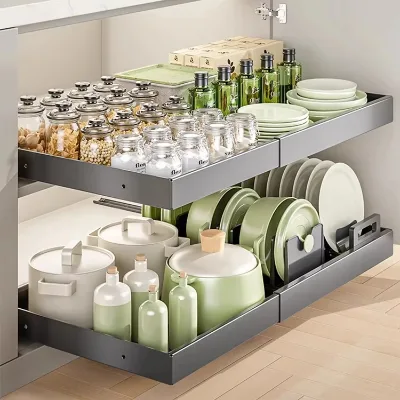
The current market for flexible pull cabinet organizers exhibits a wide range of product types, primarily categorized by their material composition and structural design. Metal remains the dominant material, offering durability and a modern aesthetic that aligns with contemporary kitchen trends. Products are often described with attributes such as "Flat Wire Pull-out Basket" or "Multipurpose Drawer Basket," indicating their specific utility in organizing spices, sundries, or general tableware. The presence of multi-tiered designs and units with drawers suggests a focus on maximizing storage density without compromising ease of access.
Listing signals also reveal significant variability in packaging and branding strategies. While some products are packaged individually in standard cartons, others are offered as sets, which may simplify installation but complicate inventory management. Branding options range from established names like "Welldo" to OEM customization, allowing buyers to white-label products for their own distribution channels. The observed price range of 1-1999 USD and MOQs varying from 1 to 3000 pieces indicate a market that accommodates both small-scale prototyping and large-scale industrial procurement. Buyers should carefully review these signals to determine if a supplier’s offerings align with their specific volume and branding needs.
Technical Specifications to Verify
Verifying technical specifications is paramount to ensuring that the selected organizers fit seamlessly into the intended cabinetry. Key dimensions such as cabinet width, depth, and height must be cross-referenced with the supplier’s provided standards. For instance, some models specify a cabinet width of 200mm or 350mm, while others provide overall product dimensions like D460xW645xH180 or W764D460H158mm. Buyers must distinguish between the internal capacity dimensions and the external footprint to avoid installation conflicts. The distinction between "Large" and "Medium" sizes further underscores the need for precise measurement verification before placing orders.
In addition to dimensions, the structural design and layer configuration are critical technical factors. Products may feature two layers or multi-tier arrangements, each affecting the weight distribution and load-bearing capacity. The design attribute "with Drawer" or "for Base Cabinet" indicates specific mounting requirements and usage scenarios. Buyers should also verify the finish and color options, as metal and white finishes are commonly observed, to ensure aesthetic consistency with the overall kitchen design. Confirming these details with the supplier through detailed drawings or samples is essential to prevent costly modifications or returns.
Compliance and Safety Documentation
Compliance and safety documentation form the backbone of a reliable procurement process, particularly for products used in food-adjacent environments like kitchens. The presence of ISO certification is a common indicator of quality management systems, suggesting that the manufacturer adheres to standardized production processes. However, buyers should not assume that ISO certification alone guarantees product safety or material suitability for food contact. It is crucial to request specific test reports or material safety data sheets that confirm the absence of harmful substances and the durability of the metal components under regular use.
Furthermore, buyers must verify that the products meet relevant regional safety and environmental standards, which may vary depending on the destination market. While the supplied facts mention ISO certifications, they do not specify compliance with other critical standards such as REACH or RoHS, which are often required for electronic or coated metal products in certain jurisdictions. Procurement teams should establish a checklist of required certifications based on their target market’s regulations and ensure that the supplier can provide valid, up-to-date documentation. This due diligence helps mitigate legal risks and ensures that the products can be legally sold and used in the intended regions.
Cost Drivers and Commercial Terms
Understanding the cost drivers associated with flexible pull cabinet organizers is essential for accurate budgeting and negotiation. The primary cost factors include the material type, manufacturing complexity, and customization level. Metal construction, particularly when involving intricate wire designs or multi-tier structures, tends to be more expensive than simpler plastic alternatives. Customization options, such as OEM branding, specific color finishes, or tailored dimensions, add to the production cost and may impact the minimum order quantity (MOQ). Buyers should anticipate higher unit costs for highly customized items and negotiate volume discounts accordingly.
Commercial terms, including packaging and shipping logistics, also significantly influence the total landed cost. Products packaged in standard cartons or brown cartons may have different handling requirements and space utilization compared to set packaging. The observed MOQ range of 1 to 3000 pieces allows for flexibility, but buyers should consider the trade-off between lower MOQs and higher per-unit prices. Additionally, lead times and shipping methods should be clarified early in the negotiation process, as these factors can affect inventory planning and cash flow. Clear communication regarding payment terms and warranty policies is also vital to protect the buyer’s interests.
Supplier Qualification and Quality Control
Supplier qualification is a critical step in ensuring the reliability and consistency of the supply chain. Buyers should conduct thorough due diligence on potential suppliers, verifying their manufacturing capabilities, production capacity, and quality control processes. The presence of OEM capabilities suggests that the supplier has the flexibility to meet specific branding and design requirements, but it is essential to assess their track record in delivering customized products on time and to specification. Requesting references or case studies from previous clients can provide valuable insights into the supplier’s performance and reliability.
Quality control measures should be established before production begins to minimize the risk of defects. Buyers should define clear acceptance criteria for dimensions, finish quality, and functional performance, such as the smoothness of the pull-out mechanism. Implementing pre-production samples and in-line inspections can help identify and rectify issues early in the manufacturing process. Additionally, buyers should consider third-party inspection services for final shipments to ensure that the products meet the agreed-upon standards. Establishing a robust quality control framework not only protects the buyer’s brand reputation but also reduces the likelihood of costly returns or customer complaints.
Long-Term Procurement Checks
Long-term procurement success depends on continuous monitoring and evaluation of supplier performance and product quality. Buyers should establish key performance indicators (KPIs) to track metrics such as on-time delivery, defect rates, and responsiveness to issues. Regular audits and performance reviews can help identify areas for improvement and strengthen the partnership with the supplier. Additionally, staying informed about industry trends and technological advancements can help buyers anticipate changes in product design and functionality, allowing them to adapt their sourcing strategies accordingly.
Sustainability and ethical sourcing practices are increasingly important considerations for long-term procurement. Buyers should assess the supplier’s commitment to environmental responsibility, including the use of recyclable materials and energy-efficient manufacturing processes. Verifying that the supplier adheres to ethical labor practices and complies with relevant regulations is also crucial for maintaining a responsible supply chain. By prioritizing sustainability and ethical considerations, buyers can enhance their brand image and contribute to a more resilient and responsible global supply network.
FAQs
What materials are used for flexible pull cabinet organizers?
Most flexible pull cabinet organizers listed on this page are made of metal, typically formed flat wire with a finished metal color. Metal construction gives the baskets the strength needed for kitchen storage of tableware, sundries, and spices. Buyers should confirm the exact wire gauge and surface treatment with each supplier, since coatings and steel grades vary between models and manufacturers.
Which cabinet widths do these pull out organizers fit?
The listed organizers are made for common base cabinet widths, with specification entries including 200mm and 350mm cabinet widths. Models such as C1635E at 470x286x465mm and WL13-800 at W764xH460xH158mm show typical dimensions. Measure your cabinet interior width, depth, and height before ordering, then match against the supplier's published specification sheet.
Can I customize the organizer size, color, or logo?
Yes, customization is available on this page. Many listings are OEM products offering logo customization, and some are supplied in white rather than the standard metal finish. Brand names include Welldo and OEM. Before ordering, agree with the supplier on size tolerances, finish color, logo printing method, and any added cost or minimum quantity for customized units.
How are the organizers packed for shipping?
Packing varies by product. The page shows single-item packing, set packing, standard carton packing, carton boxes, and brown cartons as listed options. Sets with two or multi-tier baskets are usually disassembled or nested inside the carton to reduce volume. Confirm carton dimensions, stacking strength, and whether inner boxes or foam protection are included before finalizing a shipping plan.
What is the minimum order quantity for these products?
One listing states an MOQ of 200 pieces, and the overall observed MOQ range across products spans from 1 to 3000 units. This suggests single samples or small trial orders may be possible for some items, while bulk production runs carry higher minimums. Always confirm the current MOQ directly with the supplier, as it can depend on customization level and packaging.
How many tiers or layers do the pull out baskets have?
Listed organizers include two-layer and multi-tier designs. The drawer-style models, such as the WA003P-700 measuring D460xW645xH180mm, are built for base cabinet installation with sliding baskets. Choose the layer count based on what you plan to store: shallow two-tier units suit spices and utensils, while multi-tier racks hold more sundries in the same cabinet footprint.
Do these products have any certifications?
ISO certification is listed for the products on this page. Certification alone does not cover every buyer concern, so request the valid certificate copy, its scope, and the issuing body from each supplier. If your market requires food-contact compliance or other marks for kitchen tableware storage, ask the manufacturer explicitly, since such requirements are not stated in the listed attributes.
Where are these pull out cabinet organizers produced?
The listed products originate from China, and brands shown include Welldo and OEM. Modern-style metal organizers with drawer designs and ISO certification are common offerings from this supply base. When comparing candidates, verify factory location, production capacity, and export experience yourself, because origin on a listing does not identify the specific manufacturer or its facilities.