Source French Gas Fryer for Chips Donuts and Commercial Kitchens
Compare 30 French Gas Fryer options featuring gas or electric power, stainless steel construction, and timing devices. Buyers can evaluate models for chips and donut production with varying capacities and gas pressure specifications.
Key considerations
Products List


Best Quality Gas Deep Fryers Commercial Electric Chicken French Fries Fryer
$360.00 - $420.00
MOQ: 1 Pieces

Fast Food Restaurant Supplies Fryer Machine Gas Fryer Commerical Fryer Gas
$360.00 - $420.00
MOQ: 1 Pieces

Hot Sale Gas Fryer Large Capacity Frying Chicken Machine Commercial Fryer
$360.00 - $420.00
MOQ: 1 Pieces







Comprehensive Sourcing Guide
Strategic Sourcing Guide for French Gas Fryers
Understanding Technical Specifications and Operational Variability
When sourcing a French Gas Fryer, buyers must navigate a complex landscape of technical specifications that vary significantly between models. The core functionality of these units relies on precise thermal management and gas delivery systems. Based on observed market data, gas fryers are available with distinct power sources, including both gas and electric configurations, though the specific keyword focus remains on gas-operated units. The gas pressure requirements are a critical technical parameter, with observed specifications indicating a standard operating pressure of 2800PA. This pressure level is essential for maintaining consistent flame stability and heat distribution within the fryer basket.
The fuel flexibility is another paramount consideration. Suppliers offer units compatible with multiple gas types, specifically Liquefied Petroleum Gas (LPG) and Natural Gas. This dual compatibility allows buyers to adapt equipment to local infrastructure constraints without requiring immediate hardware modifications. The gas consumption rate is another vital metric for operational cost analysis. Data indicates a consumption rate of approximately 0.47m³/H for certain models, a figure that serves as a baseline for energy efficiency calculations. However, buyers should verify this figure against specific model requirements, as consumption varies with burner size and thermal output.
Physical dimensions and capacity are equally critical for kitchen layout planning. Observed specifications reveal a wide range of dimensions. For instance, one model features an oil tank size of 445375195mm, while another standard dimension is listed as 4505951000MM. Larger commercial units may reach dimensions of 4508601130mm. The capacity of these units also varies, with some models offering a volume of 26-28L. The weight of the equipment is a significant factor for installation and floor loading. Net weights observed range from 32kg for smaller units to 55kg for heavier commercial models, with gross weights reaching up to 65kg. Buyers must ensure their kitchen flooring can support these loads and that the equipment fits within the designated service area.
Compliance, Certification, and Safety Standards
Safety and regulatory compliance are non-negotiable in the commercial food equipment sector. The primary certification observed in the market for these units is the CE mark. This certification indicates that the product meets EU safety, health, and environmental protection requirements. When evaluating potential suppliers, buyers should request valid CE documentation to ensure the equipment complies with relevant directives. While other certifications like REACH are mentioned in broader industry contexts, the CE mark is the specific, high-confidence attribute observed for these gas fryers.
Material quality is intrinsically linked to safety and longevity. The construction of these fryers frequently utilizes SUS304 stainless steel, also referred to as 304 Stainless Steel. This material grade is preferred for its corrosion resistance, ease of cleaning, and ability to withstand high temperatures without degrading. The use of high-grade stainless steel ensures that the equipment remains hygienic and durable in a high-volume commercial environment. Buyers should verify that the "Material of Complete Machine" and "Material Quality" claims align with the SUS304 standard to avoid purchasing units with inferior steel grades that may rust or contaminate food.
Standardization of dimensions and assembly is another aspect of compliance. While specific model standards vary, such as the JHYY-600-800-1000 series or the 4505951000MM specification, buyers must ensure that the equipment adheres to local fire codes and ventilation requirements. The presence of a timing device is a common feature, with some models including a timing device and others lacking one. This feature is crucial for maintaining food quality and preventing over-frying, which can lead to safety hazards like oil degradation or fire risks. Buyers should prioritize models with reliable timing mechanisms to ensure consistent operational safety.
Cost Drivers and Pricing Dynamics
The pricing of French gas fryers is influenced by a multitude of factors, resulting in a broad observed range from $40 to $110,000. This vast disparity is not indicative of a single product line but rather reflects the diversity of the market, ranging from small countertop units to large, industrial-grade commercial fryers. The minimum order quantity (MOQ) also varies, with observed ranges from 1 to 100 units. This flexibility allows buyers to procure single units for testing or small kitchens, as well as bulk orders for large chain establishments.
Several specific attributes drive the cost of these units. The power rating is a significant cost factor; units with a power output of 1.5KW differ substantially in price from those rated at 18kw. Higher power ratings generally correlate with faster heating times and higher throughput, justifying a higher price point. The complexity of the gas system, including the ability to switch between LPG and Natural Gas, can also influence the final cost. Additionally, the inclusion of advanced features such as automatic or semi-automatic grades affects pricing. While some units are manual, others offer semi-automatic operation, which adds to the manufacturing complexity and cost.
Packaging and shipping logistics are additional cost drivers. The observed packaging methods include wooden boxes, shrink film combined with wooden boxes, export cartons, and plywood cases. The choice of packaging depends on the fragility of the unit and the distance of shipment. Wooden boxes and plywood cases offer superior protection for heavy equipment but add to the overall weight and shipping costs. Buyers should factor in these packaging costs when calculating the total landed cost of the equipment. The production cycle, observed at 10 days for some models, also impacts the timeline and potential rush fees associated with procurement.
Typical Applications and Operational Context
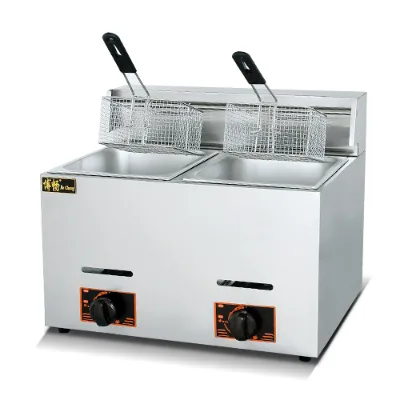
French gas fryers are designed for high-volume commercial applications, specifically targeting the preparation of fried foods such as chips and donuts. The application scope is broad, covering various food service environments from fast-food chains to large-scale catering operations. The versatility of these units allows them to handle different food items, with specific models optimized for chips and donuts. The ability to fry multiple items simultaneously is a key advantage, with some units featuring two baskets to increase throughput.
The operational context of these fryers often involves continuous use in busy kitchens. The temperature range of Room Temp to 200°C provides the necessary flexibility for different frying requirements. This wide range ensures that the equipment can be used for pre-heating, frying, and holding food at safe temperatures. The usage classification is explicitly commercial, meaning these units are built to withstand the rigors of daily, high-intensity operation. Buyers should consider the specific volume of food they need to prepare and select a model with the appropriate capacity and power rating to meet their operational demands.
The customization options available for these fryers allow for adaptation to specific kitchen workflows. Some models offer customized configurations, while others are non-customized. This flexibility enables buyers to tailor the equipment to their specific layout and operational needs. For instance, the inclusion of a timing device can be a critical feature for maintaining consistency in food quality. Buyers should evaluate their specific operational requirements to determine whether a customized or standard model best suits their needs.
Supplier Evaluation and Selection Criteria
Selecting the right supplier for French gas fryers requires a rigorous evaluation process. Buyers should prioritize suppliers who can provide clear documentation of certifications, specifically the CE mark. The origin of the products is another critical factor, with China being a primary source for these units. Buyers should verify the supplier's location and production capabilities to ensure they can meet delivery timelines and quality standards. The production cycle of 10 days for some models suggests that lead times can vary, and buyers should confirm the expected delivery window before placing an order.
The quality of the supplier's product line is paramount. Buyers should examine the materials used, ensuring that SUS304 stainless steel is used for the main construction. The consistency of the product standard, such as the 4505951000MM or JHYY-600-800-1000 specifications, indicates a commitment to standardization and quality control. Suppliers who offer a range of models with different power ratings, gas types, and capacities demonstrate a broader understanding of market needs. Buyers should also assess the supplier's ability to provide after-sales support, including maintenance and repair services.
Packaging and shipping reliability are also key evaluation criteria. The variety of packaging options, from wooden boxes to export cartons, indicates that suppliers have experience in handling different shipping requirements. Buyers should ensure that the supplier uses appropriate packaging to prevent damage during transit. The net and gross weights of the units, ranging from 32kg to 65kg, should be clearly communicated to facilitate accurate shipping cost calculations. Suppliers who provide detailed specifications and transparent pricing are more likely to be reliable partners.
Quality Control and Long-Term Procurement Considerations
Quality control is essential for ensuring the longevity and safety of French gas fryers. Buyers should implement a rigorous inspection process upon receipt of the equipment. This includes verifying the physical dimensions, checking the material quality for SUS304 stainless steel, and testing the gas pressure and consumption rates. The presence of a timing device and the accuracy of the temperature range should also be verified. Buyers should ensure that the equipment meets the observed specifications, such as the 2800PA gas pressure and 0.47m³/H gas consumption, to guarantee optimal performance.
Long-term procurement considerations involve evaluating the total cost of ownership, not just the initial purchase price. This includes factors such as energy efficiency, maintenance costs, and the availability of spare parts. The power rating of the unit, whether 1.5KW or 18kw, will significantly impact energy costs over time. Buyers should also consider the durability of the equipment, with SUS304 stainless steel offering superior resistance to corrosion and wear. The production cycle and lead times should be factored into the procurement strategy to ensure timely delivery and minimal downtime.
The customization options available for these fryers offer a strategic advantage for long-term procurement. Buyers can select models that are customized to their specific needs, ensuring that the equipment integrates seamlessly into their existing kitchen workflow. The availability of different gas types, such as LPG and Natural Gas, allows for flexibility in fuel sourcing. Buyers should also consider the scalability of their procurement strategy, ensuring that they can easily expand their fleet of fryers as their business grows. By focusing on quality, compliance, and operational efficiency, buyers can make informed decisions that support their long-term business objectives.
Comparative Analysis of Key Model Attributes
To facilitate informed decision-making, the following table summarizes the key attributes observed across different French Gas Fryer models. This comparison highlights the variability in specifications, materials, and features that buyers must consider.
| Attribute | Model A (LM-23L) | Model B (OFE301/OFG301) | Model C (JHYYZ-12) | Model D (0300101197) | Model E (GF-4G) |
|---|---|---|---|---|---|
| Power Source | Gas | Electric | Gas | Gas | Gas |
| Gas Type | LPG / Natural Gas | N/A | LPG / Natural Gas | N/A | LPG / Natural Gas |
| Gas Pressure | 2800PA | N/A | N/A | N/A | N/A |
| Gas Consumption | 0.47m³/H | N/A | N/A | N/A | N/A |
| Oil Tank Size | 445375195mm | N/A | N/A | N/A | N/A |
| Dimensions | 4505951000MM | 4508601130mm | JHYY-600-800-1000 | 600 x 650 x 475mm | W400D710H1050mm |
| Material | SUS304 | SUS304 | 304 Stainless Steel | Stainless Steel | N/A |
| Weight (Net) | 32kg | N/A | N/A | N/A | 55kg |
| Weight (Gross) | N/A | N/A | N/A | N/A | 65kg |
| Timing Device | With | With | Without | N/A | N/A |
| Application | Chips | N/A | Chips, Donut | N/A | Chips, Donut |
| Packaging | Wooden Box | Shrink Film + Wooden Box | Wooden Box Packaging | Export Carton | Plywood Case |
| Certification | CE | CE | CE | CE | CE |
| Customization | Available | Available | Non-Customized | N/A | N/A |
| Capacity | 26-28L | N/A | N/A | N/A | N/A |
| Baskets | 2 Baskets | N/A | N/A | N/A | N/A |
This table illustrates the diversity of the market and underscores the importance of verifying specific attributes against buyer requirements. Buyers should use this data as a reference point but must confirm all details with the supplier before making a purchase decision. The variability in power sources, dimensions, and features necessitates a thorough evaluation process to ensure the selected equipment meets the specific needs of the commercial kitchen.
FAQs
What gas types are compatible with these fryers?
These units are compatible with both Liquefied Petroleum Gas and Natural Gas. This dual compatibility allows adaptation to local infrastructure without hardware modifications. Buyers should verify specific model requirements for gas pressure and consumption rates.
Which certification is standard for these commercial fryers?
The CE mark is the primary certification observed for these units. This indicates compliance with EU safety and environmental protection requirements. Buyers must request valid CE documentation to ensure the equipment meets relevant directives before purchase.
Can I find models with a timing device included?
Yes, some models come with a timing device while others do not. This feature is crucial for maintaining food quality and preventing over-frying. Buyers should prioritize models with reliable timing mechanisms to ensure consistent operational safety.
What is the typical power source for these units?
Gas fryers are available with both gas and electric power sources. Specific models may operate on 380V electricity or use gas burners. Buyers must verify the power source to match their kitchen infrastructure and operational needs.
Which material is used for the machine construction?
The complete machine is frequently constructed from SUS304 stainless steel. This material grade offers corrosion resistance and ease of cleaning for high-volume environments. Buyers should verify that the material quality aligns with the SUS304 standard.
How much does the equipment typically weigh?
Net weights range from 32kg for smaller units to 55kg for heavier commercial models. Gross weights can reach up to 65kg depending on the specific model. Buyers must ensure their kitchen flooring can support these loads.
What is the production cycle for these fryers?
The production cycle is observed at 10 days for some models. This timeline impacts the expected delivery window and potential rush fees. Buyers should confirm the specific lead time with the supplier before placing an order.