Source Frosting Glass Liquor Bottle for Spirits, Wine, and Beverages
Compare 30 options for the Frosting Glass Liquor Bottle designed for spirits, wine, and beverages. Buyers can review customization, sealing types, and capacity standards from verified Chinese manufacturers.
Key considerations
Products List


Frosted Brandy Glass Bottle Frosted Liquor Bottle for Whisky Brandy Glassware
$0.15 - $0.40
MOQ: 6000 Pieces


750ml Glass Bottle for Wine Spirit Alcoholic Beverages Liquor Empty Glass Bottle
$0.39 - $0.45
MOQ: 6000 Pieces

Custom 750ml Frosted Clear Round Special Shape Liquor Glass Bottle with Lid
$0.27 - $0.39
MOQ: 6000 Pieces

375ml 500ml Round Glass Bottle for Spirit Wine Liquor Juice Alcoholic Beverages
$0.36 - $0.41
MOQ: 1000 Pieces

250ml 500ml Custom Frosting Glass Wine Spirit Alcoholic Beverages Bottle with Cork
$0.38 - $0.43
MOQ: 1000 Pieces

Super Flint High Frosted 500ml Glass Liquor Bottles with Cap for Spirits
$0.27 - $0.39
MOQ: 6000 Pieces

Recyclable Glass Packaging Bottle for Wine Liquor Spirit Red Bear Glass Bottle
$0.38 - $0.45
MOQ: 6000 Pieces
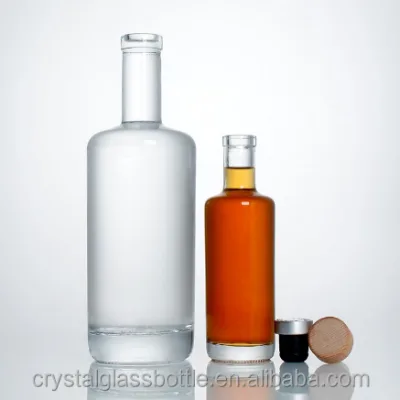


Frosted Glass Bottle Liquor 375ml Whisky Whiskey Brandy Tequila Gin with Customized Stopper
$0.30 - $0.85
MOQ: 10000 Pieces

Frosting 100ml 375ml 500ml 750ml Liquor Glass Bottle for Vodka Gin Whiskey Rum with Cork
$0.30 - $0.85
MOQ: 6000 Pieces


200ml 375ml 500ml 750ml Clear /Frost Glass Wine /Beverage /Liquor Bottles with Cork
$0.30 - $0.85
MOQ: 6000 Pieces

Custom Design Glass Whisky Liquor Bottle Empty Glass Bottle for Whisky Liquor
$0.30 - $0.85
MOQ: 10000 Pieces

Comprehensive Sourcing Guide
Sourcing Guide for Frosting Glass Liquor Bottles
Understanding Product Attributes and Variations
When sourcing frosting glass liquor bottles, buyers must first distinguish between the specific aesthetic finish and the underlying structural requirements. The term "frosting" refers to a surface treatment that creates a matte, opaque appearance, often achieved through acid etching or sandblasting. However, the supplied product data indicates a diverse range of available finishes, including "Black Color," "Clear Transparent," and "Color." This suggests that while the core keyword focuses on a frosted look, the market offers a spectrum of visual options that may include frosted clear glass or fully colored opaque glass.
The physical form of these bottles varies significantly in the supply chain. Observations show the existence of both "Round Bottle" and "Square Bottle" shapes. The round configuration is often associated with traditional spirits, while square designs may appeal to modern branding needs. Furthermore, the "prod_standard" field lists multiple volume capacities, including 1000ml, 750ml, 500ml, 375ml, and 200ml. Buyers should verify that the specific frosting process does not compromise the structural integrity of the glass, particularly for larger volumes like the 1000ml option. The base material is consistently noted as "Extra Flint Glass" or "Super Flint Glass," which are high-quality, clear glass types ideal for achieving a crisp frost finish without unwanted impurities.
Technical Specifications and Surface Handling
The technical execution of the frosting process is critical for brand consistency. The supplied data mentions "Surface Handling: Decal," which implies that some bottles may feature printed designs or logos applied over the glass surface. However, for a true frosted finish, the etching process must be uniform. Buyers should inquire whether the frosting is a permanent chemical etch or a temporary coating, as this affects durability during shipping and storage.
Sealing mechanisms are another vital technical specification. The data presents a dichotomy in closure types, listing both "Screw Cap" and "Cork" options, as well as "Rubber Stopper." The choice of closure often dictates the bottle's intended use. For instance, a "Screw Cap" is common for spirits requiring easy resealing, while a "Cork" might be preferred for premium aging or specific traditional liquor presentations. The "prod_packing" details indicate that bottles are typically shipped in "Carton" or "Carton + Pallet" configurations. This packing method must be robust enough to protect the frosted surface from abrasion, which can easily mar the matte finish.
The weight of the bottle is listed as "Customized" or "Custom," indicating that glass thickness can be adjusted to meet specific branding or durability requirements. A heavier bottle often conveys a sense of premium quality, but it also increases shipping costs. Buyers should request specific weight specifications for the frosted variant to ensure compatibility with their filling lines and logistics budget.
Compliance, Certification, and Material Standards
In the B2B procurement of glass containers, verifying compliance is non-negotiable. The supplied facts highlight several certifications and standards that serve as benchmarks for quality assurance. Notably, "ISO&SGS" and "ISO9001: 2008, ISO14001:2004" are explicitly mentioned. These certifications suggest that the manufacturing facility adheres to international quality management and environmental standards. However, buyers must treat these as observed attributes of specific suppliers rather than universal guarantees for all frosted bottles.
When evaluating a supplier, it is essential to confirm that their "ISO" certification is current and covers the specific production lines used for frosted glass. The "ISO14001" standard specifically addresses environmental management, which is increasingly important for brands concerned with the sustainability of their packaging. Additionally, the material composition is listed as "Extra Flint Glass" or "Super Flint Glass." This material is preferred for its clarity and chemical resistance, but buyers should verify that the raw materials meet food-grade safety standards, especially since the "Usage" field includes "Liquor, Beverage, Food," and "Medicine."
While the data mentions "ROHS," "REACH," and "CE" in a low-confidence section, these should not be assumed as standard features. Instead, buyers should explicitly request test reports or compliance certificates for these regulations if they are required for their target markets. The "Certification" field also lists "ISOColor:Color,Transparent," which is a somewhat ambiguous entry. Buyers should clarify whether this refers to colorfastness testing or general color consistency standards to ensure the frosting and any underlying colors remain stable over time.
Cost Drivers and Pricing Dynamics
The pricing of frosting glass liquor bottles is influenced by several interconnected factors. The observed price range in the market is between 0.1 and 1 USD per unit, but this is a broad spectrum that likely encompasses different volumes, thicknesses, and levels of customization. The "MOQ" (Minimum Order Quantity) is a significant cost driver, with observed ranges from 1,000 to 100,000 units. Suppliers with a standard MOQ of 10,000 pieces may offer better unit economics, but buyers with smaller needs might face higher per-unit costs or be forced to consolidate orders.
Customization is a primary cost variable. The data confirms that "Customization: Available," "Logo: Customized Logo Printing," and "Weight: Customized" are all possible. Each of these adds a layer of complexity to the production process. For example, custom logo printing via decal or etching requires additional setup time and quality control checks. Similarly, customizing the weight or shape (e.g., choosing a square bottle over a round one) may require new molds or adjustments to the production line, which can impact the final price.
Lead times also play a role in cost management. The observed "Delivery Time" is 28-30 days. This timeline includes the production of the glass, the frosting process, and the application of any custom logos. Buyers should factor in this lead time when planning their inventory to avoid stockouts. The "Price Term" options, including "EXW/Fob/CIF/Other," indicate that the final cost will vary depending on the Incoterms selected. For instance, an EXW (Ex Works) price will be lower than a CIF (Cost, Insurance, and Freight) price, but the buyer assumes more risk and logistics responsibility with EXW.
Typical Applications and Market Fit
The versatility of frosting glass liquor bottles makes them suitable for a wide array of applications. The "Usage" field explicitly lists "Spirits," "Liquor," "Beverage," "Food," "Medicine," "Chemical," "Cosmetics," and "Personal Care Product." This broad applicability means that a single supplier might serve multiple industries, but buyers should ensure the specific product line is optimized for their intended use. For example, a bottle used for "Spirit Liquor" may have different sealing requirements compared to one used for "Chemical" products.
The "Industrial Use" is specifically noted as "Spirit Liquor," reinforcing the primary market for these products. The "Age Group" is listed as "Adult," which aligns with the regulatory requirements for alcohol packaging. The "Shape" options, including "Round" and "Square," allow for differentiation in the crowded spirits market. A frosted finish can provide a premium, sophisticated look that stands out on retail shelves, appealing to consumers looking for high-end or artisanal products.
The "prod_model" numbers, such as "1," "St0001," "GB104," and "YCY71301," suggest a catalog of standardized designs. Buyers should cross-reference these model numbers with their design requirements to ensure the base shape and volume match their brand identity. The "Standard" field lists various volumes like "750 ml" and "750/700/200," indicating that suppliers often stock common sizes but can accommodate custom requests.
Supplier Evaluation and Quality Control
Evaluating a supplier for frosting glass bottles requires a rigorous approach to quality control. The "prod_origin" is listed as "China" and "Shandong," which are known manufacturing hubs for glass products. While this indicates a strong supply base, buyers should not rely solely on the region. Instead, they must verify the specific factory's capabilities regarding the frosting process.
Key quality control checkpoints include:
- Surface Uniformity: Inspect a sample batch for consistent frosting density. Uneven etching can look unprofessional and detract from the brand image.
- Seal Integrity: Test the "Screw Cap," "Cork," or "Rubber Stopper" for leaks, especially if the bottle is intended for carbonated beverages or high-alcohol content spirits.
- Logo Durability: If "Customized Logo Printing" is used, perform adhesion tests to ensure the decal or print does not rub off during handling or shipping.
- Packaging Strength: Verify that the "Carton" and "Pallet" packaging can withstand stacking and transport without damaging the fragile frosted surface.
The "OEM/ODM: Welcom" status suggests that suppliers are open to working with buyers on design and manufacturing. However, buyers should clarify the extent of this support. Does the supplier offer design assistance, or are they strictly a manufacturer? The "Sample: Free" attribute is a valuable resource for buyers to test the product before committing to a large order.
Long-Term Procurement Considerations
Sourcing frosting glass liquor bottles is not just a one-time transaction but a long-term partnership that requires strategic planning. The "Delivery Time" of 28-30 days means that buyers must maintain a healthy inventory buffer to account for potential delays. Supply chain disruptions, such as raw material shortages or logistical issues, can impact this timeline.
Sustainability is another long-term consideration. With "ISO14001:2004" mentioned, buyers should ask about the supplier's waste management practices and the recyclability of the glass. The "Extra Flint Glass" used is highly recyclable, but the frosting process and any adhesives used for logos must also be considered in the product's end-of-life cycle.
Finally, buyers should monitor the "MOQ" flexibility. As demand grows, the ability to increase order quantities without a proportional increase in unit cost is crucial. Conversely, if a product line is discontinued, the ability to order smaller quantities for special editions or limited runs can be a significant advantage. The "Customized" nature of the weight and logo allows for brand evolution, but buyers should ensure that the supplier can maintain consistency across different production batches over time. By focusing on these long-term factors, buyers can secure a reliable supply of high-quality frosting glass liquor bottles that meet their brand standards and market demands.
FAQs
What customization options are available for frosting glass liquor bottles?
Customization is available for logos, weight, and specific bottle shapes. Buyers can request customized logo printing and adjust the weight to meet branding needs while choosing between round or square configurations.
Which certifications do the glass bottle manufacturers typically hold?
Manufacturers often hold ISO and SGS certifications, including ISO9001:2008 and ISO14001:2004 standards. These verify quality management and environmental compliance, though buyers should confirm current status for specific production lines.
How long is the delivery time for custom orders?
The standard delivery time ranges from 28 to 30 days. This period covers glass production, frosting application, and any custom logo printing before the goods are packed in cartons or on pallets.
What are the minimum order quantity requirements for these bottles?
Minimum order quantities vary, typically ranging from 1,000 to 100,000 pieces. A common baseline is 10,000 pieces, though some suppliers may require 12,000 pieces depending on the specific model and customization level.
Can I get a free sample before placing a large order?
Yes, free samples are available for evaluation. Buyers can request these to verify the frosting finish, seal integrity, and overall quality before committing to a bulk purchase order.
What materials are used to make these liquor bottles?
The bottles are made from extra flint glass or super flint glass. This high-quality material ensures clarity and chemical resistance, making it suitable for spirits, beverages, and food applications.
Which sealing types are offered for these glass bottles?
Various sealing types are offered, including screw caps, corks, and rubber stoppers. The choice depends on the specific liquor type and whether the bottle is intended for spirits, medicine, or chemical use.