Source Granite Cutting Disc for masonry, tile, and stone saws
Find 30 Granite Cutting Disc options from Chinese manufacturers suitable for wet and dry cutting. Compare specifications like segment height, blade thickness, and OEM services to select the right tool for masonry saws, tile saws, and handheld angle grinders.
Key considerations
Products List


$10.00 - $20.00
MOQ: 50 Pieces




Comprehensive Sourcing Guide
Strategic Sourcing Guide for Granite Cutting Discs
Understanding Technical Specifications and Performance Metrics
When sourcing granite cutting discs, buyers must first navigate a complex landscape of technical specifications that directly influence cutting efficiency, blade longevity, and operational safety. The core product category encompasses various models designed for specific cutting conditions, ranging from wet to dry operations. Based on available market data, the manufacturing processes for these discs primarily fall into two distinct categories: sintered and brazed. Sintered blades are often associated with high-performance applications where continuous cutting is required, while brazed segments may offer different wear characteristics depending on the bond matrix used.
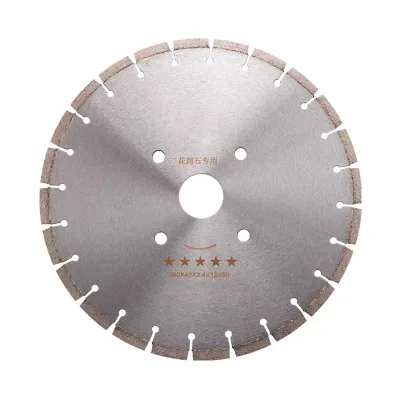
A critical variable in selection is the segment height, which dictates the total usable life of the blade. Observed data indicates segment heights ranging from 10mm to 15mm. A 10mm segment height is typical for standard masonry and tile saws, whereas a 15mm segment height suggests a design intended for heavier-duty stone cutting, such as basalt or granite, offering extended service life before the blade requires replacement. The blade thickness is another fundamental specification; a thickness of 2.4mm is commonly observed, balancing kerf width with structural rigidity. Thinner blades reduce material waste but may require more stable machinery to prevent deflection during deep cuts.
The physical dimensions of the discs vary significantly to accommodate different power tools. The standard diameter range spans from 125mm to 600mm, with specific models like the SGBA and STBA series catering to these sizes. In metric terms, this translates to a range of 4 inches to 14 inches for certain industrial applications. For handheld angle grinders and circular saws, smaller diameters such as 125mm to 230mm are prevalent. Conversely, larger stationary masonry saws utilize blades up to 600mm. The bore size, or arbor hole, is equally critical; standard arbor sizes include 25.4mm, 50mm, and 60mm. Buyers must verify that the bore size of the purchased disc matches the spindle of their specific equipment to ensure safe mounting and operation.
The material composition of the blade blank is often steel, providing the necessary tensile strength to withstand high rotational speeds. The cutting segments themselves are designed for specific stone types, with "basalt cutting blade" and "normal granite blade" being common descriptors. These blades are engineered to deliver good cutting speed and long life, which are primary advantages sought by procurement teams. The blade type may also vary, with turbine designs appearing in the market to enhance cooling and debris removal during the cutting process.
Compliance, Certification, and Safety Standards
In the industrial procurement of cutting tools, compliance with international safety and performance standards is non-negotiable. The primary certification observed in the Granite Cutting Disc market is EN 13236. This standard specifically addresses the safety requirements for cutting tools for stone, masonry, and concrete. It ensures that the blades have undergone rigorous testing for burst pressure, vibration levels, and structural integrity under load. Buyers should explicitly request proof of EN 13236 certification for any lot of discs intended for professional use, as this document validates that the product meets the necessary safety thresholds for operation in wet or dry environments.
While EN 12413 is sometimes referenced in broader tool contexts, the specific and high-confidence certification for stone cutting discs remains EN 13236. Procurement teams must verify that the supplier can provide valid test reports or certificates of conformity that align with this standard. Relying on uncertified products poses significant risks, including potential blade failure, which can lead to severe injury or equipment damage.
Furthermore, the origin of the product plays a role in compliance verification. The majority of these discs originate from China, a major manufacturing hub for abrasive tools. While the country of origin is not a quality indicator in itself, it necessitates a robust due diligence process regarding the supplier's quality management systems. Buyers should ensure that the supplier's quality control protocols are aligned with the requirements of the destination market, particularly if importing into regions with strict liability laws.
The certification process should also cover the specific application environment. For instance, blades marked for "wet cutting" must demonstrate resistance to thermal shock and water ingress, while "dry cutting" blades must be designed to dissipate heat effectively without water cooling. Some products are rated for both wet and dry cutting, offering versatility but requiring careful verification of the specific operating parameters to avoid overheating or premature wear.
Cost Drivers and Pricing Structures
The pricing of granite cutting discs is influenced by a multitude of factors, creating a wide observed range from $0.05 to $119 per unit. This variance is not arbitrary but reflects differences in size, segment height, manufacturing process, and brand positioning. Smaller diameter blades with lower segment heights, such as those for handheld angle grinders, naturally command lower prices. Conversely, large-diameter blades (up to 600mm) with 15mm segment heights and sintered manufacturing processes represent a higher cost tier due to the increased material usage and more complex production requirements.
Minimum Order Quantity (MOQ) is a significant driver of the effective unit cost. The market observes MOQs ranging from 1 piece to 1000 pieces. While some suppliers may offer low MOQs of 5 pieces or even single units for sampling purposes, larger orders typically unlock better pricing tiers. The supply ability of the manufacturer, often cited as 1000 pieces per day, suggests that bulk orders can be fulfilled without significant lead time delays, provided the order volume aligns with the production capacity.
Customization is a major cost variable. The availability of OEM (Original Equipment Manufacturer) and ODM (Original Design Manufacturer) services allows buyers to request specific branding, packaging, or technical modifications. These customizations, such as specific bore sizes or segment geometries, generally incur additional costs compared to standard off-the-shelf products. The "customized support" feature, which includes OEM, ODM, and OBM options, indicates that suppliers are willing to tailor products, but buyers should anticipate a price premium for these services.
Packaging also impacts the final cost. Standard packaging involves plastic bags inside carton boxes, with options for palletized shipping for larger volumes. The single package size of 35x35x25 cm and a gross weight of 2.400 kg are typical metrics that influence logistics costs. Buyers must factor in shipping expenses, which vary based on the transportation mode selected—ocean, land, air, or express. Air freight will significantly increase the total landed cost compared to ocean freight, making it a critical consideration for large, heavy orders.
Typical Applications and Equipment Compatibility
Granite cutting discs are specialized tools designed for a variety of construction and fabrication tasks. The primary application is the cutting of hard stone materials, including granite, sandstone, and basalt. The versatility of these blades allows them to be used on a wide array of equipment. Common usage equipment includes masonry saws, tile saws, and stone saws, which are typically stationary or semi-stationary units used in workshops or on-site for large-scale cutting operations.
For more portable applications, the discs are compatible with handheld angle grinders and handheld circular saws. This compatibility expands the utility of the product, allowing for detailed cuts, notching, and edge finishing that stationary saws cannot easily achieve. The specific model number, such as AB-DIS or STBF, often correlates with the intended equipment type. For example, smaller models like STBF (125-230mm) are optimized for handheld tools, while larger models like SGBA (250-600mm) are suited for masonry saws.
The cutting environment is another critical factor in application selection. Some discs are designed exclusively for wet cutting, which utilizes water to cool the blade and suppress dust. This method is preferred for indoor work or where dust control is a priority. Other discs are suitable for dry cutting, which is essential for outdoor applications or where water access is unavailable. A subset of products is rated for both wet and dry cutting, offering flexibility but requiring the operator to adhere to specific speed and pressure guidelines to prevent blade damage.
The "turbine" blade type mentioned in the specifications suggests a design optimized for specific cutting dynamics, likely enhancing air flow and cooling. This feature is particularly beneficial in dry cutting scenarios where heat buildup is a primary concern. The "normal granite blade" feature indicates a standard configuration suitable for general-purpose granite cutting, balancing cost and performance for the majority of construction tasks.
Supplier Evaluation and Procurement Strategy
Evaluating suppliers for granite cutting discs requires a multi-faceted approach that goes beyond price comparison. The first step is verifying the supplier's capability to provide the specific technical attributes required. Buyers should confirm the availability of customization, OEM services, and the specific model numbers that match their equipment. The presence of "Aibei" as a brand name in the market data suggests that established brands exist, but buyers should remain open to evaluating other manufacturers who meet the technical criteria.
The manufacturing process is a key differentiator. Suppliers offering both sintered and brazed processes provide a broader range of options. Buyers should inquire about the specific bond matrix used in the segments, as this determines the wear rate and cutting speed. A supplier with a proven track record in sintered technology may be better suited for high-volume, continuous cutting operations, while a brazed supplier might offer cost-effective solutions for intermittent use.
Logistics and supply chain reliability are equally important. The observed transportation options—ocean, land, air, and express—indicate that suppliers are equipped to handle various shipping needs. However, buyers must verify the actual lead times and the reliability of the supply chain. A supply ability of 1000 pieces per day is a strong indicator of capacity, but it does not guarantee immediate availability for all order sizes. It is prudent to discuss production schedules and inventory levels before placing large orders.
Packaging and handling standards are also critical. The standard packaging of plastic bags inside carton boxes is common, but buyers should confirm if palletized options are available for bulk shipments to minimize damage during transit. The single gross weight of 2.400 kg and package dimensions of 35x35x25 cm are useful for calculating freight costs and storage requirements.
Quality Control and Long-Term Procurement Considerations
Ensuring consistent quality in granite cutting discs requires a robust quality control (QC) framework. Buyers should request detailed QC reports that include test results for segment adhesion, blade balance, and burst pressure. The warranty period, often cited as 1 year, is a strong indicator of the manufacturer's confidence in their product. However, a warranty is only as good as the supplier's ability to honor it. Buyers should clarify the terms of the warranty, including what constitutes a defect versus normal wear and tear.
Long-term procurement considerations involve building a sustainable relationship with suppliers who can deliver consistent quality over time. The ability to customize products, such as adjusting segment height or bore size, allows buyers to optimize their inventory for specific projects. This flexibility can lead to cost savings and improved operational efficiency in the long run.
The "advantage" of good cutting speed and long life is a key performance indicator that should be validated through field testing. Buyers should consider ordering samples to test the blades in real-world conditions before committing to large orders. This empirical approach helps verify the manufacturer's claims regarding performance and durability.
Finally, buyers must consider the total cost of ownership, which includes not just the purchase price but also the cost of downtime, blade changes, and potential safety incidents. Selecting a supplier who offers high-quality, certified products with a reliable warranty can significantly reduce these hidden costs. By focusing on technical specifications, compliance, and supplier reliability, procurement teams can ensure a steady supply of high-performance granite cutting discs that meet the demands of modern construction and fabrication projects.
FAQs
What cutting methods are supported by these granite discs?
These discs support wet, dry, or both cutting methods depending on the specific model. Some products are suitable for wet cutting only, while others handle dry cutting or both conditions. Buyers must verify the specific suitability attribute for their intended operation environment.
Which manufacturing processes are used for these blades?
The blades are manufactured using sintered or brazing processes. Sintered blades are common for specific applications, while brazed segments offer different wear characteristics. The choice depends on the required cutting speed and longevity for the specific stone material.
What certifications ensure safety for these cutting tools?
Products are certified under the EN 13236 standard for safety requirements. This certification validates burst pressure and structural integrity for stone cutting. Buyers should request proof of this specific certification to ensure compliance with safety thresholds for professional use.
Can I order customized granite cutting discs with my brand?
Yes, OEM, ODM, and OBM customization services are accepted for these products. Buyers can request specific branding, packaging, or technical modifications. Customized support allows for tailored bore sizes and segment geometries, though this may incur additional costs compared to standard items.
What are the standard segment heights for these blades?
Segment heights typically range from 10mm to 15mm depending on the model. A 10mm height is common for standard masonry saws, while 15mm segments are designed for heavier-duty stone cutting like basalt. The height dictates the total usable life of the blade.
How much is the minimum order quantity for these discs?
The minimum order quantity ranges from 1 to 1000 pieces depending on the supplier. Some vendors offer low MOQs of 5 pieces for sampling, while larger orders may require higher volumes. Buyers should verify the specific MOQ for their desired model and customization needs.