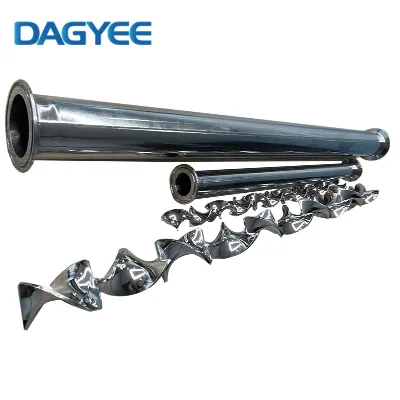
Source Helical Chlorine Blending Static Mixer for Chemical, Daily Chemical, Industrial
Compare 30 listings for Helical Chlorine Blending Static Mixer options featuring spiral or forced stirring types. Buyers can evaluate models with ISO, CE, and GOST certifications for chemical and daily chemical applications.
Key considerations
Products List

Static Mixer with Helical Mixing Element for Chemical Blending
$1500.00 - $150000.00
MOQ: 1 Pieces
Shandong Grenorth Environment Protection Technology Co., Ltd.

SD Static Mixer with Helical Mixing Element for Fluid Blending
$1500.00 - $150000.00
MOQ: 1 Pieces
Shandong Grenorth Environment Protection Technology Co., Ltd.




Static Mixers/ Micromixters Flow Chemistry/Micro Mixers/ Microfluidics Mixer
$2000.00 - $500000.00
MOQ: 1 Pieces

Multifunctional Chemical Particles Stainless Steel Drying Vertical Mixer
$2700.00 - $6500.00
MOQ: 1 Pieces


Comprehensive Sourcing Guide
Strategic Sourcing Guide for Helical Chlorine Blending Static Mixers
Understanding the Technical Architecture of Static Mixing Systems
When sourcing a Helical Chlorine Blending Static Mixer, the primary objective is to identify equipment capable of achieving precise homogenization without moving parts. The supplied product data indicates that the market offers mixers with specific configurations, including "Static Mixers" as a distinct category. The core mechanism relies on the internal geometry of the mixer to split, rotate, and recombine fluid streams. In the context of chlorine blending, the fluid dynamics are critical; the data highlights various "Stirring Types" such as "Spiral," "Forced," and "Gravity," which suggests that the internal helical element design varies significantly between suppliers.
The "Layout Type" is another critical technical variable observed in the market, ranging from "Horizontal" to "Verticle" (Vertical) and even "Both Vertical and Horizontal" configurations. For chlorine applications, the orientation often dictates the pressure drop and the residence time of the fluid within the mixing chamber. A "Horizontal" layout may be preferred for certain gravity-fed systems, while a "Verticle" layout might be selected to minimize footprint or accommodate specific piping elevations. The "Working" mechanism is described in the data as "Convection Mixer" or "Diffusion Mixer," indicating that the blending process may rely on different physical principles depending on the viscosity and flow rate of the chlorine mixture. Buyers must verify which mechanism aligns with their specific process flow rates to ensure the helical elements effectively create the necessary turbulence for blending.
Furthermore, the "Processing" quality is noted as "Very Good," and the "Workmanship" is specified to exclude "Burrs, Chips, Dents, Bumps." This is particularly vital for chlorine applications where surface imperfections can lead to corrosion initiation points or particle generation that could clog downstream valves. The "Condition" of the equipment is consistently listed as "New," implying that the sourcing guide focuses on fresh manufacturing rather than refurbished units. The "Mixer Type" is explicitly defined as "Static Mixers," confirming that the search should focus on inline, pipe-integrated solutions rather than tank-mounted agitators.
Compliance, Certification, and Standard Verification
In the chemical processing sector, particularly when dealing with reactive substances like chlorine, compliance is not merely a formality but a safety imperative. The observed product data reveals a diverse landscape of certifications and standards. Buyers will encounter suppliers offering "ISO" certification, while others provide a broader suite including "GOST," "CE," and "CCC." The presence of "ISO, SGS" and "ISO, CE" in different listings suggests that while ISO is a common baseline, the specific regulatory requirements depend heavily on the destination market. For instance, "CE" indicates conformity with European health, safety, and environmental protection standards, while "CCC" is specific to the Chinese market.
Regarding technical standards, the data lists "customization" and "customized" as product standards, alongside specific dimensional standards like "DN32, DN50, DN80, DN100" and material thickness ranges of "5mm-500mm." This indicates that static mixers are rarely off-the-shelf items for industrial chemical applications; they are often engineered to fit specific pipe diameters. The "prod_standard" field also references "GB," which refers to Chinese National Standards. When sourcing a helical chlorine blending mixer, buyers must verify that the manufacturer's stated standard (whether GB, ISO, or a custom specification) matches the piping standards of their facility.
The "Application Area" is frequently cited as "Chemical" and "Daily Chemical," confirming that these mixers are designed for industrial environments. However, the specific handling of chlorine requires materials that resist corrosion and degradation. While the data mentions "Carbon Steel" as a texture or material attribute, buyers must exercise extreme caution. Carbon steel is generally unsuitable for direct contact with wet chlorine without specific internal linings or coatings. The "Texture" attribute should be cross-referenced with the actual material grade (e.g., stainless steel grades like 316L or specialized alloys) to ensure compatibility with the chemical being mixed. The "Standard" field also includes "customized," suggesting that the material composition and internal geometry can be tailored, but the buyer must explicitly define the chemical compatibility requirements during the specification phase.
Cost Drivers and Pricing Variables
The market data presents a significant variance in pricing, with an observed range from $0.5 to $500,000 USD. This wide spectrum reflects the diversity of products available, ranging from small, simple inline mixers to large, custom-engineered industrial units with complex internal geometries. The "MOQ" (Minimum Order Quantity) is consistently observed as "1," indicating that suppliers are generally willing to accommodate single-unit orders, which is beneficial for pilot plants or specific retrofit projects.
Several factors drive the cost of a Helical Chlorine Blending Static Mixer. First, the "Customization" attribute is prevalent. Customized products, as noted in the specifications, inherently cost more than standard catalog items due to the engineering time, unique tooling, and specialized material requirements. The "Model" numbers vary from generic codes like "SD" and "SM" to specific identifiers like "SK32" and "SD-100," suggesting that model complexity and size directly influence price. Larger models or those with specific "Additional Capabilities" such as "Milling" or "Drying" integrated into the mixing process will command higher prices.
Material selection is another primary cost driver. While "Carbon Steel" is listed, the requirement for chlorine resistance often necessitates more expensive alloys or specialized linings, which would push the price toward the higher end of the observed range. The "Packing" method also affects the final landed cost; options include "Standard Packaging," "Carton Box," and "Wooden Case" or "Wooden Case Packing." For international shipping, especially for heavy industrial equipment, a "Wooden Case" is often required for protection, adding to the logistics cost. The "Power" rating, listed as "3kw" in some contexts, may apply to auxiliary systems or specific mixer types, influencing the electrical infrastructure costs at the installation site.
Typical Applications and Operational Scope
The versatility of static mixers is evident in the "Application" data, which lists "Viscous Fluid," "Powder," "Liquid with Suspended Solids," "Liquid," and "Granules." This suggests that helical static mixers are not limited to simple liquid blending but are capable of handling complex multiphase flows. For chlorine blending, the primary application involves mixing chlorine gas with carrier gases or liquids, or blending different chemical streams to achieve a uniform concentration. The "Application Area" is explicitly defined as "Chemical" and "Daily Chemical," confirming their utility in manufacturing processes.
The "Operating type" is noted as "Continuous Operating," which is ideal for industrial chemical plants that run 24/7. The "Layout Type" flexibility, offering "Both Vertical and Horizontal" options, allows for integration into various plant layouts. The "Working" mechanism, described as "Convection Mixer" or "Diffusion Mixer," implies that the device can handle different flow regimes. For instance, a "Diffusion Mixer" might be more suitable for low-velocity flows where molecular diffusion plays a larger role, while a "Convection Mixer" might be preferred for high-velocity turbulent flows.
The "Additional Capabilities" such as "Milling" and "Drying" indicate that some static mixers may be part of a larger processing train where the mixing unit also performs secondary functions. However, for a dedicated chlorine blending application, the primary focus should remain on the mixing efficiency and chemical compatibility. The "Condition" being "New" ensures that the equipment is ready for immediate deployment in a continuous operation environment without the risk of wear-related failures associated with used equipment.
Supplier Evaluation and Geographic Considerations
The supply base for these mixers is geographically diverse, with origins listed in "Shandong, China," "Shanghai," and "China, Henan." These regions are known for their heavy manufacturing and chemical equipment industries. When evaluating suppliers from these locations, buyers should consider the "After-sales Service" capabilities. The data highlights "Online Support" and "video Technical Support" as available services. This is a crucial factor for international buyers who may not have immediate access to on-site technical teams. The ability to resolve issues remotely can significantly reduce downtime.
The "Workmanship" standard of "No Burrs, Chips, Dents, Bumps" is a key quality indicator that buyers should request evidence for, such as inspection reports or photos of the manufacturing process. Since the "Processing" is rated as "Very Good," suppliers should be able to demonstrate their quality control procedures. The "Certification" landscape, including "ISO," "CE," "GOST," and "CCC," requires buyers to verify the validity of these certificates for the specific product model. A supplier claiming "ISO" certification should provide the certificate number and scope to ensure it covers the manufacturing of static mixers.
Buyers should also assess the "Standard" compliance of the supplier. If a supplier claims to meet "GB" standards, they should be able to provide documentation showing compliance with the specific Chinese National Standards relevant to pressure vessels or piping components. The "Customization" capability is a strong differentiator; suppliers who offer "customized product" models should be evaluated on their engineering team's ability to design helical elements that meet specific flow and pressure requirements. The "Model" variations (e.g., "SD," "SM," "SK32") suggest a modular approach, but buyers must ensure that the customization process is robust and that the final product matches the agreed-upon specifications.
Quality Control and Long-Term Procurement Strategy
Ensuring the long-term reliability of a Helical Chlorine Blending Static Mixer requires a rigorous quality control strategy. The "Workmanship" requirement of "No Burrs, Chips, Dents, Bumps" is not just a cosmetic standard; it is a functional necessity to prevent flow disturbances and potential failure points. Buyers should insist on pre-shipment inspections that verify the internal geometry of the helical elements and the surface finish of the mixing chamber. The "Processing" quality of "Very Good" should be backed by documented quality assurance protocols.
The "Packing" method is also a critical aspect of quality control during transit. "Wooden Case Packing" or "Wooden Case" options provide superior protection against physical damage compared to "Carton Box" or "Standard Packaging." For heavy industrial equipment, the risk of damage during shipping is significant, and the choice of packaging can determine the condition of the equipment upon arrival. Buyers should verify that the packing method aligns with the weight and dimensions of the mixer, especially for larger models like the "SD-100" or those with "DN100" connections.
Long-term procurement considerations include the availability of spare parts and the durability of the materials. The "Standard" dimensions like "DN32, DN50, DN80, DN100" suggest that these mixers are designed to fit standard pipe sizes, which aids in future maintenance and replacement. However, the "Customization" aspect means that non-standard models may require specific spare parts, which could impact long-term operational costs. Buyers should inquire about the lead time for spare parts and the supplier's policy on obsolescence.
The "After-sales Service" of "Online Support" and "video Technical Support" is a valuable asset for troubleshooting. In the event of a performance issue, the ability to receive remote guidance can save significant time and money. Buyers should also consider the "Condition" of the equipment; while "New" is the standard, verifying the warranty terms and the supplier's track record for handling warranty claims is essential. The "Application" of "Continuous Operating" implies that the mixer will be subjected to high stress, and the supplier should provide data or guarantees regarding the expected service life of the helical elements under the specific operating conditions of the buyer's plant.
Comparative Analysis of Mixer Specifications
To assist in the decision-making process, the following table summarizes the key variations observed in the product data, helping buyers categorize potential suppliers based on their specific needs.
| Feature Category | Observed Variations | Procurement Implication |
|---|---|---|
| Stirring Type | Spiral, Forced, Gravity | Determines the mixing mechanism; "Spiral" is typical for helical mixers, while "Forced" implies higher energy input. |
| Layout Type | Horizontal, Vertical, Both | Affects installation footprint and piping configuration; "Both" offers maximum flexibility. |
| Certification | ISO, CE, GOST, CCC, SGS | Must match the regulatory requirements of the installation country; "CE" is critical for Europe. |
| Material/Texture | Carbon Steel | Requires verification of corrosion resistance for chlorine; may need lining or coating. |
| Standard | GB, ISO, Custom, DN32-DN100 | "Custom" and "DN" sizes indicate tailored solutions; verify pipe compatibility. |
| Packing | Carton Box, Wooden Case | "Wooden Case" is recommended for heavy/industrial units to prevent transit damage. |
| Application | Liquid, Powder, Viscous Fluid | Confirms versatility; ensure the mixer handles the specific viscosity of the chlorine blend. |
| Origin | Shandong, Shanghai, Henan | Chinese manufacturing hubs; verify logistics and after-sales support capabilities. |
This comparative view highlights that while the core function of a static mixer remains consistent, the specific attributes vary widely. Buyers must prioritize the attributes that align with their process requirements, such as the "Layout Type" for installation constraints and the "Certification" for regulatory compliance, rather than focusing solely on price. The "Customization" availability allows for tailoring the mixer to the exact needs of a chlorine blending process, but it requires clear communication of technical specifications to the supplier. By systematically evaluating these factors, buyers can select a Helical Chlorine Blending Static Mixer that ensures safety, efficiency, and long-term operational reliability.
FAQs
What certifications are available for helical chlorine blending static mixers?
Available certifications include ISO, CE, GOST, and CCC. Buyers must verify which specific certificates apply to their target market, as some listings offer ISO alone while others provide ISO combined with SGS or CE.
Which layout types are offered for static mixers in industrial applications?
Mixers are available in horizontal, vertical, and both vertical and horizontal layouts. The choice depends on the facility's piping elevation and footprint requirements, with some models supporting dual orientation configurations.
Can suppliers provide customized models for specific pipe dimensions?
Yes, customization is available for various pipe standards including DN32, DN50, DN80, and DN100. Suppliers can also tailor models to specific thickness ranges like 5mm to 500mm based on project needs.
How is the workmanship quality ensured for these industrial mixers?
Products are manufactured with workmanship that excludes burrs, chips, dents, and bumps. The processing quality is rated as very good, ensuring smooth internal surfaces critical for preventing corrosion and flow blockages.
What packing methods are used for shipping these static mixers?
Packing options include standard packaging, carton boxes, and wooden cases. Wooden case packing is often used for heavy industrial units to ensure protection during international transport from origins like Shandong or Shanghai.
What after-sales support is provided for new static mixer units?
Support includes online assistance and video technical support for troubleshooting. These services help buyers resolve operational issues remotely without requiring immediate on-site visits from the manufacturing team.