Source Jacquard Printed Chiffon Dress Fabric for Garments, Skirts, Blouses
Compare 30 listings of Jacquard Printed Chiffon Dress Fabric from verified suppliers. Options include woven techniques, custom colors, and various packing methods for dress, skirt, and garment applications. Explore models like YW-2205 and ATA-G0417 with high-quality standards and flexible MOQs for global sourcing needs.
Key considerations
Products List


Manufacturer Small Flower Chiffon Dress Printed and Fashionable Chiffon Fabric
$1.05 - $1.45
MOQ: 1000 Meters

Wholesale Comfortable 100% Polyester Jacquard Chiffon Fabric for Garment
$4.90 - $5.00
MOQ: 1000 Meters


Manufacturers Supply Spot Supply Chiffon Printed Fabric Printed Dress Fabric
$1.05 - $1.45
MOQ: 1000 Meters




Comprehensive Sourcing Guide
Jacquard Printed Chiffon Dress Fabric Sourcing Guide
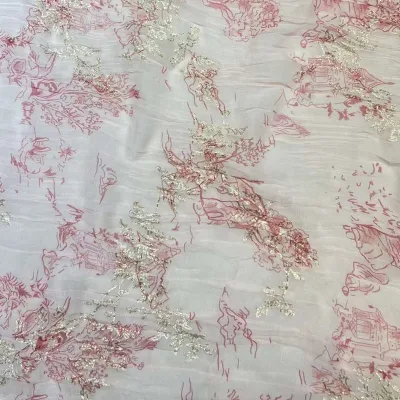
Buyers seeking this specific textile must first distinguish between woven jacquard structures and printed chiffon variations, as the supplied data indicates a diverse range of models like YW-2205 and YW-2237 that utilize woven techniques for garment applications. The observed listings confirm that while some items are explicitly labeled as printed, others rely on plain dyed or jacquard patterns, requiring careful verification of the production method to ensure the fabric meets the aesthetic requirements for dresses and skirts.
Procurement teams should prioritize suppliers who explicitly state customization availability for fabric colors and patterns, as the market data shows options ranging from standard rolls to bespoke specifications. It is critical to confirm whether the "printed" aspect refers to a surface treatment on a chiffon base or a woven jacquard effect, since the observed attributes list both "Style: Printed" and "Pattern: Jacquard" as distinct characteristics that may define different product lines within the same catalog.
Product Scope and Observed Listing Signals
The observed product range includes specific model numbers such as YW-482 and WF-C0172, which are associated with applications in dresses, skirts, and blouses, indicating a strong focus on women's apparel rather than industrial uses. Buyers must verify that the selected item matches the intended use case, as some listings in the dataset specify usage for jackets or down coats, which would be unsuitable for lightweight chiffon dress projects requiring drape and flow.
Packaging methods vary significantly across the observed listings, with options ranging from simple plastic bags to rolls on tough tubes, and some suppliers offering all types of packaging upon request. This variability necessitates a clear specification in the purchase order to prevent damage during transit, especially since the fabric is often shipped in rolls, and the outer layer protection must be sufficient to maintain the integrity of the delicate woven or printed surface.
Technical Specifications to Verify
Technical due diligence requires confirming the exact fabric composition, as the data presents materials ranging from silk and cotton blends to 100% cotton and polyester variants. Buyers must explicitly request the fiber content for each model, such as the 75D*75D or 50dx75d specifications observed, to ensure the weight and texture align with the design requirements for a specific dress style, as these metrics directly influence the final garment's drape and durability.
Dimensional standards and weave density are equally critical, with observed listings citing specific measurements like 15X15X0.2 cm or 100% cotton 6060 9088. Procurement teams should verify that the listed standard dimensions match the physical sample provided, as discrepancies in width or thread count can lead to significant waste during the cutting process and affect the overall yield of the finished dress production run.
Compliance and Safety Documentation
While the supplied facts highlight high-quality attributes, buyers must independently verify that the fabric complies with international safety standards for textiles, particularly regarding chemical residues and flammability. The absence of explicit certification data in the product listings means that suppliers must provide third-party test reports to confirm the material is safe for direct skin contact, especially for garments intended for children or sensitive skin applications.
Documentation regarding the origin of the raw materials is essential, as the data indicates production locations in China and Shengze, a known textile hub. Buyers should request proof of origin and traceability to ensure the supply chain adheres to ethical labor practices and environmental regulations, as the reputation of the sourcing region can impact the brand's compliance posture in Western markets.
Cost Drivers and Commercial Terms
The observed price range of 0.32 to 10 USD suggests significant variation based on material composition, with silk and cotton blends likely commanding higher prices than standard polyester options. Buyers must analyze the cost structure relative to the specific model number and material content, as the price per unit is heavily influenced by the complexity of the weaving technique and the customization level required for the specific pattern or color.
Minimum Order Quantities (MOQ) observed in the market range from 30 to 5000 units, with some specific listings indicating a requirement of 2000 meters per color. This wide variance requires buyers to negotiate terms that align with their inventory strategy, as ordering below the standard MOQ may incur premium costs or require a longer lead time to accommodate smaller production runs.
Supplier Qualification and Quality Control
Supplier qualification should focus on their ability to maintain consistent quality across different production batches, as the data lists multiple models with varying specifications like "High Quality" and "Customized" fabric colors. Buyers must assess the supplier's capacity to deliver on the "Free Hanger Sample" offer and ensure that the sample quality matches the bulk production standards before committing to a large order.
Quality control protocols must include rigorous inspection of the woven structure and print consistency, as the observed attributes list both plain and jacquard patterns which require different manufacturing controls. It is advisable to implement a pre-shipment inspection that verifies the fabric against the agreed-upon standard, such as the 75dx75d specification, to ensure there are no defects in the weave or color fastness issues.
Long-Term Procurement Checks
Establishing a long-term partnership requires regular audits of the supplier's production capabilities and their ability to scale with demand fluctuations. Buyers should monitor the supplier's lead times and their responsiveness to customization requests, as the observed data shows a high degree of flexibility in packaging and model availability that must be sustained over time to support continuous production cycles.
Continuous verification of material standards is necessary to prevent drift in product quality, especially when sourcing from a region with diverse textile capabilities like Zhejiang or Shengze. Procurement teams should maintain a database of tested samples for each model number to ensure that future orders consistently meet the original specifications for weight, texture, and application suitability.
FAQs
What customization options are available for this fabric?
Customization is available for this Jacquard Printed Chiffon Dress Fabric. Buyers can request specific fabric colors and packing types to match their garment needs. The product supports various styles including plain dyed and printed designs for dresses and skirts.
Which models are offered for this woven fabric?
Several models are offered including YW-2205, YW-2237, YW-2215, and YW-482. Additional options include YW-263, YW-2232, WF-C0172, and TY-5945. Specific models like PZD 980 and QK-027 are also listed for different garment applications.
How is the fabric packed for shipment?
The fabric is typically packed in rolls on tough tubes and wrapped in plastic bags. Some listings indicate roll packing or plastic bag packaging as the outer layer. All types of packages are available according to specific buyer requirements for the garment industry.
What are the standard specifications for this material?
Standard specifications include dimensions like 15x15x0.2 cm and 75D by 75D. Some variants feature a 50dx75d structure or 100% cotton 60x60 90x88 composition. The material is described as high quality with options for silk, cotton, or polyester blends.
Can I find suppliers with low minimum order quantities?
Yes, suppliers offer minimum order quantities ranging from 30 to 5000 units. Specific listings mention an MOQ of 2000 meters per color. Buyers can find vendors with flexible MOQs suitable for small batch garment production or larger industrial orders.
Where is this fabric manufactured?
The fabric originates from China, specifically from locations like Shengze and Zhejiang. These regions are known for textile production. Buyers can source this woven material directly from these established manufacturing hubs in China.
What applications does this fabric support?
This fabric supports applications for garments, dresses, skirts, blouses, and jackets. It is suitable for down coats and lining as well as industrial and home textile uses. The material is versatile for various fashion and utility projects.