Source Metal Cashier Counter for Supermarket, Store, Hotel
Compare 25 Metal Cashier Counter for Supermarket options from suppliers in China. These counters feature customizable dimensions, epoxy powder coating, and are suitable for supermarkets, convenience stores, and hotels.
Key considerations
Products List

Supermarket Stainless Steel Electric Cashier Counter Retail Design Cashier Counter
$1000.00 - $1250.00
MOQ: 1 Pieces

Supermarket Stainless Steel Cashier Counter Retail Design Cashier Counter
$240.00 - $350.00
MOQ: 1 Pieces


Durable Material Dimension Design Supermarket Cashier Checkout Counter
$1000.00 - $1400.00
MOQ: 10 Pieces

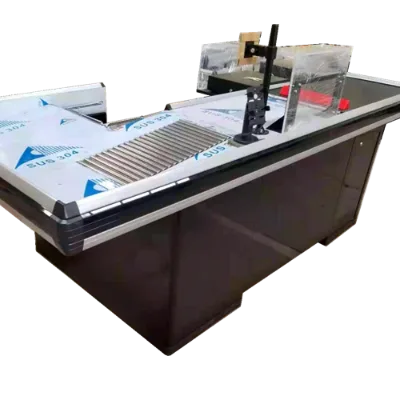
Hot Sell Supermarket Cashier Counter Retail Checkout Counter with Conveyor Belt
$1300.00 - $1500.00
MOQ: 10 Pieces


Comprehensive Sourcing Guide
Strategic Sourcing Guide for Metal Cashier Counters in Supermarket Environments
Selecting the appropriate metal cashier counter for a supermarket or convenience store requires a rigorous evaluation of technical specifications, material integrity, and compliance standards. The procurement landscape for these fixtures is characterized by a diverse range of models, each tailored to specific operational needs, from high-volume drug stores to boutique hotels. Buyers must navigate a market where customization is a primary differentiator, with options ranging from standard dimensions to bespoke requests. This guide provides a structured approach to evaluating potential suppliers and products, ensuring that the selected equipment aligns with both functional requirements and long-term durability expectations.
Technical Specifications and Dimensional Analysis
The foundation of a successful procurement decision lies in understanding the precise technical specifications of the available metal cashier counters. The product data indicates a variety of standard dimensions, suggesting that buyers should not assume a one-size-fits-all approach. For instance, specific models are documented with dimensions such as L2500W1050H870mm, while others are listed as L2000W1100H900mm or L1800W600H850mm. These variations directly impact the floor space required and the workflow efficiency within the checkout area.
When evaluating a product, the buyer must verify if the listed dimensions are fixed or if they can be customized. The supply data confirms that customization is available, with some models explicitly stating "Size: as Request" or "L2000W600H850mm(Customized)." This flexibility is crucial for stores with unique architectural constraints. Furthermore, the height of the counter is a critical ergonomic factor. One specific model is noted with a height of 850mm, which is a standard reference point for service counters, but buyers should verify if this height applies universally or if it varies by model. The surface treatment is another vital technical attribute; the supply chain data highlights "Epoxy Powder Coated" as a standard process, which is essential for resistance against wear, scratches, and chemical cleaning agents common in retail environments.
| Model Reference | Standard Dimensions (LWH) | Customization Availability | Surface Treatment |
|---|---|---|---|
| YD-R0001 | L2500W1050H870mm | Available | Epoxy Powder Coated |
| YD-R0013 | L2000W1100H900mm | Available | Epoxy Powder Coated |
| YD-R0012 | L1800W600H850mm | Available | Epoxy Powder Coated |
| YD-R0017 | L2000W900H850mm | Available | Epoxy Powder Coated |
| YD-R0011 | L2000W600H850mm | Customized | Epoxy Powder Coated |
| HBE-CC | As Request | Available | Epoxy Powder Coated |
Material Integrity and Construction Quality
The core material of the cashier counter is a decisive factor in its longevity and load-bearing capacity. The supplied facts consistently identify "Metal" and "Steel" as the primary raw materials. Steel construction is preferred in high-traffic retail environments due to its superior strength and resistance to impact. Buyers should specifically verify the grade of steel used, as this influences the counter's ability to withstand daily operational stress without deformation.
In addition to the raw material, the finish plays a significant role in the product's aesthetic and functional lifespan. The "Epoxy Powder Coated" finish mentioned in the data is a robust choice that provides a smooth, durable surface. This coating is typically applied to prevent rust and corrosion, which is particularly important in environments where cleaning chemicals are frequently used. The color options are also a key consideration; the data indicates that "Customized Colors" are available, allowing retailers to match the counter to their brand identity. However, specific color palettes like "Grey" are also observed in certain listings, suggesting that standard options exist alongside custom requests. Buyers must confirm whether the color customization involves a change in the powder coating process or if it is limited to specific pre-finished options.
Compliance, Certification, and Safety Standards
In the B2B procurement of retail fixtures, compliance with international and regional safety standards is non-negotiable. The product data references several certifications, including "CE" and "ISO9001." The CE mark indicates conformity with health, safety, and environmental protection standards for products sold within the European Economic Area, while ISO9001 relates to quality management systems. It is important to note that while these certifications are listed, buyers must verify that the specific unit they are purchasing carries the valid certification documentation. The presence of "SGS" as a standard in one listing suggests that third-party inspection reports may also be available, providing an additional layer of assurance regarding product quality.
When evaluating a supplier, the buyer should request proof of these certifications rather than relying solely on the product listing. The data also mentions "Ce" and "CE, ISO9001" in different contexts, highlighting the need to distinguish between general company certifications and product-specific compliance. For supermarkets operating in multiple jurisdictions, ensuring that the counter meets local building codes and fire safety regulations is essential. The "Direction: Can Be Changed" attribute suggests that the design may allow for modular reconfiguration, which could be relevant for stores that need to adapt their layout for safety or flow optimization.
Cost Drivers and Pricing Structures
Understanding the cost structure of metal cashier counters is vital for budget management. The observed price range in the market spans from 85 to 1680 USD, a wide variance that reflects differences in size, material thickness, customization level, and finishing quality. Several factors drive these costs. First, the size of the unit is a primary determinant; larger models like the L2500mm length will naturally cost more than compact L1800mm units. Second, the level of customization significantly impacts the price. Models with "Customized" logos, specific dimensions, or unique color requests will incur higher manufacturing costs compared to standard "Non-Customized" or off-the-shelf options.
The Minimum Order Quantity (MOQ) is another critical cost driver. The data shows an MOQ range of 1 to 50 units, with a specific mention of "10PCS" for certain models. Buyers looking to purchase a single unit for a pilot store or a small boutique may find suppliers with an MOQ of 1, but these may come at a premium per unit. Conversely, bulk orders for large supermarket chains can leverage economies of scale, potentially reducing the unit cost. Payment terms also influence the financial planning of the procurement; standard terms include "T/T 30% Deposit+ Balance Paid," while other options like "L/C, T/T, Western Union" are available. Buyers should negotiate these terms based on their cash flow and the supplier's trust level.
Typical Applications and Operational Fit
The versatility of metal cashier counters allows them to serve a wide array of commercial settings. The product data explicitly lists applications in "Supermarket, Convenient Store, Store, Drug Store, Hotel, Restaurant," and even "Bank" and "Station." This broad applicability suggests that the design is robust enough to handle diverse traffic patterns and functional requirements. For a supermarket, the counter must facilitate high-volume transactions and accommodate point-of-sale (POS) systems. In a drug store or convenience store, the footprint might need to be more compact to maximize shelf space, making the L1800mm or L1800*W600mm models particularly relevant.
The "Kind" of the product is categorized as "Table" or "Service Counter," indicating its primary function is to provide a stable surface for transactions and customer interaction. The "Wood Style: No" attribute confirms that these are purely metal fixtures, which aligns with the need for durability and ease of cleaning in food retail environments. Buyers should consider the specific workflow of their store when selecting a model. For instance, a hotel or bank might require a counter with a more formal aesthetic, while a supermarket might prioritize speed and capacity. The ability to change the direction of the counter ("Can Be Changed") is a valuable feature for stores that need to reorient their checkout lanes to manage queue lengths during peak hours.
Supplier Evaluation and Logistics Management
Evaluating suppliers requires a focus on their origin, logistics capabilities, and packaging standards. The product data indicates that the origin is primarily "Suzhou Changshu," "Changshu Jiangsu Province," or generally "Jiangsu, China (Mainland)." This concentration in the Jiangsu province suggests a mature manufacturing hub with established supply chains for metal fabrication. Buyers should verify the specific factory location to assess the logistics lead time. The loading port is consistently listed as "Shanghai," which is a major global shipping hub, facilitating efficient export to international markets.
Packaging is a critical aspect of ensuring the product arrives in pristine condition. The data specifies packaging methods such as "with Plastic Bubble Film/Carton," "Packed by Carton and Bubble Films," and "Export Carton." These descriptions indicate a standard practice of protecting the metal surfaces from scratches and dents during transit. However, buyers should confirm the specific packaging details for their order to ensure that the protective measures are sufficient for long-distance shipping. Additionally, the "Condition" is listed as "New," which is a baseline expectation, but buyers should verify the warranty terms and after-sales support provided by the supplier.
Long-Term Procurement Considerations
Sourcing metal cashier counters is not merely a transactional purchase but a strategic investment in the store's infrastructure. The long-term value of the counter depends on its durability, maintainability, and adaptability. The "Epoxy Powder Coated" finish offers a significant advantage in longevity, as it resists fading and chipping better than traditional paint. However, buyers should inquire about the warranty period for the coating and the structural integrity of the steel frame.
Customization is a double-edged sword; while it allows for a perfect fit, it can complicate future repairs or replacements. If a specific model is customized with a unique dimension or logo, sourcing a replacement part or a second unit in the future might be challenging. Therefore, buyers should consider the scalability of their order. If they plan to expand to multiple locations, standardizing on a few core models with minor customization might be more efficient than creating unique designs for each store. Finally, the payment terms and lead times should be factored into the overall project timeline. With a potential MOQ of 10 units and a deposit requirement, buyers must ensure their cash flow can accommodate the initial outlay before the goods are shipped from the Shanghai port. By carefully analyzing these factors, buyers can secure a reliable, high-quality metal cashier counter that enhances their operational efficiency and customer experience.
FAQs
What customization options are available for metal cashier counters?
Customization is available for logos, colors, and dimensions. Buyers can request specific sizes like L2500mm or choose from customized colors to match their brand identity. Some models allow the direction to be changed for flexible layout planning.
Which certifications do these metal counters typically hold?
Many models carry CE and ISO9001 certifications to ensure safety and quality management. Some listings also reference SGS standards for third-party inspection. Buyers should verify specific documentation for the unit they intend to purchase.
How are these counters packaged for international shipping?
Products are packed using export cartons combined with plastic bubble films or air bubble film. This method protects the epoxy powder-coated surfaces from scratches and dents during transit from the Shanghai loading port.
Can the dimensions of the counter be customized to fit my store?
Yes, dimensions can be customized based on specific requests. Standard models range from L1800mm to L2500mm, but options like L2000*W600*H850mm are explicitly listed as customizable to suit unique architectural constraints.
What payment terms are accepted for bulk orders?
Standard payment terms include a T/T 30% deposit with the balance paid before shipment. Other accepted methods may include L/C and Western Union depending on the specific supplier agreement and order volume.
Where are these metal cashier counters manufactured?
The products originate from Jiangsu, China, specifically from locations like Suzhou Changshu. This region is a known manufacturing hub for metal fabrication, ensuring a mature supply chain for these retail fixtures.
What is the minimum order quantity for purchasing these counters?
The minimum order quantity varies, with some models requiring 10 pieces while others allow orders as low as one unit. Bulk purchases may leverage economies of scale to reduce the per-unit cost significantly.