Source Modular WPC Marina Access Bridge for resorts, airports, and marinas
Explore 30 listings for the Modular WPC Marina Access Bridge, comparing features like WPC decking, aluminum beams, and customizable widths. Buyers can evaluate load capacities, certifications, and design options for various floating dock projects.
Key considerations
Products List


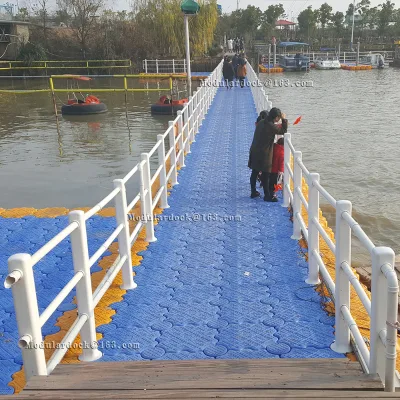


Reliable Water Plastic Bridge, Modular Floating Pontoon Dock Bridge
$200.00 - $1000.00
MOQ: 1 Square Meters


Floating Modular Dock Floating Bridge on The Lake Price Floating Walkway Plastic Walkways
$250.00 - $300.00
MOQ: 5 Square Meters

Comprehensive Sourcing Guide
Strategic Sourcing Guide for Modular WPC Marina Access Bridges
Understanding the Technical Architecture of Modular Systems
When sourcing a modular WPC (Wood-Plastic Composite) marina access bridge, the buyer must first distinguish between the decking material and the underlying structural framework. The supplied product data indicates that while some units utilize WPC or preserved wood for the decking surface, the structural integrity often relies on high-grade aluminum alloys or heavy-duty HDPE (High-Density Polyethylene) components. For instance, specific models in the market utilize anodized aluminum beams with surface treatments designed to resist corrosion in saline environments. The standard structural material for these frames is often Aluminum 6061-T6, processed via MIG welding to ensure a seamless and robust connection between modular segments.
The load-bearing capacity is a critical technical parameter that varies significantly by design. Observed specifications list load capacities ranging from 200kg/m² to 350kg/sqm for certain floating dock configurations. However, other engineering solutions are explicitly "engineered to project specifications," suggesting that the 200-350kg range may apply to specific pedestrian or light vehicle models rather than heavy industrial applications. The freeboard, which is the vertical distance from the waterline to the deck surface, is another vital dimension. Data points show freeboard heights typically ranging between 450mm and 650mm, with some specialized models offering a range of 500mm to 550mm. These dimensions are not arbitrary; they are engineered to accommodate tidal fluctuations and wave action while ensuring safe pedestrian access.
The width of the gangway is another primary specification that dictates the utility of the bridge. Available configurations include widths of 1.2m, 1.5m, 2m, and 2.5m. The selection of width depends on the intended traffic volume and the need for emergency egress. Furthermore, the anchoring system is a crucial component of the bridge's stability. The market offers various anchoring solutions, including pile systems, chain-based mooring, and specialized flexible systems like Seaflex. The choice of anchoring must align with the specific seabed conditions of the installation site.
Compliance and Certification Verification Protocols
In the marine industry, compliance is not merely a formality but a safety imperative. Buyers must rigorously verify that the supplier holds valid certifications from recognized bodies. The supplied data confirms that reputable manufacturers often possess ISO and CE certifications, with some holding ISO9001:2015 standards. Additionally, company-level certifications from organizations such as SGS, NOA, and BIA are frequently cited as indicators of quality assurance. It is essential to note that certification status can vary by product model; for example, one model is explicitly listed with CE and ISO9001:Condition:New, while others may carry different certification profiles.
Beyond general certifications, specific design standards must be checked against the intended location of the marina. Some products adhere to Australian Standards for marina design, while others may follow free-design protocols tailored to local regulations. The structural standards for aluminum components are often defined by the alloy type and welding process, such as the Aluminum 6061-T6 MIG welding standard. Buyers should request the specific test reports and certification documents for the exact model number they intend to purchase, as a supplier may hold certifications for one product line (e.g., the HRZ1 model) but not necessarily for another (e.g., the QH 07 model).
The origin of the product also plays a role in compliance. Products originating from China, specifically from regions like Shenzhen or Shandong, are common in the global market. However, the "Made in China" label does not preclude high quality; rather, it necessitates a deeper dive into the specific factory's quality control processes and the validity of their export certifications. Buyers should verify that the CE marking corresponds to the specific directive applicable to marine equipment in their target market, ensuring that the product meets the safety requirements of the European Union or other relevant jurisdictions.
Cost Drivers and Economic Factors in Procurement
The price range for modular WPC marina access bridges is exceptionally broad, observed from $15 to $100,000 USD. This variance is driven by several key factors, including the scale of the project, the complexity of the design, and the materials selected. A simple, short walkway with a 1.2m width and standard HDPE decking will naturally cost significantly less than a complex, multi-segment floating bridge with 2.5m width, custom anchoring systems, and integrated lighting or power pedestals.
The Minimum Order Quantity (MOQ) is another economic factor that influences the total cost of ownership. The observed MOQ range spans from 1 unit to 300 units. For small-scale projects, such as a private residential dock, a supplier with an MOQ of 1 is ideal. Conversely, large-scale commercial developments may benefit from bulk purchasing, potentially lowering the unit cost, provided the supplier can accommodate the volume. The packaging requirements also impact logistics costs; while some units are packed "as required" or "in bags," others are shipped via FCL (Full Container Load) or LCL (Less than Container Load), which affects shipping expenses and handling time.
Customization is a significant cost driver. The data indicates that customization is available for these systems. Custom colors (Blue, Black, or Customized), specific dimensions, and tailored anchoring systems will increase the unit price. Additionally, the inclusion of auxiliary components like 16A, 32A, 63A, or 125A pedestals for power and water connections adds to the overall cost. Buyers must balance the desire for customization against the budget constraints, understanding that standard configurations are generally more cost-effective than bespoke solutions.
Typical Applications and Project Scenarios
Modular WPC marina access bridges are versatile and serve a wide array of applications. The observed representative projects include high-profile locations such as the Disneyland Marina and the Maldives International Airport. These examples highlight the ability of these systems to meet the aesthetic and functional demands of luxury tourism and large-scale infrastructure. The floating nature of the bridges makes them particularly suitable for areas with significant tidal variations, where fixed structures would be impractical or require expensive foundation work.
The product data also identifies a specific application in "Fisheries Auxiliary Machinery," suggesting that these bridges are used in commercial fishing ports to facilitate the loading and unloading of catch and equipment. The durability of the materials, with a stated service life of 50+ years for HDPE-based systems, makes them ideal for long-term infrastructure projects. The anti-slip properties of the HDPE pedals and the corrosion resistance of the AISI 316 bolts ensure safety in wet and salty environments.
Furthermore, the modular design allows for expansion and reconfiguration. As a marina grows or as the water level changes, additional modules can be added or removed without major construction work. This flexibility is particularly valuable for temporary events or seasonal marinas. The ability to design the marina layout freely, as noted in the product attributes, allows architects and engineers to create unique shapes and configurations that maximize the usable water frontage.
Supplier Evaluation and Capability Assessment
Evaluating a supplier for modular marina bridges requires a holistic approach that goes beyond price and certification. The presence of an installation team is a critical indicator of supplier capability. The data mentions that some suppliers provide "3 Teams" for installation, which suggests a capacity to handle large-scale projects efficiently. Buyers should inquire about the composition of these teams, their experience with similar projects, and their ability to manage on-site logistics.
The product model and standard specifications are also key evaluation points. Suppliers offering a range of models, such as HRZ1, HRZ2, CM1, and QH 07, demonstrate a broader product portfolio and technical expertise. Buyers should verify if the supplier can provide the specific model that matches their project requirements, including the correct standard dimensions (e.g., 10/12/14/18/22m lengths) and width options. The ability to offer "Free Design" services is a significant advantage, as it allows the supplier to tailor the bridge to the specific hydrological and topographical conditions of the site.
Quality control processes should be scrutinized. The mention of "Condition: New" and specific material standards like HDPE Floating Pipe and HDPE Bracket indicates a focus on new, high-quality manufacturing. Buyers should request evidence of the supplier's quality control measures, including material testing reports and welding inspection records. The origin of the product, whether from Shenzhen or Shandong, should be verified to ensure it aligns with the buyer's supply chain preferences and any trade restrictions that may apply.
Quality Control and Long-Term Procurement Considerations
Ensuring the long-term performance of a Modular WPC Marina Access Bridge requires a focus on material quality and maintenance planning. The use of HDPE for floatation and decking, combined with anodized aluminum beams, provides a robust defense against corrosion and UV degradation. However, the longevity of the system depends on the quality of the fasteners. The specification of AISI 316 bolts is a positive indicator, as this grade of stainless steel is highly resistant to saltwater corrosion. Buyers should verify that all metal components, including railings and pedestals, are made from compatible materials to prevent galvanic corrosion.
The service life of these systems is a major consideration for procurement planning. With a stated service life of 50+ years for certain HDPE models, the initial investment is amortized over a long period. However, buyers should understand that this lifespan is contingent on proper installation and maintenance. The modular nature of the bridges allows for easy replacement of individual components, such as a damaged pedal or a worn-out fender (PE/Rubber), without replacing the entire structure.
Procurement considerations should also include the availability of spare parts and the supplier's after-sales support. The "as Required" packing and "customized" standard options suggest that the supplier is flexible, but buyers must ensure that future expansion or repair needs can be met. The lead time for custom orders should be clarified, as the "Condition: New" status implies that the products are manufactured to order rather than held in stock. Finally, buyers should consider the environmental impact of the materials, as HDPE and WPC are often chosen for their sustainability and recyclability compared to traditional timber or concrete.
Comparative Analysis of Key Specifications
To assist buyers in making informed decisions, the following table summarizes the key technical specifications observed in the market for modular WPC marina access bridges. This comparison highlights the variability in design and performance, emphasizing the need for precise specification matching.
| Specification Category | Observed Range / Options | Notes for Verification |
|---|---|---|
| Load Capacity | 200kg/m² to 350kg/sqm | Verify specific project engineering; some models are custom-engineered. |
| Freeboard Height | 450mm - 650mm | Some models specify 500mm-550mm; check tidal requirements. |
| Gangway Width | 1.2m, 1.5m, 2m, 2.5m | Select based on traffic volume and safety regulations. |
| Decking Material | WPC, Preserved Wood, HDPE Anti-Slip Pedals | HDPE offers 50+ year service life; WPC offers aesthetic appeal. |
| Structural Frame | Aluminum 6061-T6, HDPE Bracket | Aluminum requires anodized treatment; HDPE is corrosion-proof. |
| Anchoring System | Pile, Chain, Seaflex | Must match seabed conditions and tidal range. |
| Fasteners | AISI 316 Bolts | Essential for saltwater resistance; verify grade on all metal parts. |
| Certifications | ISO, CE, ISO9001, SGS, NOA, BIA | Check validity for specific model and target market. |
| Product Origin | China (Shenzhen, Shandong) | Verify factory location and export compliance. |
| Service Life | 50+ Years (for HDPE models) | Dependent on maintenance and environmental conditions. |
This table serves as a checklist for buyers to ensure that all critical parameters are addressed during the sourcing process. By systematically evaluating each category against the specific needs of the project, buyers can mitigate risks and secure a high-quality, durable marina access bridge that meets both functional and regulatory requirements.
FAQs
What certifications do modular wpc marina access bridges typically hold?
These bridges commonly hold ISO and CE certifications, with some models also featuring ISO9001 standards. Additional company-level certifications from SGS, NOA, or BIA may be available depending on the specific manufacturer and product line.
Which materials are used for the structural frame and decking?
Structural frames often utilize Aluminum 6061-T6 with MIG welding, while decking options include WPC, preserved wood, or HDPE anti-slip pedals. Floatation is typically provided by HDPE floating pipes or brackets in HDPE-based systems.
How wide can the gangway be for these modular bridges?
Gangway widths are available in 1.2m, 1.5m, 2m, and 2.5m configurations. The selection depends on traffic volume requirements and safety standards for the specific marina or dock installation project.
Can the load capacity be customized for heavy projects?
Load capacities range from 200kg/m2 to 350kg/sqm for standard models, but some units are engineered specifically to project specifications. This allows for flexibility in handling varying weights from pedestrian traffic to light vehicles.
What anchoring systems are compatible with these floating bridges?
Compatible anchoring systems include pile, chain, and specialized flexible options like Seaflex. The choice depends on seabed conditions and the specific stability requirements of the marina or dock location.
Which fasteners are used to ensure corrosion resistance?
AISI 316 bolts are used as fasteners to provide high resistance against saltwater corrosion. This ensures the structural integrity and longevity of the bridge in marine environments over its service life.
What is the typical service life of HDPE floating walkways?
HDPE-based floating walkways are engineered for a service life of over 50 years. This longevity is achieved through durable materials like HDPE floating pipes and anti-slip pedals designed for marine conditions.