Source Office File Folder Ring Binder for Office, School, and Home
Compare 30 Office File Folder Ring Binder options from verified Chinese manufacturers. Buyers can evaluate PU and PVC materials, custom sizes, and branding features for diverse document storage needs; compare the available evidence and request quotations based on your requirements.
Key considerations
Products List


Comprehensive Sourcing Guide
Office File Folder Ring Binder Sourcing Guide
Sourcing an Office File Folder Ring Binder for corporate, retail, or stationery programs requires balancing material choice, ring mechanism style, and customization capability against realistic order volumes. The listings observed in this category range from simple PP document holders at pennies per unit to PU leather binders at several dollars, with minimum order quantities spanning from as low as ten pieces for sampling to 5,000 pieces for full production runs. This spread reflects a market that serves both small buyers testing a design and large buyers placing recurring annual orders.
This guide walks through the decisions that matter most: defining the product scope before contacting factories, verifying technical specifications in writing, understanding which documentation to request, identifying the cost drivers behind quoted prices, qualifying suppliers through structured quality control, and building long-term procurement checks that protect your program as volumes grow. Each section addresses one buyer decision so you can move from first inquiry to repeat ordering with fewer surprises and a documented basis for every choice you make with your chosen manufacturer.
Product Scope and Observed Listing Signals
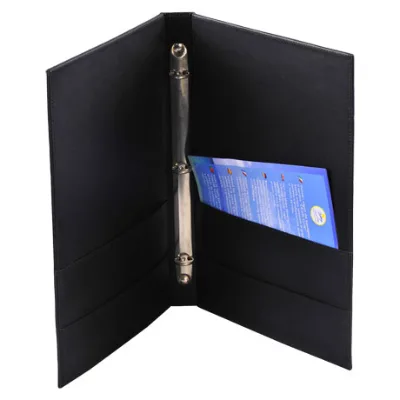
The observed listings cover several distinct product families that buyers often lump together. PU leather ring binders with 3 O-ring mechanisms, positioned as office folders with embossed logo and company name finishes, sit at the premium end. Alongside these are ring binder file folders in classic styles, box file variants with locks and clips, and double-ply document bags in PVC or leather, some specified for file box, data book, and wordpad usage. Standard sizes such as A4 and a documented 220x310mm format appear, alongside custom dimensions like 21x24.5x4.5cm.
Listing signals suggest how suppliers segment their offerings. Model numbers such as FR01/FR02/FR03, ST-0091, HW-0014, HW-009261, JH-PL2319, and BDR_PU_0002 indicate established product lines rather than one-off listings. One listing cites 30PCS/Carton packing, a 0.35kg unit weight, and a 30-day guarantee, while another references sample times of 7-10 days and claimed experience exceeding ten years. Origins cluster in Guangdong and Anhui, China. Treat these attributes as observations about individual listings, not guarantees across the category, and confirm which product family each quote actually covers.
Technical Specifications to Verify
Begin verification with the ring mechanism, since the style — 3 O-ring in the observed listings, but potentially D-ring or other configurations — determines sheet capacity and page-turn behavior. Confirm ring diameter, metal gauge, and whether rings close squarely without gaps. For size, A4 is the common benchmark but custom dimensions such as 21x24.5x4.5cm appear in listings; verify internal sheet dimensions, spine width, and whether the stated size refers to the cover or the usable capacity.
Material claims deserve equal scrutiny. PU leather, PP, PVC, and leather are all observed in this category, and each behaves differently for durability, printability, and cost. Ask for material thickness, whether the PU is bonded over board or paper, and how the cover handles repeated opening. For decoration, the observed finishing options include logo and company name embossing, with CMYK or Pantone color matching offered — specify which color system your artwork uses and request a physical pre-production sample. Finally, verify packing configuration, unit weight, and carton dimensions so landed-cost calculations rest on confirmed figures.
Compliance and Safety Documentation
Compliance documentation should be requested before sample approval, not after production. One observed listing references RoHS, which concerns restriction of hazardous substances and may be relevant where metal ring components or coated materials are involved — ask any prospective supplier to state which certifications their specific product line holds and to provide current certificates rather than assertions. Never assume a certification applies to every listing in a supplier's catalog, since materials such as PU, PVC, PP, and leather each carry different regulatory exposure.
Beyond certificates, request material safety declarations for the cover stock and any coatings, inks used in CMYK or Pantone printing, and metal composition details for the ring mechanism. Buyers supplying corporate clients, educational institutions, or government purchasers often face documentation requirements at the point of tender, so obtaining these files early avoids delays later. Ask how the supplier handles batch traceability — whether production lots can be linked to material shipments — and confirm the guarantee terms in writing; one listing offers a 30-day guarantee, but coverage scope, claim procedure, and remedies need explicit definition in your purchase agreement.
Cost Drivers and Commercial Terms
Observed prices span from $0.09 to $8.79, and the gap is explained by identifiable drivers rather than random variation. Material is the largest factor: thin PP folders sit at the bottom of the range, while PU leather binders with board covers and metal mechanisms occupy the top. Decoration method matters too — embossing a logo carries different tooling and per-unit costs than full CMYK printing — and ring diameter, cover thickness, and custom sizing all add cost relative to standard A4 configurations.
On commercial terms, observed MOQs range from 10 to 5,000 pieces, with specific listings citing 500 and 1,000-piece minimums. Lower MOQs typically carry higher unit prices because setup costs amortize over fewer units, so model your total cost at two or three volume tiers before negotiating. Sample times of 7-10 days appear in listings; confirm whether sample fees are credited against production orders. Clarify Incoterms, payment structure, packing (one listing cites 30PCS/Carton), and whether the quoted price holds for repeat orders, since customization and Pantone matching can affect both first-run and re-order pricing.
Supplier Qualification and Quality Control
Qualify suppliers by testing the claims visible in their listings against verifiable evidence. Origin details such as Guangdong, Guangzhou, and Anhui tell you the manufacturing region but not capability; ask for factory photos, production-line descriptions, and references to claimed experience — one listing cites exceeding ten years, which you can probe with questions about product evolution and repeat-client programs. Request samples from your shortlist and compare ring closure smoothness, cover material hand-feel, and print or embossing fidelity side by side.
Establish a defined inspection process for production runs. Define your AQL sampling approach and inspection checklist before the purchase order is signed, covering ring alignment, cover lamination, decoration placement against approved artwork, sheet capacity, and carton packing counts. Agree on whether inspection occurs pre-shipment, during production, or both, and who bears rework costs for failures. The 30-day guarantee cited in one listing is a useful signal of after-sales willingness, but fold it into a written quality agreement specifying defect categories, acceptable limits, and remedies. For first orders, consider a pilot quantity at the low end of the MOQ range to validate the supplier before scaling.
Long-Term Procurement Checks
Once a supplier performs well, convert the relationship into a structured repeat-purchase framework. Lock in approved specifications — model numbers such as BDR_PU_0002 or FR01/FR02/FR03, Pantone references, embossing artwork, size, and packing configuration — in a specification sheet both parties sign, so re-orders do not drift. Confirm that quoted pricing holds across order cycles or define a review mechanism, and record the supplier's stated sample time of 7-10 days as a benchmark for measuring ongoing responsiveness.
Monitor continuity risks that affect long programs. Model numbers, materials, and even origins can change; one observed listing attributes products to both Anhui and Guangzhou, so confirm which facility will produce your orders and whether a facility change would alter materials or quality. Re-verify certifications periodically rather than relying on documents supplied at onboarding, and re-run sample comparisons annually to detect material substitution. Track defect rates across shipments to build an evidence base for volume negotiations, and maintain a qualified second source with comparable MOQ terms so a single supplier disruption does not halt your office supplies program.
Word count check: approximately 1,290 words across the seven sections, within the 1,225-1,435 target range.
FAQs
What materials are used for these ring binders?
The ring binders are primarily constructed from PU leather and PP plastic. Some document bags utilize PVC or leather materials. These materials ensure durability and a professional appearance for office use. The choice of material depends on the specific model and customization requirements selected by the buyer.
Can I customize the logo and design?
Yes, customization is available for logos, company names, and custom designs. Buyers can request embossing for their brand identity. Custom colors are also accepted to match corporate branding. This flexibility allows businesses to create unique office supplies that reflect their specific visual identity and professional standards.
What is the minimum order quantity for these items?
The minimum order quantity varies by product model. Some items require an MOQ of 500 pieces, while others may require 1000 pieces. Buyers should check the specific model details for exact requirements. This range allows for flexible ordering based on inventory needs and budget constraints for bulk procurement.
Where are these products manufactured?
These products are manufactured in China, with origins in Guangdong, Anhui, and Guangzhou. The diverse manufacturing locations ensure supply chain resilience. Buyers can specify preferred origins if needed. This geographic distribution supports efficient logistics and timely delivery for international orders while maintaining consistent quality standards across all production sites.
What sizes are available for the binders?
Standard sizes include A4 dimensions, with specific models measuring 21x24.5x4.5 cm. Custom sizes are also available upon request. The A4 format is ideal for standard document storage. Buyers can choose from various specifications to ensure the binder fits their specific filing needs and organizational requirements effectively.
How long does sample production take?
Sample production typically takes 7 to 10 days. This timeframe allows for quality checks and customization adjustments. Buyers can request samples to verify material quality and design accuracy before placing bulk orders. This process ensures that the final products meet the specified requirements and expectations for office use.