Source Restaurant Retail POS Terminal for Dining, Shop, Cafe
Explore 30 options for a Restaurant Retail POS Terminal designed for dining counters, retail shops, and cafes. Compare Android-based devices with NFC, barcode scanners, and thermal printers to find the right fit for your business needs; compare the available evidence and request quotations based on your requirements.
Key considerations
Products List


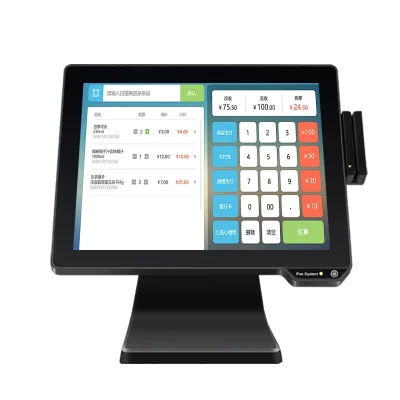


Beautifully Designed 23.8 Inch Self-Service Ordering and Cash Register
$439.00 - $459.00
MOQ: 1 pieces


Comprehensive Sourcing Guide
Restaurant Retail POS Terminal Sourcing Guide
The modern Restaurant Retail POS Terminal serves as a critical hub for transaction processing, inventory tracking, and customer engagement in high-volume dining environments. Based on observed market listings, these devices typically integrate Android operating systems with robust connectivity options to ensure seamless data synchronization across kitchen and front-of-house stations. Buyers should prioritize units that support both fixed and portable configurations to accommodate varying floor layouts and service models.
Procurement decisions must account for the specific hardware requirements of the intended application, such as the need for integrated thermal printers or external barcode scanners. The observed product range includes models with varying screen sizes, from compact 6.75-inch displays to larger 15.6-inch units, allowing buyers to select hardware that matches their specific counter space and visibility needs. Understanding these physical constraints is essential before finalizing any purchase order.
Product Scope and Observed Listing Signals
Market analysis reveals a diverse range of POS terminals with prices spanning from $18 to $4,000, reflecting significant differences in feature sets and build quality. The minimum order quantities are generally low, often starting at just one or two units, which facilitates small-scale testing or pilot deployments for new restaurant concepts. This flexibility allows buyers to validate performance without committing to large inventory volumes immediately.
Buyers must carefully distinguish between models with integrated printers and those designed as standalone terminals requiring external peripherals. Some listings indicate a 58mm paper roll capacity, while others support up to 80mm rolls, directly impacting the length of receipts and the frequency of paper changes. Additionally, the presence of a secondary customer display varies, with some units offering a 2.4-inch color screen and others featuring larger 10.1 or 15.6-inch displays for enhanced transparency during transactions.
Technical Specifications to Verify
The core processing unit is a critical determinant of system stability, with observed models utilizing MediaTek processors like the Mt8766 or Mt8786 paired with Android 15. Memory configurations typically max out at 4GB RAM and 64GB storage, which is sufficient for standard POS applications but requires verification for heavy multitasking scenarios. Buyers should confirm that the chosen model supports the specific software stack required by their point-of-sale application provider.
Connectivity and input capabilities are equally vital for operational continuity in a busy restaurant setting. The devices generally support Wi-Fi, Bluetooth, and Ethernet, ensuring redundant network paths to prevent downtime during peak hours. Verification of the camera system is also necessary, as some units offer 5-megapixel or 2-megapixel autofocus capabilities for ID scanning, while others may include monocular or binocular options for advanced barcode reading.
Compliance and Safety Documentation
Regulatory compliance is non-negotiable for payment terminals, and buyers must verify that devices carry recognized certifications such as CE and Google Mobile Services (GMS). These certifications ensure that the hardware meets international safety standards and is compatible with the Google Play ecosystem, which is essential for accessing secure payment applications. Without these credentials, the device may fail to meet local banking regulations or software compatibility requirements.
Environmental operating conditions must also be validated against the specific climate of the restaurant location. The observed operating temperature range of 0°C to 45°C defines the thermal limits within which the device can function reliably. Procurement teams should ensure that the installation environment, including areas near ovens or outdoor patios, remains within these bounds to prevent hardware failure or data corruption during service.
Cost Drivers and Commercial Terms
The final cost of a POS terminal is heavily influenced by the inclusion of specialized peripherals such as 2D barcode scanners, contactless card readers, and thermal printers. Models featuring NFC support for Softpos and ISO14443 Type A/B standards often command a premium due to the added security and versatility they provide for contactless payments. Buyers should calculate the total cost of ownership, including the need for separate peripherals if the base unit does not include them.
Commercial terms regarding packaging and logistics also play a significant role in the overall procurement budget. Most units are shipped in carton boxes or cases, with dimensions varying significantly based on the model, such as the 193mm width for compact units versus the 367mm width for larger all-in-one systems. Understanding these physical dimensions is crucial for planning warehouse storage and delivery logistics, especially when ordering multiple units for a multi-location rollout.
Supplier Qualification and Quality Control
Supplier qualification should focus on the manufacturer's ability to provide consistent hardware quality and reliable after-sales support. Buyers must verify that the supplier can offer Mobile Device Management (MDM) capabilities, which are essential for maintaining security and updating software across a fleet of devices. The presence of a concealed cable design in some models also indicates a higher level of attention to detail regarding table aesthetics and cable management.
Quality control processes should include a rigorous check of the physical build and port configurations. The observed I/O ports typically include multiple USB 2.0 and 3.0 interfaces, along with RJ11 and RJ45 connections for legacy and modern networking. Ensuring that the supplier can provide detailed specifications for these ports and confirm their functionality is a key step in preventing compatibility issues with existing kitchen printers or cash drawers.
Long-Term Procurement Checks
Sustainability and upgradeability are key considerations for long-term procurement strategies in the restaurant industry. Buyers should assess whether the device supports network management features that allow for remote monitoring and troubleshooting, reducing the need for on-site technical visits. The replaceable 5200mAh battery is another critical feature that extends the operational life of portable units, ensuring they remain functional throughout a full shift without frequent recharging.
Finally, the adaptability of the POS terminal to future technological shifts must be evaluated. The inclusion of adjustable angles, ranging from 45 degrees to 340 degrees, allows the hardware to be reconfigured as service models evolve. Buyers should also consider the resolution of the main display, with options ranging from 1280x720 HD to 1920x1080 Full HD, to ensure that the interface remains clear and responsive as menu items and graphics become more complex over time.
FAQs
What Android version and processor power the SM1 handheld POS?
The SM1 handheld POS runs on Android 15 and is powered by the Mt8766 or Mt8786 processor. This configuration ensures smooth multitasking for retail applications. It features a 6.75-inch IPS capacitive touch screen with 1280x720 resolution. The device also includes a 5200mAh replaceable battery and supports Wi-Fi and Bluetooth connectivity for reliable field operations.
Can the Restaurant Retail POS Terminal process contactless NFC payments?
Yes, the terminal supports contactless NFC payments using Softpos technology. It complies with ISO14443 Type A/B and MIFARE standards for non-contact IC cards. Users can tap cards beside the device or under the second display. This capability enables fast, secure mobile payment processing for retail and restaurant environments without requiring additional hardware peripherals.
What are the screen specifications for the SC1P fixed POS model?
The SC1P fixed POS model features a 15.6-inch main display with 1920x1080 resolution. It includes a customer display that can be either 15.6 or 10.1 inches. The screen offers 10-point G+G touch capability and 250 cd/m² brightness. The unit supports adjustable angles up to 45 degrees and includes concealed cable design for tidy table setups.
Which printer options are available for the Restaurant Retail POS Terminal?
The terminal offers flexible printer configurations, including a 58mm paper roll option with 70mm/s speed or an 80mm receipt thermal printer. Some models are available without a printer for specific use cases. These printers support standard thermal paper rolls and integrate seamlessly with the Android 15 operating system for efficient receipt generation in high-volume retail environments.
What certifications does the Restaurant Retail POS Terminal hold?
The terminal holds CE certification for safety and compliance in international markets. It also supports Google Mobile Services (GMS) certification, ensuring access to the full Google Play ecosystem. These certifications validate the device's adherence to global standards for electronic equipment and software compatibility, making it suitable for deployment in regulated retail and restaurant sectors.
How does the device handle barcode scanning for inventory management?
The device supports both 1D and 2D barcode scanning with hard decoding capabilities. This allows for rapid identification of products and inventory tracking. The scanning function integrates directly with the Android 15 interface, enabling seamless data entry for retail transactions. This feature enhances operational efficiency by reducing manual input errors and speeding up checkout processes.