Source rust-proof knife-edge ruler for Transportation, Machine Parts, and Building Walls
Compare 30 rust-proof knife-edge ruler options from suppliers in Zhejiang and Hebei, China. These tools feature casting techniques, various precision grades, and surface treatments suitable for transportation, machine parts, and building wall applications.
Key considerations
Products List



Comprehensive Sourcing Guide
Strategic Sourcing Guide for Rust-Proof Knife-Edge Rulers
Understanding Technical Specifications and Material Composition
When sourcing a rust-proof knife-edge ruler, the primary objective is to identify instruments that maintain dimensional stability and surface integrity under demanding conditions. The term "rust-proof" implies a material composition or surface treatment capable of resisting oxidation, a critical factor for tools used in environments with humidity or frequent handling. Based on the available product data, the material landscape for these precision tools is diverse, ranging from cast iron and carbon steel to stainless steel and wood. For a rust-proof application, stainless steel is the most logical candidate, as it inherently offers superior corrosion resistance compared to carbon steel or cast iron, which typically require additional surface treatments to achieve similar protection.
The technical specifications for these rulers often include precise dimensional standards. Observed data indicates that product models such as AM22221.1207/2009 and AM22335.008 are associated with specific length standards, including 6 inches, 12 inches, and 200mm. The precision of these instruments is equally vital; buyers should look for accuracy grades such as "0class /1class" or "0grade 1 class," which denote high-precision manufacturing suitable for fine metrology. The resolution of these devices can reach as fine as 0.01mm, while overall precision tolerances may be specified at 0.015mm. These figures are not merely marketing terms but represent the measurable limits of the tool's ability to detect deviations in flatness and edge straightness.
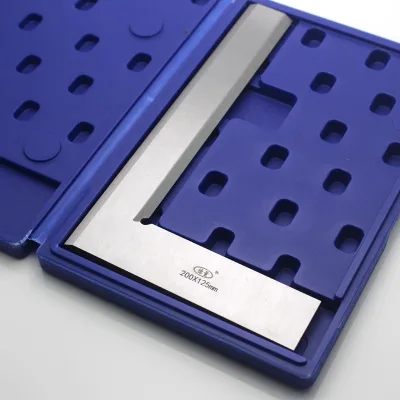
The physical form of the ruler is another critical specification. The product name "90 degree flat edge square" and the type "Straight Edge" suggest that these tools are designed for checking squareness and straightness simultaneously. The edge itself must be sharp and precise, often referred to as a "knife-edge," to allow for accurate contact with the workpiece. The standard size observed in the market includes 300*200mm dimensions, while other variants exist in ranges like 50~75mm or 0~300mm. When evaluating a potential supplier, buyers must verify that the stated material matches the rust-proof requirement, as some listings may offer carbon steel with a "Nature" color finish, which implies a lack of protective coating unless explicitly stated otherwise.
Compliance, Certification, and Standard Verification
In the B2B procurement of precision measuring instruments, compliance with international and regional standards is non-negotiable. The data indicates that products may carry certifications such as ISO, GB, ANS, DIN, and JIS. These acronyms represent distinct regulatory frameworks: ISO for international standardization, GB for Chinese national standards, ANS likely referring to American National Standards, DIN for German Institute for Standardization, and JIS for Japanese Industrial Standards. A rust-proof knife-edge ruler intended for export or use in regulated industries must demonstrate compliance with the specific standard required by the buyer's region or industry sector.
It is essential to distinguish between the product's origin and the standards it claims to meet. The observed data lists origins in Zhejiang and Hebei, China. While these regions are known for manufacturing hubs, the location itself does not guarantee compliance. Buyers must request documentation proving that the specific batch of rulers adheres to the claimed standards. For instance, a ruler claiming to meet DIN standards must undergo testing protocols defined by the Deutsches Institut für Normung. Similarly, ISO certification implies adherence to quality management systems, but it does not automatically certify the physical dimensions of every individual ruler.
The standardization of the product itself is also evident in the listed specifications. Some products reference a "prod_standard" of 17cm, while others list 6"/12" or 8"/200mm. These variations highlight the need for buyers to verify that the standard cited in the product description matches the actual physical dimensions and tolerance classes required for their specific application. A mismatch between the claimed standard and the actual product can lead to significant errors in quality control processes. Furthermore, the "Precision Measuring Device" attribute suggests that these tools are subject to rigorous calibration, and buyers should ensure that the supplier provides traceable calibration certificates linked to the relevant standards.
Cost Drivers and Pricing Structure Analysis
The pricing of rust-proof knife-edge rulers is influenced by a complex interplay of material costs, manufacturing techniques, and order volume. The observed price range in the market spans from $0.17 to $150, a vast disparity that reflects differences in quality, material, and precision. The lower end of this spectrum likely corresponds to basic carbon steel or cast iron rulers with minimal surface treatment, while the higher end encompasses stainless steel models with high-precision grinding and specialized coatings.
Material selection is a primary cost driver. Stainless steel is significantly more expensive than carbon steel or cast iron due to the alloying elements required for corrosion resistance. Additionally, the manufacturing process plays a crucial role. The data mentions "Casting" as a technique, which is generally less precise and cost-effective for high-tolerance tools compared to grinding or machining. However, casting may be used for the base structure, with the knife-edge being machined to exact specifications. The presence of "Surface Treatment" as a product attribute indicates an additional cost layer; processes such as polishing, coating, or plating are necessary to achieve the "rust-proof" claim, especially for non-stainless materials.
Order volume is another critical factor in cost determination. The Minimum Order Quantity (MOQ) ranges from 1 piece to 5,000 pieces. Buyers purchasing small quantities, such as single items or small batches, will face a higher unit cost due to the fixed costs of setup and packaging. Conversely, bulk orders can leverage economies of scale, reducing the per-unit price. The packaging method also affects cost; options like "1PC/OPP Bag" or "1PC/Blister Card" are standard for individual sales, while "300PCS/Carton" suggests bulk industrial packaging. Buyers should evaluate the total cost of ownership, including shipping and handling, rather than focusing solely on the unit price, as the latter can be misleading when comparing suppliers with different MOQ structures.
Typical Applications and Functional Requirements
The functional applications of rust-proof knife-edge rulers are diverse, spanning from general transportation and machine parts manufacturing to specialized building and construction tasks. The data explicitly lists "Transportation" and "Machine Parts" as primary application areas. In these sectors, the rulers are used to verify the straightness of shafts, the flatness of machine beds, and the squareness of assembly components. The "90 degree flat edge square" designation suggests that these tools are particularly valuable for ensuring right-angle accuracy in structural assemblies.
In the construction industry, the function of "Building Walls" indicates the use of these rulers for checking the plumb and level of wall structures. The "Outside Diameter" measurement capability suggests that these tools can also be used in conjunction with other measuring devices to assess cylindrical components. The "Resolution" of 0.01mm and "Precision" of 0.015mm are critical for applications requiring high accuracy, such as in the aerospace or automotive industries where even minor deviations can compromise safety and performance.
The "Measure Method" is listed as "Manual," which implies that these tools are designed for direct human operation rather than automated integration. This manual nature requires operators to have a high level of skill and understanding of the tool's limitations. The "Range" of 0~300mm or 50~75mm dictates the size of the workpieces that can be effectively measured. Buyers must ensure that the selected ruler's range matches the dimensions of the objects they intend to inspect. For instance, a ruler with a 300mm range may be insufficient for large-scale construction projects, while a 50mm ruler might be too small for general machine part inspection.
Supplier Evaluation and Customization Capabilities
Evaluating a supplier for rust-proof knife-edge rulers requires a thorough assessment of their customization capabilities and production flexibility. The data indicates that "Customization" and "Customized support" are available, with "OEM" (Original Equipment Manufacturer) services explicitly mentioned. This suggests that suppliers can tailor product specifications, such as length, material, or packaging, to meet specific buyer requirements. For example, a buyer might require a ruler with a specific length not listed in standard catalogs or a unique packaging format for their distribution network.
The "Brand name" attribute is listed as "no" in some entries, indicating that many suppliers operate as white-label manufacturers. This is common in the B2B sector, where buyers prefer to brand the products themselves. However, the lack of a brand name does not imply a lack of quality; rather, it highlights the need for buyers to rely on technical specifications and certifications rather than brand reputation. Buyers should verify the supplier's ability to maintain consistency in quality across different batches, especially when customizing materials or dimensions.
The "Place of origin" is listed as Zhejiang and Hebei, China, which are major manufacturing regions. While these locations offer access to a robust supply chain, buyers should conduct on-site audits or request third-party inspection reports to verify the supplier's production capabilities. The "Warranty" period of 3 months is a standard offering, but buyers should negotiate longer terms for high-volume or critical applications. Additionally, the "Selling Units" being "Single item" suggests that suppliers are flexible with order sizes, but buyers should confirm if there are any hidden costs associated with small orders, such as higher shipping fees or minimum handling charges.
Quality Control and Long-Term Procurement Considerations
Quality control is paramount when sourcing precision measuring instruments. The "Precision Grade" and "Accuracy" attributes, such as "0class /1class" and "A," serve as benchmarks for quality. Buyers should implement a rigorous quality control protocol that includes receiving inspections, random sampling, and periodic calibration checks. The "Resolution" of 0.01mm requires that the tools be handled with care to prevent damage that could compromise their accuracy. Storage conditions are also critical; even rust-proof materials can degrade if exposed to harsh chemicals or extreme humidity over extended periods.
Long-term procurement considerations involve building a sustainable relationship with suppliers who can consistently deliver high-quality products. The "MOQ" range of 1 to 5,000 pieces allows for flexibility, but buyers should aim to establish a steady demand to secure better pricing and priority production slots. The "prod_packing" options, such as "Carton Box" or "1PC/OPP Bag," should be evaluated for their ability to protect the product during transit and storage. For long-term contracts, buyers might negotiate for custom packaging that includes desiccants or anti-corrosion coatings to further enhance the rust-proof properties of the rulers.
Furthermore, the "Surface Treatment" attribute indicates that the supplier offers additional protective measures. Buyers should inquire about the specific treatments applied, such as oiling, lacquering, or passivation, and their effectiveness in preventing rust. Regular maintenance schedules should be established to ensure that the tools remain in optimal condition. By focusing on these quality control and long-term strategies, buyers can ensure that their investment in rust-proof knife-edge rulers delivers consistent value and reliability over time.
FAQs
What materials are used for rust-proof knife-edge rulers?
Stainless steel is the primary material for rust-proof applications due to its inherent corrosion resistance. While carbon steel and cast iron are also available, they typically require surface treatments to achieve similar protection against oxidation in humid environments.
Which certifications do these precision rulers typically hold?
Products often carry ISO, GB, ANS, DIN, and JIS certifications to ensure compliance with international and regional standards. Buyers must verify that the specific batch adheres to the claimed standard, as origin location alone does not guarantee compliance with these rigorous frameworks.
How precise are the measurements for these straight edge tools?
High-precision models offer resolutions as fine as 0.01mm with accuracy grades of 0class or 1class. The overall precision tolerance may be specified at 0.015mm, making them suitable for fine metrology and demanding industrial applications requiring strict dimensional stability.
Can suppliers provide customized options for these measuring devices?
Yes, customization and OEM support are available to tailor specifications like length, material, or packaging. Suppliers can adjust product dimensions to meet specific buyer requirements, though the lack of a brand name in some listings indicates a white-label manufacturing approach.
What is the typical price range for these industrial tools?
The market price ranges from $0.17 to $150, reflecting differences in material quality and precision levels. Stainless steel models with high-precision grinding cost more, while basic carbon steel or cast iron variants with minimal treatment are found at the lower end of the spectrum.
Which dimensions are standard for these flat edge squares?
Standard sizes include 300*200mm, 6 inches, 12 inches, and 200mm, with specific models like AM22335.008. Buyers should verify that the cited standard matches the actual physical dimensions and tolerance classes required for their specific application to avoid measurement errors.