Source Semi-Automatic Roll-to-Roll DTF Printer with Shaker for Apparel, Bags, and Caps
Find 30 Semi-Automatic Roll-to-Roll DTF Printer with Shaker options from verified suppliers. Compare specifications including print speed, ink types, and printhead models to select the right equipment for textile and promotional product printing.
Key considerations
Products List


Dtf Printer 60cm Dtf Printer Printing Automatic Machine All in One Dtf Printer
$7746.00 - $7988.00
MOQ: 1 Pieces


1.2m Wide Format Dtf I3200 8 Head Automatic Roll-to-Roll Printer 1-Year Warranty
$999.00 - $21150.00
MOQ: 1 Pieces


Support Local After-Sales Service Dtf Printer and Shaker System L3200 Head
$5099.00 - $5299.00
MOQ: 1 Pieces


Best Selling Roll Film Textile Printing Machine Roll to Roll Dtf Printer with Software Free
$13000.00 - $26000.00
MOQ: 1 Pieces
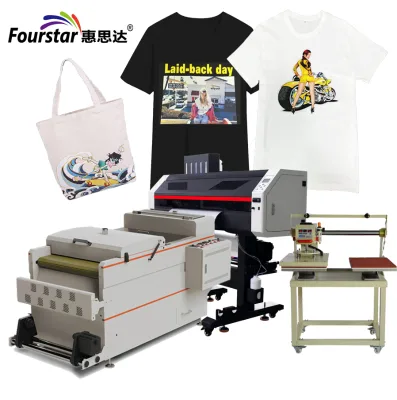


Best A3 Dtf Printer Printing Machine with Shaker for T Shirt Printing Price
$3000.00 - $3900.00
MOQ: 1 Pieces


2 XP600 60cm Dtf Printer with Shaker for T Shirt Printing for Small Business
$3800.00 - $5000.00
MOQ: 1 Pieces


Comprehensive Sourcing Guide
Strategic Sourcing Guide for Semi-Automatic Roll-to-Roll DTF Printers with Shaker Integration
Understanding the Core Technology and Market Position
The search for a semi-automatic roll-to-roll Direct-to-Film (DTF) printer with an integrated shaker represents a specific niche within the digital textile printing market. Unlike flat-bed printers designed for rigid substrates or small-format label printers, roll-to-roll systems are engineered for continuous media handling, essential for high-volume garment decoration and apparel manufacturing. The "semi-automatic" designation implies a workflow where the operator manages media loading, film tensioning, or powder application cycles, rather than a fully automated line that runs unattended. The inclusion of a shaker is critical for the DTF process, as it ensures the adhesive powder is evenly distributed across the printed ink before curing.
Based on observed market data, the equipment landscape for DTF printing includes a variety of configurations. Some units are identified as "A1 All-in-One DTF Printers" with dimensions around 1920mm in length, while others are compact models like the "DTF-300" with a width of approximately 30cm. The observed price range for these systems spans from $320 to $26,000, indicating a vast difference in capabilities, build quality, and automation levels. Buyers must distinguish between entry-level desktop units and industrial-grade semi-automatic roll-to-roll systems. The latter typically feature larger print widths, such as the 600mm or 620mm maximum print sizes observed in models like the JT-A1 DTF-6002A, and are designed to handle rolls of PET film rather than individual sheets.
Technical Specifications and Hardware Configuration
When evaluating a semi-automatic roll-to-roll DTF printer, the technical specifications serve as the primary filter for suitability. The print head is the most critical component determining print quality and durability. In the current market, the Epson i3200-A1 printhead is a prevalent standard, often configured in dual or multi-head setups (e.g., 2 to 4 PCS) to increase throughput. Some observed configurations utilize the Epson Tx600, which may be suitable for smaller formats but less ideal for high-speed roll-to-roll production. The printing accuracy is typically defined in DPI, with observed ranges including 720x1200, 720x1800, and 720x2400 dpi. Higher DPI settings generally yield finer detail but may reduce printing speed.
The printing speed is another vital metric. Data indicates that speeds can vary significantly based on the number of passes. For instance, a 4-pass configuration might achieve 13 square meters per hour, while an 8-pass configuration could drop to 9 square meters per hour. Other observed speeds range from 3 to 12 square meters per hour for flat-bed variants, but roll-to-roll systems generally prioritize continuous flow. The ink system is equally important; the standard configuration involves CMYK (Cyan, Magenta, Yellow, Black) plus White (W) ink. The ink type is typically water-based or specifically formulated DTF ink, with cartridge capacities observed at 1.5 liters per color. The RIP software, such as Maintop, Print Factory, or Photo Print, is essential for managing color profiles and print queues, and compatibility with Windows XP or Windows 10/64-bit systems must be verified.
The Role of the Shaker and Powder Application Systems
The integration of a shaker is a defining feature for DTF printers intended for garment production. The shaker's function is to apply adhesive powder uniformly over the wet ink on the PET film. In a semi-automatic setup, the operator often places the printed film onto a conveyor or into a shaker unit, where the powder is dispensed and shaken to cover the ink. The quality of this application directly impacts the bond strength of the transfer to the fabric. While specific shaker dimensions are not universally standardized in the provided data, the overall machine footprint is substantial. For example, the JT-A1 DTF-6002A model has a standard size of 1920mm x 760mm x 1470mm, suggesting a large footprint that likely accommodates a shaker unit within the workflow.
Buyers should verify the mechanism of the shaker. Is it a vibrating tray, a rotating drum, or a manual shaking station? The semi-automatic nature suggests that the operator may need to manually load the film into the shaker or manage the powder recycling process. The net weight of the machine is a proxy for its stability; observed weights range from 120 kg to 180 kg. A heavier machine, such as the 180 kg model, likely offers better stability during the shaking process, reducing vibration-induced misalignment. The media type is consistently identified as DTF PET film, and the system must support the specific width of the film roll, which can range from A3+ (30cm) to A1 (600mm).
Cost Drivers and Procurement Economics
The cost of a semi-automatic roll-to-roll DTF printer with a shaker is influenced by several factors, including print head count, automation level, and build quality. The observed price range of $320 to $26,000 reflects the diversity of the market. The lower end of the spectrum likely corresponds to small-format, semi-automatic desktop units or those with older printhead technology. The higher end, approaching $26,000, likely represents industrial-grade semi-automatic systems with multiple i3200 heads, advanced RIP software, and integrated curing or shaker units.
Beyond the initial purchase price, buyers must consider the cost of consumables and maintenance. The ink cartridge capacity of 1.5 liters per color suggests a system designed for moderate to high volume, but the cost per square meter of ink and powder must be calculated. The power requirement is typically 110/220V, which is standard for industrial equipment, but the specific wattage and energy consumption should be verified to ensure compatibility with local electrical infrastructure. The lead time for these machines is observed to be between 3 and 15 days, which is relatively short, allowing for quick deployment. However, the shipping dimensions, such as 1889774cm or 17857901613mm, will impact logistics costs and warehouse space requirements.
Compliance, Certification, and Safety Standards
Compliance and certification are critical for B2B procurement, ensuring that the equipment meets safety and environmental standards. While the provided data mentions "CE" as a potential certification, it is listed as low-confidence background information. Buyers should not assume that every listed product is CE certified. Instead, procurement teams must request specific certification documents from the supplier. The CE mark indicates conformity with health, safety, and environmental protection standards for products sold within the European Economic Area. Other relevant standards may include ISO certifications for quality management or electrical safety standards like UL or ETL for North American markets.
The physical standards of the machine, such as the dimensions 1920mm760mm1470mm, are manufacturing specifications rather than safety certifications. However, the packaging standard, often a "Wooden Box" or "Wooden Case," is important for ensuring the machine arrives without damage. The origin of the products is frequently listed as Guangzhou, China, or generally China. While this is a major manufacturing hub, buyers should verify the specific factory location and request proof of origin to ensure supply chain transparency. Safety features, such as emergency stop buttons, electrical grounding, and fume extraction requirements for the shaker and curing process, must be explicitly confirmed in the product specifications.
Supplier Evaluation and Quality Control Protocols
Evaluating suppliers for semi-automatic DTF printers requires a rigorous approach. With 30 products observed in the market, the selection process must focus on the supplier's ability to provide consistent quality and after-sales support. Key evaluation criteria include the supplier's response time, technical support capabilities, and warranty terms. Since the data does not provide specific supplier names, buyers should look for manufacturers who offer comprehensive documentation, including user manuals, software installation guides, and maintenance schedules.
Quality control should be implemented at multiple stages. First, verify the hardware specifications against the supplier's claims. For example, confirm that the printhead is indeed the Epson i3200-A1 and not a generic equivalent. Second, request sample prints to test the print quality, color accuracy, and powder adhesion. The printing speed should be tested under real-world conditions to ensure it matches the claimed 3-12 m2/h or 13 m2/h rates. Third, inspect the build quality of the shaker and the conveyor system. The net weight of the machine, observed between 120 kg and 180 kg, can be a quick indicator of build robustness; lighter machines may be prone to vibration issues during operation. Finally, check the software compatibility with the buyer's existing operating system, whether Windows XP, Windows 10, or 64-bit variants.
Long-Term Procurement and Operational Considerations
Long-term procurement considerations extend beyond the initial purchase to include maintenance, scalability, and workflow integration. The semi-automatic nature of the printer means that labor costs and operator training are significant factors. The workflow involves loading the film, printing, applying powder in the shaker, curing, and peeling the transfer. Each step requires skilled labor, and the efficiency of the process depends on the synchronization of these steps. Buyers should consider whether the semi-automatic system can be upgraded to a fully automatic line in the future, or if the current configuration is sufficient for their production volume.
The maintenance requirements for the printhead and ink system are also crucial. Water-based inks and DTF inks can be prone to clogging if the printer is not used regularly. Buyers should inquire about the recommended cleaning procedures and the availability of spare parts, such as printheads, ink pumps, and shaker components. The lead time of 3-15 days suggests that replacement parts should be available relatively quickly, but this should be confirmed with the supplier. Additionally, the environmental impact of the ink and powder waste should be considered, especially if the buyer operates in a region with strict environmental regulations.
Comparative Analysis of Key Specifications
To assist in the decision-making process, the following table summarizes the key technical specifications observed in the market for DTF printers, highlighting the variations that buyers must evaluate.
| Feature | Low-End / Compact Model | Mid-Range / Semi-Auto Model | High-End / Industrial Model |
|---|---|---|---|
| Print Width | A3+ / 30cm | A1 / 600mm | 620mm / Roll-to-Roll |
| Printhead | Epson Tx600 | 2 PCS I3200-A1 | 2-4 PCS EPS I3200-A1 |
| Printing Speed | ~4 m²/h (6 Pass) | 3-12 m²/h | 13 m²/h (4 Pass) |
| Ink Type | Water Based / CMYKWW | DTF Inks (C,M,Y,K+W) | DTF Inks (C,M,Y,K+W) |
| Net Weight | ~120 Kg | ~120-180 Kg | ~180 Kg |
| Structure | Platen Press | Flat-bed Cylinder Press | Platen Press / Roll-to-Roll |
| Software | Windows XP | Maintop/Print Factory | Maintop/Print Factory |
| Dimensions | 980630530mm | 17667501513mm | 19207601470mm |
This comparison illustrates the trade-offs between size, speed, and cost. Buyers must align these specifications with their specific production needs. A small shop may find the A3+ model sufficient, while a large garment manufacturer will require the roll-to-roll capabilities and higher print speeds of the industrial models. The integration of the shaker is a common requirement for all DTF applications, but the efficiency of the shaker unit varies by model.
In conclusion, sourcing a semi-automatic roll-to-roll DTF printer with a shaker requires a careful balance of technical requirements, budget constraints, and long-term operational goals. By rigorously verifying specifications, demanding proper certifications, and evaluating supplier reliability, buyers can secure equipment that enhances their production capabilities and ensures consistent print quality. The market offers a wide range of options, from compact desktop units to large industrial systems, and the decision should be driven by a clear understanding of the specific workflow and volume requirements of the business.
FAQs
What printhead models are used in semi automatic roll to roll dtf printers?
These printers typically use Epson i3200-A1 printheads, often configured in sets of two to four units. Some compact models may utilize Epson Tx600 heads, but the i3200-A1 is the standard for higher quality and speed in industrial applications.
How much does a Semi-Automatic Roll-to-Roll DTF Printer with Shaker cost?
The price range for these systems spans from 320 to 26000 USD depending on specifications. Lower costs usually reflect smaller formats or fewer printheads, while higher prices indicate industrial-grade units with advanced automation and larger print widths.
Which ink types are compatible with semi automatic roll to roll dtf printers?
The standard ink configuration includes Cyan, Magenta, Yellow, Black, and White in a water-based or specific DTF formulation. Cartridge capacities are often 1.5 liters per color, ensuring sufficient supply for continuous production runs on PET film media.
Can these printers handle A1 size media for large format printing?
Yes, many models support maximum print sizes of A1 or 600mm, suitable for large format applications. Specific models like the JT-A1 DTF-6002A are designed to accommodate this width, making them ideal for extensive garment decoration tasks.
What is the typical lead time for ordering a semi automatic roll to roll dtf printer?
The lead time generally ranges from 3 to 15 days for production and preparation. This duration allows for manufacturing and packaging, often in wooden boxes, before shipping from origins like Guangzhou, China, to the buyer's location.
How is the printing speed affected by the number of passes?
Printing speed varies significantly based on pass settings, ranging from 3 to 13 square meters per hour. A 4-pass configuration can achieve up to 13 m2/h, while an 8-pass setup may reduce speed to 9 m2/h for higher detail.
What software systems are supported by these semi automatic roll to roll dtf printers?
These machines typically support RIP software such as Maintop, Print Factory, or Photo Print for color management. Operating system compatibility often includes Windows XP, Windows 10, or 64-bit variants, ensuring integration with standard desktop environments.