Source Semi-Automatic Puzzle Parking Equipment for Residential, Commercial, and Public Parking
Compare 22 semi-automatic puzzle parking equipment options featuring PLC control and hydraulic lifting for residential, commercial, and public parking needs. These systems offer customizable levels, safety sensors, and efficient space utilization.
Key considerations
Products List


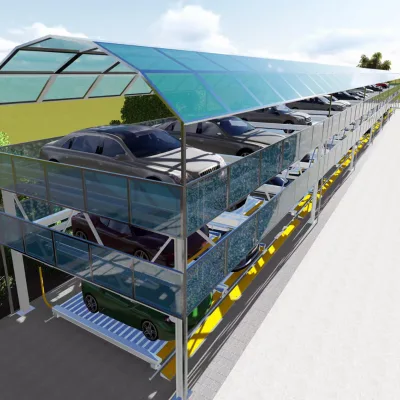
Smart Car Parking Equipment Semi Automatic Vertical Puzzle Parking System
$8200.00 - $8800.00
MOQ: 1 sets


Hydraulic Parking Equipment Semi-Automatic Smart Puzzle Parking System
$2000.00 - $5000.00
MOQ: 5 unit/units

Hydraulic Garage Equipment Semi-Automatic Puzzle Car Parking System
$2000.00 - $5000.00
MOQ: 5 unit/units

$2000.00 - $5000.00
MOQ: 5 unit/units

Multilevel Independent Parking Four-Level Smart Space-Saving Puzzle Car Parking Equipment
$2000.00 - $5000.00
MOQ: 5 unit/units

Semi-Automated Parking Systems Lift-Slide Puzzle and Pit parking system
$1800.00 - $2500.00
MOQ: 5 Pieces


Multiparking Efficient Car Puzzle Parking Equipment with Quasi Unmanned Features
$1360.00 - $1580.00
MOQ: 50 Sets


12 Story Puzzle Parking Equipment with Automatic Access Control and License Plate Recognition
$3600.00 - $4000.00
MOQ: 1 Pieces

7 11 Story Puzzle Parking Equipment with Automatic Access Control and License Plate Recognition
$2600.00 - $3000.00
MOQ: 1 Pieces

Automatic Puzzle Parking System with Intelligent Control and Space Saving Performance
$1500.00 - $3000.00
MOQ: 1 Pieces
Comprehensive Sourcing Guide
Strategic Sourcing Guide for Semi-Automatic Puzzle Parking Equipment with PLC Control
Understanding the Technical Architecture of Puzzle Parking Systems
The core keyword, semi-automatic puzzle parking equipment with PLC control, refers to a sophisticated class of mechanical parking solutions designed to maximize vertical space utilization in urban environments. These systems, often categorized under the BDP series or similar designations, operate on a "puzzle" principle where parking bays are arranged in a grid that allows vehicles to be moved horizontally and vertically to create access paths. The defining technical characteristic is the integration of a Programmable Logic Controller (PLC) system, which manages the complex coordination of hydraulic drives, wire ropes, and safety sensors.
In the observed market data, the control architecture frequently utilizes an Omron PLC system, ensuring high reliability and precise timing for lifting and sliding operations. The lifting mechanism typically combines a hydraulic cylinder with wire rope technology, providing a robust method for raising and lowering vehicles. The driving force is hydraulic, allowing for smooth acceleration and deceleration, which is critical for the safety of both the vehicle and the structure. The system supports multiple operation modes, including manual, automatic, and quasi-unmanned operation, often controlled via buttons and IC cards. This flexibility allows facility managers to choose between fully automated access for high-volume commercial areas or semi-automatic modes for residential settings where user intervention might be preferred.
The physical design of these units is predominantly a four-post structure, constructed from high-grade aluminum to balance strength with weight considerations. The surface treatment is a critical aspect of the manufacturing process, with hot spray galvanization and powder coating (or power coating) being the standard finishes. These treatments ensure resistance against corrosion, particularly in outdoor environments where the equipment is exposed to the elements. The system is designed to accommodate specific vehicle dimensions, with observed specifications indicating a maximum available car length of 5070mm and a width of 1950mm. The lifting speed varies across different models, ranging from 8 to 120 meters per minute, while sliding speeds are generally observed around 8 meters per minute.
Compliance, Certification, and Safety Standards
When sourcing semi-automatic puzzle parking equipment, verifying compliance with international standards is non-negotiable. The supplied product facts indicate that reputable manufacturers in this sector typically hold CE and ISO certifications, specifically ISO9001 for quality management systems. These certifications are not merely marketing labels but represent adherence to rigorous design and manufacturing protocols. Buyers must verify that the specific unit being procured carries valid CE marking, which is a legal requirement for selling machinery within the European Economic Area, and ISO certification, which validates the manufacturer's quality control processes.
Safety is paramount in automated parking systems due to the heavy loads involved and the proximity of vehicles to moving machinery. The observed product attributes highlight several critical safety features that must be present in the equipment. These include safety sensors to detect obstructions, safety railings to prevent falls, and overload protection mechanisms to prevent structural failure. An emergency stop button is a mandatory feature, allowing for immediate system shutdown in case of a malfunction. Additionally, anti-slip surfaces on the vehicle platforms are essential to prevent vehicles from shifting during operation.
A specific focus must be placed on the falling prevention devices. The market data lists two distinct types: an anti-falling frame and a shaft-based prevention device. Buyers should confirm which specific mechanism is integrated into the unit they are purchasing, as this is the primary fail-safe against catastrophic failure. The working mode, described as "quasi-unmanned" or utilizing a button and IC card interface, implies a level of automation that still requires human oversight or interaction, necessitating clear safety protocols for users. The voltage requirements are typically standardized at 380V, 3-phase, though customized options may be available for specific regional power grids.
Cost Drivers and Pricing Variables
The pricing for semi-automatic puzzle parking equipment is influenced by a complex matrix of technical specifications, customization levels, and logistical factors. The observed price range in the market spans from $1,360 to $16,000 USD, a significant variance that reflects differences in system capacity, number of parking spaces, and the level of automation. The primary cost driver is the number of parking spaces, with the observed data indicating a capacity of 2000 kg to 2500 kg per space. Systems with higher lifting speeds, such as those reaching 120 meters per minute, will naturally command a higher price point compared to slower, more energy-efficient models operating at 8-12 meters per minute.
Customization is a major factor in the final cost. The product attributes confirm that customization is available, which can include modifications to the voltage, control systems, or structural dimensions to fit specific site constraints. The design of the system, whether it is a standard four-post configuration or a specialized puzzle layout, also impacts the price. Furthermore, the material costs, particularly the use of aluminum and the extensive surface treatment processes like hot spray galvanization, contribute significantly to the base cost.
Logistics and packaging play a substantial role in the total landed cost. The observed data specifies a standard export packing method and notes that a 40-foot container can load approximately 17 parking spaces. This containerization efficiency is a key metric for buyers to consider when calculating shipping costs. The gross weight of the equipment, listed as 1200kg per parking space, directly influences freight charges. Buyers should also consider the Minimum Order Quantity (MOQ), which ranges from 1 to 50 units. Purchasing a single unit for a small residential project will have a different cost structure per unit compared to a bulk order of 50 units for a large commercial complex.
Typical Applications and Site Suitability
Semi-automatic puzzle parking systems are versatile solutions designed for a wide range of environments, as indicated by the "Suitable for" attributes covering residential use, public parking, and commercial use. In residential settings, these systems are ideal for high-density apartment complexes where land is scarce, and maximizing the number of available parking spots is crucial. The quasi-unmanned operation mode is particularly well-suited for residential areas, offering a balance between automation and user control.
For public parking facilities, such as those near shopping centers, hospitals, or government buildings, the high capacity and reliability of the PLC-controlled system are essential. The ability to handle a high volume of vehicles with lifting speeds up to 120 meters per minute ensures that customers experience minimal wait times. The system's design allows for head-in or back-in vehicle entry, providing flexibility in how vehicles are parked and retrieved. This adaptability is a significant advantage in public spaces where traffic flow patterns can be unpredictable.
Commercial use cases, including office buildings and industrial parks, benefit from the robustness of the hydraulic drive and the durability of the aluminum construction. The system's capacity to handle vehicles up to 5070mm in length and 1950mm in width makes it suitable for a broad spectrum of vehicle types, from compact cars to larger SUVs and light commercial vehicles. The available levels, ranging from 2 to 15, allow for vertical expansion, making these systems scalable for future growth. The installation types, including underground, surface mount, and multi-level configurations, further expand the range of potential applications, allowing for integration into existing structures or new builds.
Supplier Evaluation and Verification Protocols
Evaluating suppliers for semi-automatic puzzle parking equipment requires a rigorous approach to ensure the quality and reliability of the machinery. The first step is to verify the supplier's location and origin. The observed data points to Qingdao, China, as a significant manufacturing hub for these systems. Buyers should confirm the specific origin of the equipment to understand the logistics and potential import duties. It is also crucial to verify the supplier's ability to provide after-sales services, such as installation supervision, which is listed as a standard offering.
The supplier's certification status must be validated. Buyers should request current copies of CE and ISO9001 certificates and verify their authenticity with the issuing bodies. The presence of these certifications indicates that the manufacturer adheres to international quality and safety standards. Additionally, buyers should inquire about the warranty period, with the observed data suggesting a standard 12-month warranty. It is important to clarify the scope of this warranty, including what components are covered and the terms for claims.
The supplier's production capacity and lead time are also critical evaluation criteria. While specific lead times are not provided in the data, buyers should request detailed timelines for manufacturing, testing, and shipping. The ability to customize the equipment, such as adjusting the voltage or control system, should be confirmed, along with any additional costs or time delays associated with these modifications. The supplier's experience with the specific BDP series or similar models should be assessed, as familiarity with the design leads to better performance and fewer technical issues.
Quality Control and Long-Term Procurement Considerations
Quality control is a continuous process that begins at the manufacturing stage and extends through the installation and operation of the equipment. The use of hot spray galvanization and powder coating as finishing processes is a strong indicator of a commitment to durability. Buyers should verify that these processes are applied consistently across all components, particularly the structural posts and vehicle platforms. The use of aluminum as the primary material offers a balance of strength and weight, but the quality of the alloy and the precision of the fabrication must be inspected.
The control system, specifically the Omron PLC, is the brain of the operation. Buyers should ensure that the PLC is programmed to handle all safety scenarios, including sensor failures and power outages. The integration of safety features such as the anti-falling frame or shaft, overload protection, and emergency stop buttons must be tested thoroughly before the system is commissioned. The lifting and sliding speeds should be calibrated to ensure smooth operation without excessive vibration or noise.
Long-term procurement considerations include the availability of spare parts and the supplier's commitment to ongoing support. The 12-month warranty is a starting point, but buyers should negotiate extended service agreements to cover the lifespan of the equipment. The ability to upgrade the control system or add new safety features as technology evolves is also a valuable consideration. Finally, the total cost of ownership, including energy consumption and maintenance costs, should be calculated. The power range of 4-15kw indicates that energy efficiency is a factor, and buyers should compare the power requirements of different models to minimize operational costs over time.
Summary of Key Technical Specifications
| Attribute | Observed Specification / Range |
|---|---|
| Product Model | BDP series / BDP |
| Control System | Omron PLC System |
| Operation Mode | Manual, Automatic, Quasi Unmanned |
| Power Source | Solar, Electric, Battery |
| Voltage | 380V, 3p / Customized |
| Power Consumption | 4-15kw |
| Lifting Speed | 8-120 M/Min (varies by model) |
| Sliding Speed | 8m/Min |
| Lift Mode | Hydraulic Cylinder + Wire Rope |
| Driving System | Hydraulic |
| Material | Aluminum |
| Surface Treatment | Hot Spray Galvanized, Powder Coating |
| Design | Four Post, Puzzle Parking |
| Available Levels | 2-15 |
| Capacity | 2000 Kg / 2500 Kg |
| Max Car Length | 5070mm |
| Max Car Width | 1950mm |
| Safety Features | Safety Sensors, Anti-Falling Frame/Shaft, Overload Protection |
| Certification | CE, ISO9001 |
| Warranty | 12 Months |
| Origin | Qingdao, China |
| Container Load | 17 Parking Spaces / 40FT |
This comprehensive guide provides a structured approach to sourcing semi-automatic puzzle parking equipment with PLC control. By focusing on technical specifications, compliance, cost drivers, and supplier evaluation, buyers can make informed decisions that ensure the long-term success and safety of their parking infrastructure projects.
FAQs
What is the maximum car size supported by this equipment?
The system supports vehicles up to 5070mm in length and 1950mm in width. This capacity accommodates most standard passenger cars and light commercial vehicles within the specified dimensions.
Which certifications are required for this parking system?
The equipment typically holds CE and ISO9001 certifications. These standards ensure compliance with international safety and quality management protocols for machinery manufacturing.
How many parking spaces fit in a 40-foot container?
A 40-foot container can load approximately 17 parking spaces. This density helps optimize shipping logistics and reduces the overall cost per unit for international buyers.
Can the system be customized for specific voltage requirements?
Yes, customization is available for voltage settings including 380V 3-phase or other customized options. This flexibility allows the system to adapt to different regional power grid standards.
What is the standard warranty period for this equipment?
The standard warranty period is 12 months. This coverage typically includes support for mechanical and electrical components under normal operating conditions.
Which installation types are available for this puzzle system?
Available installation types include underground, surface mount, and multi-level configurations. These options allow the system to be integrated into various site layouts and structural constraints.
What safety features are included in the lifting mechanism?
Safety features include overload protection, emergency stop buttons, and anti-falling frames or shafts. These mechanisms ensure safe operation and prevent accidents during vehicle lifting and sliding.