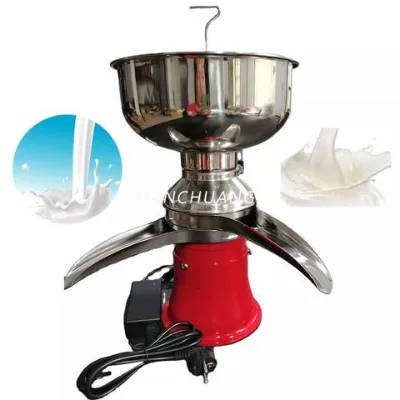
Source Stainless Steel Milk Cream Separator for Cheese Yogurt Milk Powder
Find 30 listings for the Stainless Steel Milk Cream Separator to compare specifications like capacity, voltage, and separation phases. Buyers can evaluate options for processing milk, cheese, yogurt, and milk powder in food and beverage factories.
Key considerations
Products List

Stainless Steel Milk Cream Separator Centrifugal Milk Cream Separator
$27000.00 - $28500.00
MOQ: 1 Pieces


High Efficiency Disc Centrifuge Separator for Milk Cream Separation
$8800.00 - $13800.00
MOQ: 1 Pieces


Factory Directly Supply Disc Stack Centrifuge Separator Milk Cream Separator
$9800.00 - $13800.00
MOQ: 1 Pieces




Comprehensive Sourcing Guide
Strategic Sourcing Guide for Stainless Steel Milk Cream Separators
The global demand for dairy processing equipment has driven the need for precise, reliable, and hygienic machinery capable of handling high-volume liquid processing. For procurement professionals seeking a Stainless Steel Milk Cream Separator, the decision-making process extends beyond simple price comparison. It requires a deep understanding of technical specifications, material integrity, certification compliance, and the specific operational context of the intended facility. This guide provides a structured approach to evaluating potential suppliers and selecting the right equipment, grounded in verified product attributes and industry standards.
Technical Specifications and Operational Capabilities
When evaluating a Stainless Steel Milk Cream Separator, the primary focus must be on the machine's ability to perform liquid-liquid and liquid-liquid-solid separation with high efficiency. The core function of these units is to separate cream from milk, or to process yogurt and milk powder, often requiring a two-phase or three-phase separation capability. Buyers should verify that the selected model supports an automatic grade of operation, ensuring continuous and automated processing which is critical for maintaining throughput in commercial dairy environments.
Power requirements vary significantly across different models and regions. Observed specifications indicate that units may operate on voltages such as 318V, 380V, 220V, or 480V at 50Hz, with some models offering customized voltage options to match local grid infrastructure. The power source is consistently electric, necessitating a robust control system. Most modern units are equipped with a PLC (Programmable Logic Controller) control box, which allows for precise automation and monitoring of the separation process. The control plate is often customizable, enabling operators to tailor the interface to specific workflow requirements.
Capacity is another critical technical parameter. Available data suggests that processing capacities can range from 5 cubic meters per hour to larger systems handling volumes between 500 and 5000 liters. The physical dimensions of the machinery also vary, with some models adhering to specific standard sizes such as 12009501400CM, while others are customized to fit existing factory layouts. The separation phase capability is a key differentiator; some units are designed for two-phase separation (cream and skim milk), while others offer three-phase separation to include the removal of solid impurities.
Material Integrity and Construction Standards
The construction material of the separator is paramount for food safety and equipment longevity. The raw material for the machine body is typically specified as 304 or 316L food-grade stainless steel. This material selection is essential for resisting corrosion from acidic dairy products and ensuring that the equipment meets strict hygiene standards. The use of stainless steel also facilitates easier cleaning and maintenance, which is vital for preventing bacterial growth in dairy processing lines.
The internal components, such as the bearings, also require careful scrutiny. High-performance units often utilize SKF brand bearings or other famous brand bearings to ensure smooth operation under high-speed centrifugal forces. The choice of bearing directly impacts the vibration levels, noise, and overall lifespan of the separator. Additionally, the machine's condition should be verified as "New" to ensure that all components are within their optimal operational life and have not been subjected to prior wear and tear.
Compliance, Certification, and Safety Standards
Navigating the regulatory landscape is a non-negotiable aspect of sourcing industrial dairy equipment. Buyers must verify that the supplier provides valid certifications that align with international and local safety standards. Common certifications observed in the market include CE (Conformité Européenne) and ISO (International Organization for Standardization). Some listings may reference combined certifications like ISOCE, indicating adherence to both international quality management and European safety directives.
It is crucial to understand that certification status is not a universal guarantee for every listed product. Buyers should request specific documentation for the exact model they intend to purchase. The standard for the product may be "customized" or "depend on model," meaning that the compliance framework is often tailored to the specific application or export destination. For instance, the export area for these machines often includes regions like Peru, the USA, and Russia, each with its own set of regulatory requirements. Therefore, the buyer must confirm that the specific unit's certification covers the intended market of operation.
Cost Drivers and Procurement Economics
The price of a Stainless Steel Milk Cream Separator is influenced by a complex array of factors, including capacity, automation level, material grade, and customization requirements. The observed price range in the market spans from $80 to $100,000 USD, reflecting the vast difference between small-scale laboratory units and large industrial processing lines. Several key drivers contribute to this variance.
First, the capacity of the machine is a primary cost determinant. A unit with a capacity of 5 M3/H will likely be priced differently than a system capable of 5000L processing. Second, the level of customization significantly impacts the final cost. Options such as customized voltage, specific PLC control interfaces, and tailored dimensions add to the manufacturing complexity and price. Third, the inclusion of premium components, such as SKF bearings or advanced impurity filtration systems capable of reducing impurities to less than 1ppm or 2ppm, will increase the unit cost.
Minimum Order Quantity (MOQ) is another economic factor to consider. In many cases, the MOQ for these specialized machines is as low as 1 unit, allowing for single-unit procurement for pilot plants or small factories. However, buyers should be aware that lead times and shipping costs, particularly for heavy machinery packed in wooden cases or wood cartons, can vary based on the destination and the specific dimensions of the unit.
Typical Applications and Industry Fit
Stainless steel milk cream separators are versatile machines designed for a wide range of applications within the food and beverage sector. The primary application is the separation of milk to produce cream, skim milk, and butter. However, the utility of these machines extends beyond basic dairy processing. They are also employed in the production of yogurt, milk powder, and cheese, where precise separation is required to achieve the desired texture and consistency.
The versatility of the separator is further highlighted by its ability to handle natural ingredients and process various liquid streams. Some models are designed for applications in energy and mining sectors, although the primary focus remains on food processing. The operation is typically automatic and continuous, making these units suitable for high-volume factories that require uninterrupted production cycles. The ability to adjust the cream percentage according to specific requirements allows manufacturers to produce a variety of dairy products from a single machine, enhancing operational flexibility.
Supplier Evaluation and Quality Assurance
Selecting the right supplier involves more than just reviewing product specifications; it requires a thorough evaluation of the supplier's capability to support the buyer throughout the lifecycle of the equipment. Key factors to consider include the availability of after-sales service, the quality of the packing, and the origin of the machinery.
After-sales support is critical for minimizing downtime. Suppliers should offer services such as video technical support, online assistance, and the availability of engineers to service machinery overseas. This global support network ensures that any technical issues can be resolved promptly, regardless of the buyer's location. The origin of the machine, often listed as Jiangsu, China, provides insight into the manufacturing hub, but buyers should verify the specific factory's track record and reputation.
Quality assurance also extends to the packaging and shipping process. Products are typically packed in wooden cases or wood cartons to protect the machinery during transit. Buyers should ensure that the packing standards are sufficient to prevent damage during long-distance shipping, especially when exporting to international markets. Additionally, the condition of the machine upon arrival should be verified to ensure it matches the "New" condition specified in the product listing.
Long-Term Procurement Considerations
Sourcing a milk cream separator is a long-term investment that requires careful planning for future maintenance and scalability. Buyers should consider the availability of spare parts, the ease of maintenance, and the potential for future upgrades. The use of standardized components, such as PLC control boxes and famous brand bearings, facilitates easier maintenance and reduces the risk of obsolescence.
Furthermore, the customization options available should be evaluated in the context of future production needs. If a buyer anticipates scaling up production, they should choose a supplier that offers modular upgrades or larger capacity models. The ability to customize the control plate and voltage settings ensures that the machine can adapt to changes in factory infrastructure or production requirements.
In conclusion, sourcing a Stainless Steel Milk Cream Separator requires a balanced approach that weighs technical specifications, material quality, certification compliance, and supplier reliability. By focusing on these core areas and verifying all claims against the provided product data, buyers can make informed decisions that ensure the long-term success of their dairy processing operations. The complexity of the equipment demands a rigorous evaluation process, but the result is a high-performance machine capable of meeting the demanding standards of the modern food industry.
FAQs
What certifications do stainless steel milk cream separators typically have?
These machines commonly hold CE and ISO certifications to ensure safety and quality standards. Some listings may show combined ISOCE marks, but certification status varies by model and should be verified for the specific unit intended for purchase.
Can the voltage and power source be customized for different regions?
Yes, the power source is electric and voltage options like 220V, 380V, or 480V are often available. Customized voltage is explicitly listed as an option to match local grid infrastructure and specific operational requirements.
Which materials are used to construct the separator body?
The machine body is typically constructed from 304 or 316L food-grade stainless steel. This material ensures resistance to corrosion and meets strict hygiene standards required for processing milk, yogurt, and cheese.
How is the separation phase capability defined for these units?
Separation capabilities include two-phase or three-phase options depending on the specific model. Two-phase separates cream and skim milk, while three-phase models can also remove solid impurities for higher purity.
What is the minimum order quantity for purchasing this equipment?
The minimum order quantity is typically one unit, allowing for single-unit procurement for pilot plants. This low MOQ supports small factories or specific testing needs without requiring bulk purchases.
Can the machine handle impurities effectively during the process?
Yes, the separator is designed to reduce impurities to less than 1ppm or 2ppm depending on the configuration. This high level of filtration ensures the final dairy products meet strict quality and safety standards.