Find Stainless Steel Patient Trolley for Hospital, Clinic, and Home Care
Explore 30 Stainless Steel Patient Trolley options designed for medical environments. Compare dimensions, layer configurations, and caster types to identify the right equipment for your facility's specific workflow and storage needs; compare the available evidence and request quotations based on your requirements.
Key considerations
Products List


Hospital Furniture 2 Sections Stainless Steel Patient Trolley for Emergency
$215.00 - $240.00
MOQ: 20 Pieces


Hospital Furniture Stainless Steel 2 Section Patient Stretcher Trolley
$215.00 - $240.00
MOQ: 20 Pieces

Hospital Equipment 2 Section Stainless Steel Medical Patient Trolley with IV Pole
$215.00 - $240.00
MOQ: 20 Pieces

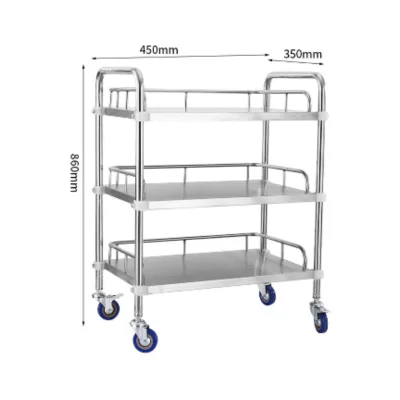


Hospital Furniture Clinic Equipment Stainless Steel Medical Instrument Trolley
$49.90 - $68.80
MOQ: 20 Pieces


Professional Manufacturer Stainless Steel Medical Trolley with Flat Plate
$363.00 - $768.00
MOQ: 1 Pieces

Stailess Steel Medical Trolley Hospital Medicine Trolley/Medicine Cart
$150.00 - $250.00
MOQ: 1 Pieces


Comprehensive Sourcing Guide
Stainless Steel Patient Trolley Sourcing Guide
Procuring stainless steel patient trolleys requires a disciplined approach to verifying material integrity and structural suitability for clinical environments. Buyers must distinguish between general-purpose utility carts and specialized medical equipment designed for specific patient care workflows. The observed product range includes models with varying layer configurations, from single-layer designs to three-layer units, indicating diverse functional requirements. Understanding these distinctions is critical for aligning procurement with actual hospital department needs, such as nursing stations or ambulance transport.
The market offers both customized and non-customized options, allowing facilities to tailor dimensions and features to their specific spatial constraints. High-confidence data indicates that many listings specify ABS materials for certain components, while others utilize stainless steel for the primary frame. This material mix affects durability, cleaning protocols, and overall lifecycle costs. Buyers should clarify whether the stainless steel designation applies to the entire structure or only specific load-bearing parts. Additionally, wheel types vary between swivel and fixed casters, which impacts maneuverability in tight corridors versus stability during transport.
Product Scope and Observed Listing Signals
The observed listings reveal a broad spectrum of trolley types, including nursing carts, hospital trolleys, and ambulance stretchers. Each category serves distinct operational purposes, from medication storage to patient transport. For instance, the MS-T220A model is identified as a nursing cart with a compact footprint, while the MS-S514 is a larger hospital trolley with adjustable height capabilities. Buyers must map these product types to their specific clinical workflows to avoid over-specifying or under-specifying equipment. Misalignment between product type and intended use can lead to inefficiencies and potential safety risks in patient care settings.
Weight and dimension data provide critical insights into logistical requirements and installation constraints. Observed net weights range from 4.9 kg for smaller units to 36 kg for larger, more robust models. Gross weights also vary significantly, impacting shipping costs and handling requirements. Dimensions such as 400400900mm for compact carts versus 2120800680-980mm for larger trolleys dictate storage and transport logistics. Buyers should verify that the selected trolley fits within existing facility infrastructure, including doorways, elevators, and storage areas. Ignoring these physical constraints can result in costly returns or the need for facility modifications.
Technical Specifications to Verify
Material composition is a primary technical specification that requires rigorous verification. While stainless steel is the core keyword, buyers must confirm the grade and thickness of the steel used. High-confidence facts indicate that some products specify stainless steel as the metal type, but others may use ABS for non-structural components. The choice of material affects corrosion resistance, ease of cleaning, and overall durability. Buyers should request material certificates to ensure that the stainless steel meets industry standards for medical equipment. This verification step is crucial for preventing premature degradation in high-humidity or chemical-heavy environments.
Structural specifications, including layer count and load capacity, must be aligned with intended usage. Observed listings include one-layer, two-layer, and three-layer configurations, each offering different storage capacities. Buyers should assess the maximum load per layer to ensure that the trolley can safely support the weight of medical supplies, equipment, or patients. Additionally, wheel type specifications, such as swivel versus fixed casters, impact maneuverability and stability. Swivel casters offer greater flexibility in tight spaces, while fixed casters provide better directional control. Buyers should test or simulate the trolley's movement in their specific facility layout to ensure optimal performance.
Compliance and Safety Documentation
Compliance with international safety and quality standards is non-negotiable for medical equipment procurement. High-confidence facts indicate that some products carry CE, FDA, and ISO certifications, which are essential for market access and regulatory approval. Buyers must verify that the specific model they are purchasing holds valid certifications for their target market. For example, FDA approval is required for products sold in the United States, while CE marking is necessary for the European Union. Requesting copies of these certificates and verifying their authenticity with the issuing bodies is a critical step in the procurement process.
Safety features, such as corrosion resistance and easy cleaning capabilities, are also important compliance considerations. Observed attributes highlight these features as key selling points, indicating that manufacturers prioritize hygiene and durability. Buyers should review the manufacturer's cleaning and maintenance guidelines to ensure that the trolley can be effectively sanitized in accordance with hospital infection control protocols. Additionally, warranty terms, such as the one-year warranty mentioned in some listings, provide a baseline for post-purchase support. Buyers should clarify the scope of the warranty, including what components are covered and the process for claiming repairs or replacements.
Cost Drivers and Commercial Terms
Pricing for stainless steel patient trolleys varies widely, with observed listed prices ranging from $1 to $768. This broad range reflects differences in material quality, size, complexity, and brand positioning. Buyers should not rely solely on the listed price but should request detailed quotations that break down costs for materials, labor, and shipping. Understanding the cost drivers allows buyers to negotiate more effectively and identify areas where value can be optimized. For instance, a higher-priced trolley may offer superior stainless steel grade or additional safety features that justify the premium.
Minimum Order Quantity (MOQ) requirements also impact procurement strategy and cash flow. Observed MOQs range from 1 to 100 pieces, with some listings specifying 50 or 100 pieces. Buyers should assess their inventory needs and budget constraints to determine the optimal order size. Ordering in bulk may reduce per-unit costs but ties up capital and storage space. Conversely, smaller orders offer greater flexibility but may result in higher per-unit prices. Buyers should negotiate payment terms, such as advance payments or milestone-based payments, to align with their cash flow cycles. Additionally, shipping terms, such as FOB or CIF, should be clearly defined to avoid unexpected costs.
Supplier Qualification and Quality Control
Supplier qualification is a critical factor in ensuring the reliability and consistency of Stainless Steel Patient Trolley procurement. Buyers should evaluate suppliers based on their manufacturing capabilities, quality control processes, and track record in the medical equipment industry. High-confidence facts indicate that some suppliers offer onsite training, which can be a valuable service for ensuring proper installation and usage. Buyers should request references from other healthcare facilities and review the supplier's quality management system, such as ISO 9001 certification, to assess their commitment to quality.
Quality control measures, including incoming material inspection, in-process checks, and final product testing, are essential for maintaining product integrity. Buyers should request detailed quality control plans and audit reports to verify that the supplier adheres to strict standards. Additionally, after-sales service, such as onsite training and technical support, can enhance the overall value of the procurement. Buyers should clarify the scope of after-sales service, including response times and availability of spare parts. Establishing a strong relationship with the supplier can facilitate smoother communication and quicker resolution of any issues that may arise during the product lifecycle.
Long-Term Procurement Checks
Long-term procurement strategies should focus on sustainability, scalability, and total cost of ownership. Buyers should consider the environmental impact of the materials used, such as the recyclability of stainless steel and ABS. Choosing suppliers with sustainable manufacturing practices can align with corporate social responsibility goals and reduce long-term environmental liabilities. Additionally, scalability is important for facilities that anticipate growth or changes in patient volume. Buyers should ensure that the supplier can accommodate increased order volumes without compromising quality or lead times.
Total cost of ownership includes not only the initial purchase price but also maintenance, repair, and replacement costs. Buyers should estimate the lifecycle costs of the trolley, including cleaning supplies, wheel replacements, and potential repairs. Regular maintenance can extend the lifespan of the trolley and reduce the frequency of replacements. Buyers should establish a maintenance schedule and train staff on proper care procedures to maximize the value of the investment. By considering these long-term factors, buyers can make more informed decisions that align with their strategic goals and budget constraints.
FAQs
What materials are used for stainless steel patient trolleys?
Stainless steel patient trolleys are primarily constructed from stainless steel to ensure durability and hygiene. Some models may incorporate ABS plastic components for specific parts. The metal type is consistently stainless steel across the product range, providing corrosion resistance and ease of cleaning for hospital environments.
What are the standard dimensions for these trolleys?
Dimensions vary by model, with common sizes including 2120*800*680-980mm and 1935*640*570-900mm. Other models measure 1930*640*500-900mm or 700*480*850mm. These specifications allow for different storage capacities and mobility needs within hospital settings, ensuring compatibility with various clinical workflows and space constraints.
Can stainless steel patient trolleys be customized?
Yes, customization is available for stainless steel patient trolleys. Buyers can request specific configurations to meet their operational requirements. This includes adjustments to layer counts, which can range from one to three layers, and other structural modifications. Customization options help tailor the trolley to specific hospital departments or patient care needs.
What certifications do these trolleys hold?
Stainless steel patient trolleys typically hold CE, FDA, and ISO certifications. These certifications ensure compliance with international safety and quality standards. They are essential for hospital procurement, verifying that the equipment meets rigorous medical device requirements. Buyers should verify specific certification documents for each model before purchase.
What is the typical MOQ for ordering these trolleys?
The minimum order quantity varies by model, with some requiring 100 pieces and others 50 pieces. However, certain configurations allow for an MOQ of just 1 piece. Buyers should confirm the specific MOQ for their desired model and customization level. Lower MOQs are often available for standard, non-customized units, facilitating smaller initial orders.
How are stainless steel patient trolleys packaged?
Stainless steel patient trolleys are generally packaged in cartons, with one piece per carton for most models. This packaging method protects the trolley during shipping and storage. The gross weight of the packaged unit can range from 5.5 kg to 38 kg, depending on the size and material composition of the specific trolley model.
What wheel types are available for these trolleys?
Stainless steel patient trolleys are available with both swivel and fixed casters. Swivel casters provide greater maneuverability, allowing the trolley to turn easily in tight spaces. Fixed casters offer stability during transport. The choice of wheel type depends on the specific usage scenario and the need for directional control versus flexible movement.