Source Telescopic Fiberglass Tent Pole for Camping, Hiking, Events
Compare 30 listings for Telescopic Fiberglass Tent Pole options featuring FRP materials, pultrusion processes, and customizable dimensions. Buyers can evaluate specifications like diameter, length, and certifications from verified Chinese manufacturers.
Key considerations
Products List


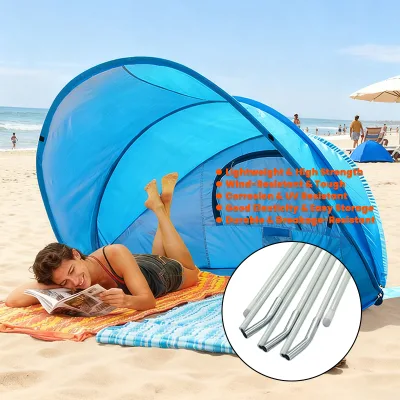
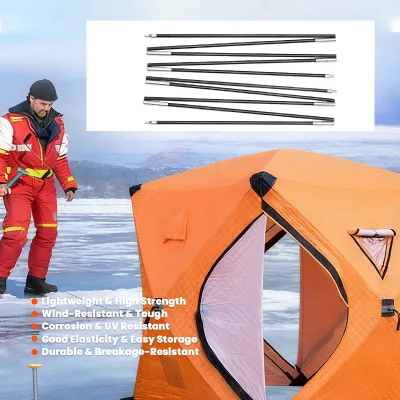


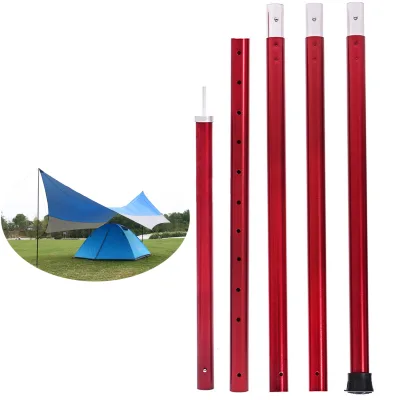
Foldable Tent Pole, Adjust Tent Pole, Telescopic Tent Pole, Beach Tent Pole
$0.01 - $0.01
MOQ: 100000 Pieces


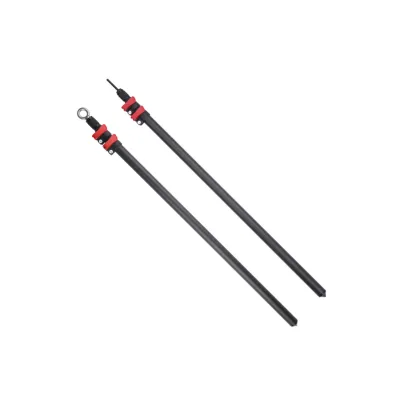


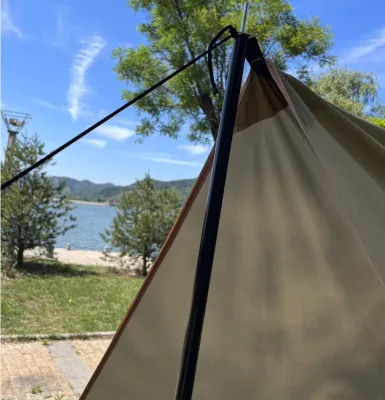

Lightweight Fiberglass Tent Poles for Easy Setup and Superior Performance
$1.99 - $3.19
MOQ: 500 Pieces


Comprehensive Sourcing Guide
Strategic Sourcing Guide for Telescopic Fiberglass Tent Poles
The global outdoor equipment market relies heavily on durable, lightweight structural components, with telescopic fiberglass tent poles serving as a critical element in modern camping and temporary shelter systems. For procurement professionals, sourcing these components requires a nuanced understanding of material science, manufacturing processes, and supply chain logistics. This guide synthesizes available product data and industry standards to provide a comprehensive framework for evaluating suppliers and specifications. The focus remains on objective analysis of the Fiberglass Reinforced Plastic (FRP) market, ensuring that buyers can make informed decisions based on verified attributes rather than unverified marketing claims.
Material Composition and Manufacturing Processes
The foundation of a high-performance tent pole lies in its material composition. The supplied data consistently identifies the core material as Fiberglass Reinforced Plastic (FRP), also referred to as Fibreglass or Fiberglass Yarn combined with Polymer Resin. This composite structure is engineered to balance tensile strength with flexibility, a requirement that distinguishes fiberglass from aluminum or carbon fiber alternatives in specific applications. The specific type of glass fiber mentioned in the product attributes is E-Glass, which is the industry standard for general-purpose structural reinforcement due to its excellent electrical insulation and mechanical properties.
The manufacturing technique is equally critical to the final product's integrity. The data explicitly points to the "Pultrusion process" as the primary forming way. Pultrusion involves pulling continuous fibers through a resin bath and then through a heated die to cure the resin. This process results in a product with consistent cross-sectional properties and high strength-to-weight ratios. Buyers must verify that the supplier utilizes this specific technique, as other methods like hand lay-up or filament winding may yield inconsistent results regarding diameter tolerance and structural uniformity. The surface treatment is described as "smooth," which is essential for preventing friction damage to tent fabrics and ensuring smooth sliding action in telescopic mechanisms.
Technical Specifications and Dimensional Standards
When evaluating technical specifications, buyers must look beyond generic descriptions to precise dimensional data. The product attributes list a wide range of diameters, specifically 6mm, 6.9mm, 7.9mm, 8.5mm, 9.5mm, 11mm, 12.7mm, and 15mm. These measurements are not arbitrary; they correspond to standard tent pole gauges used in the industry. For instance, 8.5mm and 9.5mm are common sizes for family-sized tents, while smaller diameters like 6mm are often used for backpacking or single-person shelters. The data also indicates that the "Length" can be "Any Length" or "Customized," suggesting that suppliers offer flexibility in sizing to match specific tent designs.
Shape is another critical specification. While the data notes "Round Shape" as a common attribute, it also lists "Square" and "Customized Shape" as available options. This variability allows manufacturers to design poles that fit specific hub mechanisms or aesthetic requirements. Furthermore, the "Elbow Connector" is a vital component for multi-segment poles. The standard angle is noted as 110 or 120 degrees, but customization is available. This flexibility is crucial for tents with complex roof structures. The "Matel Tube" (likely referring to the metal or internal tube component) is available in "Straight or Elbow" configurations, and the "Cap" is typically made of plastic. Buyers should ensure that the specific combination of diameter, shape, and connector angle matches their engineering requirements before placing an order.
Compliance, Certification, and Quality Assurance
In the B2B procurement of structural components, compliance and certification are non-negotiable. The supplied facts indicate that products often carry "ISO" certification, with specific references to "ISO9001:2008." This standard verifies that the manufacturer has a quality management system in place to ensure consistent product quality. While the data confirms the existence of these certifications, buyers must independently verify the validity of the certificates for the specific batch of goods they intend to purchase. Relying solely on a supplier's claim without checking the certificate number and expiration date is a significant risk.
Beyond general quality management, buyers should inquire about material-specific testing. The attributes highlight features such as "Durable," "Anticorrosive," and "Corrosion Resistance." While these are listed as product features, they are observations rather than guaranteed test results. To validate these claims, procurement teams should request third-party test reports regarding tensile strength, flexural modulus, and resistance to environmental degradation. The "Elastic Rope" feature mentioned in the data suggests an integrated shock absorption or tensioning system, which requires specific testing to ensure it does not degrade under UV exposure or repeated loading cycles. Additionally, the "Surface Treatment" being "smooth" should be verified against roughness standards to ensure it meets the friction requirements of the intended tent application.
Cost Drivers and Pricing Dynamics
Understanding the cost structure of fiberglass tent poles is essential for budgeting and negotiation. The observed price range in the market spans from $0.01 to $200 USD, a vast disparity that reflects differences in diameter, length, customization level, and order volume. The Minimum Order Quantity (MOQ) is equally variable, ranging from 1 unit to 100,000 units. This wide MOQ range indicates that suppliers cater to both prototyping needs and mass production runs.
Several factors drive the final cost. First, the "Customization" aspect is a primary cost driver. Standard diameters and lengths are likely produced at a lower cost due to economies of scale, whereas "Customized Lengths," "Customized Colors," and "Customized Shapes" require dedicated production runs or secondary processing. The "Pultrusion process" itself is capital intensive, and the cost of raw materials, specifically the E-Glass yarn and polymer resin, will fluctuate with global commodity markets. The "Packing" method, which includes "Carton" and "Pallet" configurations (with a standard pallet size of 1.11.11.4m), also impacts logistics costs. Buyers should note that while the base price may be low, the total landed cost will be significantly influenced by the complexity of the customization and the shipping volume.
Supplier Evaluation and Geographic Considerations
Geographic origin plays a significant role in the supply chain dynamics for fiberglass products. The data consistently identifies the "Place of Origin" as "China," with specific mentions of "Guangdong" as a manufacturing hub. Guangdong is a major center for composite materials and outdoor equipment manufacturing, offering a mature supply chain for raw materials and finished goods. However, buyers must exercise due diligence when selecting suppliers from this region.
Supplier evaluation should focus on the consistency of their "Product Name" and "Model Number" nomenclature. The data shows various model identifiers such as "szfrp," "sz-frp," "GTFB-TENT POLE," "HY-002," and "HY-04." This inconsistency in naming conventions across different listings suggests that buyers should rely on technical specifications rather than model numbers when communicating with suppliers. The "Brand Name" "haoheng" is mentioned, but buyers should not limit their search to a single brand. Instead, they should evaluate suppliers based on their ability to meet the specific technical requirements outlined in the previous sections. The "Forming Way" (Pultrusion) and "Processing Service" (Cutting) are key capabilities to verify. A supplier that offers in-house cutting and pultrusion capabilities is more likely to provide better quality control and faster lead times than one that relies on subcontracting.
Typical Applications and Performance Expectations
The primary application for these poles is clearly defined as "Tent support pole" or "Tent support." The "Product Type" is listed as "Common," indicating their widespread use in general camping scenarios. However, the "Feature" list, which includes "High Strength," "Leightweight" (Lightweight), and "Anticorrosive," suggests suitability for demanding environments. The "Elastic Rope" feature implies that these poles are designed to absorb shock, making them ideal for windy conditions where tent structures are subjected to dynamic loads.
The versatility of the product is further enhanced by the "Customized Shape" and "Customized Length" options. This allows the poles to be used in various configurations, from simple A-frame tents to complex geodesic domes. The "Diameter" range allows for adaptation to different tent sizes, from ultralight backpacking gear to large family shelters. Buyers should consider the specific environmental conditions of their target market. For instance, poles intended for coastal or humid environments must demonstrate robust "Corrosion Resistance," a feature explicitly listed in the product attributes. The "Plastic Cap" and "Elastic Rope" components must also be durable enough to withstand repeated assembly and disassembly cycles without failure.
Long-Term Procurement and Quality Control Strategies
Sourcing fiberglass tent poles is not a one-time transaction but a long-term partnership that requires ongoing quality control. The "Standard" dimensions provided, such as 6mm to 15mm, serve as a baseline, but buyers must establish their own tolerance limits. The "Packing" method, utilizing "Carton" and "Pallet" systems, must be evaluated for its ability to protect the poles during transit. Damage to the fiberglass surface during shipping can compromise the structural integrity of the pole.
To ensure long-term success, procurement teams should implement a rigorous quality control protocol. This includes random sampling of incoming goods to verify diameter consistency, surface smoothness, and the integrity of the "Elbow Connector" angles. The "ISO9001:2008" certification should be a baseline requirement, but buyers should also request specific test data for tensile strength and flexural properties. The "Process" of "Cutting" should be monitored to ensure that cut ends are sealed or treated to prevent moisture ingress, which can degrade the resin matrix over time. Finally, buyers should maintain open communication with suppliers regarding any changes in raw material sources or manufacturing processes, as these can impact the final product's performance. By adhering to these strategies, buyers can secure a reliable supply of high-quality telescopic fiberglass tent poles that meet the rigorous demands of the outdoor industry.
FAQs
What material is used for telescopic fiberglass tent poles?
The poles are made of Fiberglass Reinforced Plastic, also known as FRP. This composite combines E-Glass yarn with polymer resin to ensure high strength and lightweight performance suitable for camping applications.
Which diameters are available for these tent poles?
Available diameters include 6mm, 6.9mm, 7.9mm, 8.5mm, 9.5mm, 11mm, 12.7mm, and 15mm. Buyers can select from these standard sizes or request customized lengths to match specific tent designs.
Can the shape and color of the poles be customized?
Yes, the shape can be customized to round, square, or other forms, and colors are available as black, white, or other customized options. Suppliers also offer customized elbow connector angles of 110 or 120 degrees.
How are the poles manufactured and finished?
The poles are produced using the pultrusion process to ensure consistent cross-sectional properties. The surface treatment is smooth to prevent friction damage, and the forming way is specifically designed for high strength and durability.
What certifications do the manufacturers hold?
Manufacturers typically hold ISO9001:2008 certification to verify their quality management systems. Buyers should verify specific certificate validity for the batch of goods intended for purchase to ensure consistent product quality.
Where are these fiberglass tent poles sourced from?
The products originate from China, with specific manufacturing hubs located in Guangdong. This region offers a mature supply chain for composite materials and outdoor equipment components.
What are the packaging and shipping configurations?
Poles are packed in cartons and pallets, with standard pallet dimensions of 1.1 by 1.1 by 1.4 meters. This packaging method protects the poles during transit while facilitating efficient logistics for bulk orders.