Source Vinyl Insulated Disconnects for Wiring, Transmission, and Signal Use
Explore 30 listings of Vinyl Insulated Disconnects featuring copper terminals and PVC insulation. Buyers can compare models like PBDD1.25-250 and FDFN, reviewing certifications such as CE and UL alongside customization options for electrical signal transmission.
Key considerations
Products List




Comprehensive Sourcing Guide
Strategic Sourcing Guide for Vinyl Insulated Disconnects
Understanding Product Specifications and Material Composition
When sourcing Vinyl Insulated Disconnects, buyers must first establish a clear understanding of the fundamental technical specifications that define product performance. The core material composition is a primary determinant of durability and electrical safety. In the current market, copper remains the predominant conductor material due to its superior conductivity and malleability. The insulation layer, which is critical for safety, is frequently identified as PVC (Polyvinyl Chloride) or Nylon Tube, depending on the specific application requirements. The choice between these insulation materials often dictates the thermal and chemical resistance of the terminal.
The physical geometry of the disconnects varies significantly based on the intended connection method. Market observations indicate the availability of both round and rectangular shapes, catering to different wire entry points and terminal block designs. The terminal types are generally categorized into single-hole and dual-hole configurations. Single-hole terminals are designed for straightforward connections, while dual-hole variants facilitate the bridging of multiple conductors or the connection of a wire to a busbar. The production process plays a vital role in the final integrity of the product; common manufacturing techniques include cold pressing for the metal components and injection molding for the insulation housing. Surface treatments such as tin-plating or brazed seams are frequently applied to the copper conductors to enhance corrosion resistance and ensure a reliable electrical path.
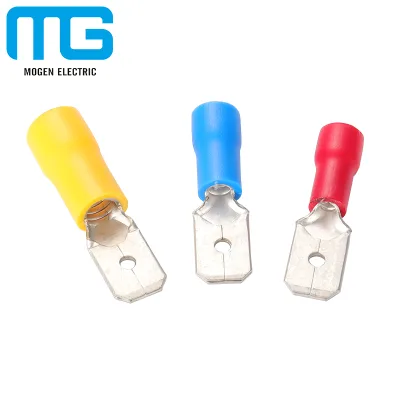
A critical specification to verify is the wire range compatibility. Sourcing guides must account for the fact that different models support varying cross-sectional areas, with observed ranges extending from 0.5mm² up to 6mm². This variability means that a single SKU cannot satisfy all procurement needs. Buyers must match the specific wire gauge of their harnesses or wiring systems to the terminal's rated capacity. Furthermore, the current carrying capacity (I Max) is a non-negotiable parameter. Data suggests that these terminals are rated for currents such as 10A, 15A, and 24A, but these values are model-specific. The color coding of the insulation, typically available in red, blue, and yellow, serves as a visual indicator for phase identification or circuit differentiation, which is essential for maintenance and troubleshooting in complex electrical assemblies.
Compliance and Certification Verification Protocols
Navigating the regulatory landscape is a cornerstone of responsible B2B procurement for electrical components. While the core keyword implies a focus on vinyl insulation, the compliance status of the product determines its eligibility for use in specific markets and industries. Buyers must rigorously verify certification claims against the specific requirements of their target regions. In the provided context, certifications such as CE and UL are explicitly mentioned as attributes associated with these products. The presence of CE marking indicates conformity with health, safety, and environmental protection standards for products sold within the European Economic Area. Similarly, UL certification is a critical benchmark for safety in North American markets, often referencing standards like UL 486 for wire connectors, though specific standard numbers must be confirmed on a per-product basis.
It is imperative for buyers to treat certification status as a dynamic attribute rather than a static guarantee. Not every listed product in a catalog will possess every certification. A supplier may offer a product line where some models are UL certified while others are not, or where the certification applies only to specific insulation materials. Therefore, the procurement process must include a direct request for valid, current certification documents for the specific model numbers being considered. Relying on general category knowledge without verifying the specific model's status can lead to compliance failures and potential liability issues.
Beyond the primary safety certifications, buyers should also look for evidence of adherence to industry standards. The data indicates that various standards, such as QSC, BNY, and specific model-based standards like FDD1.25-250, are associated with these products. These standards often define the dimensional tolerances, electrical performance limits, and environmental resistance criteria. For instance, a standard like "4-6mm" might refer to a specific dimensional range or a wire capacity classification. When evaluating a supplier, the procurement team should request a comparison of the product's claimed standard against the actual test reports. This verification ensures that the product meets the rigorous requirements of the application environment, whether it involves high-voltage transmission or low-voltage signal processing.
Cost Drivers and Pricing Structure Analysis
The pricing structure for Vinyl Insulated Disconnects is influenced by a complex interplay of material costs, production complexity, and order volume. The base cost is heavily driven by the price of copper, which fluctuates in the global market. Since copper is the primary conductive material, any increase in raw material costs will directly impact the unit price of the terminals. Additionally, the type of insulation material contributes to cost variance; PVC is generally more cost-effective than specialized nylon tubes, which may be required for higher thermal resistance or chemical stability.
Production processes also serve as significant cost drivers. Products manufactured using injection molding for the insulation housing may carry a different cost structure compared to those relying on cold pressing and manual assembly. The surface treatment applied to the copper, such as tin-plating or brazed seams, adds an additional layer of processing cost. While tin-plating is a common and relatively standard treatment, more complex treatments or higher purity plating can increase the final price.
Order volume is perhaps the most immediate lever for cost optimization. The market data reveals a wide range in Minimum Order Quantities (MOQ), spanning from as low as 1 unit to as high as 50,000 units. This variability suggests that suppliers offer tiered pricing structures. Small buyers or those testing new designs may face higher per-unit costs due to the low MOQ, while large-scale manufacturers can leverage economies of scale to secure significantly lower prices. The packaging method, whether polybags, boxes, or cartons, also influences the final landed cost, as bulk packaging reduces per-unit handling and shipping expenses. Buyers should analyze their total volume requirements against the MOQ thresholds to determine the most cost-effective ordering strategy. It is essential to note that the observed price range in the market spans from 0 to 5000 USD, but this likely represents the total value of a transaction or a specific high-volume lot rather than the unit price of a single terminal.
Typical Applications and Performance Environments
Vinyl Insulated Disconnects are versatile components designed for a wide array of electrical applications. Their primary function is to conduct electricity and transmit electrical signals, making them indispensable in automotive wiring, industrial control panels, and consumer electronics. The specific application dictates the required performance characteristics. For instance, in automotive contexts, the terminals must withstand vibration and varying temperatures, while in industrial settings, they may need to handle higher current loads and resist harsh chemical environments.
The environmental protection characteristics of these terminals are a key consideration for application suitability. Products are often rated for moistureproof and corrosion-resistant performance, which is critical for outdoor installations or environments with high humidity. The thermal resistance range, observed as -10°C to 75°C in some specifications, defines the operational envelope. Buyers must ensure that the disconnects they select can withstand the ambient temperatures of their specific application without degrading the insulation or compromising the electrical connection.
The usage scenarios also vary based on the terminal type. Single-hole terminals are typically used for connecting a single wire to a device or another wire, whereas dual-hole terminals are employed for bridging connections or connecting multiple wires to a common point. The color coding (red, blue, yellow) is not merely aesthetic; it serves a functional role in circuit identification, helping technicians quickly identify live, neutral, or ground connections, thereby reducing the risk of wiring errors during installation and maintenance. The ability to customize the product is a valuable feature for buyers with unique application requirements, allowing for tailored solutions that standard off-the-shelf items cannot provide.
Supplier Evaluation and Sourcing Strategy
Evaluating suppliers for Vinyl Insulated Disconnects requires a multifaceted approach that goes beyond price comparison. The origin of the product is a significant factor, with China and specifically the Zhejiang region identified as key manufacturing hubs. While these regions offer competitive pricing and robust supply chains, buyers must assess the supplier's ability to maintain consistent quality and adhere to international standards. The presence of specific certifications like CE and UL is a strong indicator of a supplier's commitment to quality and regulatory compliance.
The production process capabilities of the supplier are also critical. Suppliers utilizing advanced cold pressing and injection molding techniques are more likely to produce terminals with consistent dimensional accuracy and reliable insulation bonding. Buyers should inquire about the supplier's quality control measures, including in-process inspections and final testing protocols. The ability to provide detailed technical data sheets and test reports is a hallmark of a reliable supplier.
Furthermore, the supplier's flexibility in meeting customization needs is a vital differentiator. The market data indicates that customization is available, which is essential for buyers with specialized requirements. A supplier that can accommodate custom wire ranges, specific insulation materials, or unique packaging requirements (such as 1000PCS/Bag or 100PCS/Bag) offers greater value. However, customization often comes with higher MOQs or longer lead times, which must be factored into the procurement planning. Buyers should also consider the supplier's logistical capabilities, including their packaging standards (polybag, box, paper, carton) and their ability to meet delivery schedules.
Quality Control and Long-Term Procurement Considerations
Ensuring the long-term reliability of Vinyl Insulated Disconnects requires a robust quality control framework. Buyers should implement a multi-stage verification process that includes incoming inspection, random sampling, and periodic audits. Key quality metrics to monitor include the integrity of the insulation, the conductivity of the copper, and the resistance of the surface treatment to corrosion. The thermal resistance range and moistureproof characteristics should be verified through environmental testing, especially for applications in extreme conditions.
Long-term procurement considerations also involve supply chain resilience. Given the variability in MOQs and the potential for raw material price fluctuations, buyers should develop relationships with multiple suppliers to mitigate supply chain risks. Diversifying the supplier base ensures that production is not halted due to a single point of failure. Additionally, buyers should establish clear communication channels with suppliers regarding changes in standards or certifications. As regulations evolve, suppliers must be able to adapt their product lines to maintain compliance.
The packaging and storage of these components are also critical for maintaining quality. Proper packaging, such as polybags or cartons, protects the terminals from physical damage and environmental degradation during transit and storage. Buyers should verify that the packaging methods align with the product's sensitivity to moisture and physical stress. Finally, maintaining a record of product performance and supplier interactions can help in making data-driven decisions for future procurement cycles, ensuring that the selected components continue to meet the evolving needs of the organization.
Comparative Analysis of Product Attributes
To facilitate informed decision-making, the following table summarizes the key attributes observed in the market for Vinyl Insulated Disconnects. This comparison highlights the variability in specifications and helps buyers identify the product that best fits their specific requirements.
| Attribute Category | Observed Variations | Key Considerations for Buyers |
|---|---|---|
| Material | Copper (Conductor), PVC/Nylon (Insulation) | Verify insulation type for thermal/chemical resistance. |
| Shape | Round, Rectangular | Match shape to terminal block or connector interface. |
| Terminal Type | Single Hole, Dual Hole | Select based on wiring complexity and connection needs. |
| Wire Range | 0.5mm² - 6mm² | Ensure compatibility with existing wire gauges. |
| Current Rating | 10A, 15A, 24A | Confirm I Max matches circuit load requirements. |
| Color | Red, Blue, Yellow | Use for phase identification and safety compliance. |
| Certification | CE, UL | Verify specific model certification for target market. |
| Production Process | Cold Pressing, Injection Molding | Assess process capability for quality consistency. |
| Surface Treatment | Tin-Plated, Brazed Seam | Check for corrosion resistance and conductivity. |
| Packaging | Polybag, Bag Box Paper, Carton, 100/1000 PCS/Bag | Align packaging with storage and handling needs. |
| Origin | China, Zhejiang | Consider logistics and supply chain proximity. |
| Customization | Available | Leverage for specialized application requirements. |
This comparative overview underscores the importance of detailed specification matching. By carefully evaluating these attributes, buyers can navigate the complex landscape of Vinyl Insulated Disconnects and secure components that ensure safety, reliability, and performance in their electrical systems.
FAQs
What certifications are available for these Vinyl Insulated Disconnects?
Products in this catalog hold CE and UL certifications. Buyers must verify that the specific model number they select carries the required certification, as not every listed item satisfies all standards.
Which materials are used to construct these electrical terminals?
The conductors are made of copper, while insulation is provided by PVC or Nylon Tube. The choice between these materials depends on the specific thermal and chemical resistance needs of the application.
Can I customize the wire range and color for my order?
Customization is available for wire ranges from 0.5mm² to 6mm² and colors like red, blue, and yellow. Buyers should confirm specific model capabilities before placing a custom order to ensure compatibility.
What is the maximum current capacity for these single hole terminals?
The maximum current rating varies by model, with options for 10A, 15A, and 24A. Users must match the terminal's specific I Max rating to their circuit requirements to ensure safe operation.
How are these terminals packaged for shipment?
Packaging options include polybags, boxes, paper, and cartons, with quantities ranging from 100 to 1000 pieces per bag. The specific packing method depends on the product model and supplier configuration.
Which production processes are used for these electrical components?
Manufacturing involves cold pressing for metal parts and injection molding for insulation housing. Surface treatments like tin-plating or brazed seams are applied to enhance corrosion resistance and electrical reliability.
What is the minimum order quantity for these Vinyl Insulated Disconnects?
MOQs range from 1 unit up to 50,000 units depending on the supplier and product type. Some specific models may require a minimum of 100 bags, so buyers should check individual listings.