Why Are Supplier Quotes for the Same Product So Different?
Supplier quotes for the “same product” can differ because suppliers may not actually be quoting the same specification, quantity, commercial scope, delivery term, or quality requirement.
A lower price may reflect:
- A different material or configuration
- A higher MOQ
- A different price tier
- Packaging or accessories excluded
- Tooling excluded
- Testing or certification excluded
- A different Incoterm
- A different lead time
- Different payment terms
- Different warranty or quality scope
So before asking:
Why is Supplier A cheaper?
ask:
What exactly is different between Supplier A's offer and Supplier B's offer?
The Product May Not Actually Be the Same
Two suppliers may use the same product name while quoting different:
- Materials
- Components
- Dimensions
- Performance
- Tolerances
- Voltage
- Accessories
- Packaging
- Product versions
For custom products, even a drawing revision can change production cost.
That means the first comparison should be:
Specification versus specification
not:
Price versus price
Quantity and MOQ Can Change the Unit Price
Supplier A may quote at 500 units.
Supplier B may quote at 5,000 units.
Supplier C may require an MOQ of 10,000 units.
Even if the products are identical, the prices do not represent the same purchase.
| Field | What to Compare |
|---|---|
| Order quantity | Quantity used for the quote |
| MOQ | Supplier's minimum order |
| Unit price | Price at that quantity |
| Price tiers | How price changes with volume |
If you need 1,000 units, a low price available only at 10,000 units may not be the better offer.
Incoterms Can Make Prices Look Very Different
An EXW price and a DDP price include very different responsibilities and costs.
The named place or port also matters because it affects where delivery takes place and how costs and risks are allocated.
Do not compare the headline numbers without understanding what delivery scope they include.
Some Suppliers Include Costs That Others Exclude
A quotation may or may not include:
- Tooling
- Molds
- Samples
- Packaging
- Printing
- Testing
- Certification
- Inspection
- Accessories
- Inland freight
- International freight
This can create a major apparent price difference.
A cheaper supplier may simply have moved some of the cost outside the unit price.
Quality and Compliance Can Change the Offer
Two suppliers may also price different levels of:
- Testing
- Certification
- Inspection
- Warranty
- Quality control
- Defect handling
- Documentation
If one supplier includes required compliance work and another assumes it is not needed, their quotations are not comparable.
For important certification information, keep the status visible as:
Required
Supplier-provided
Verified
or
Missing
Real SourcingX Example: When a Large Price Difference Needs Clarification
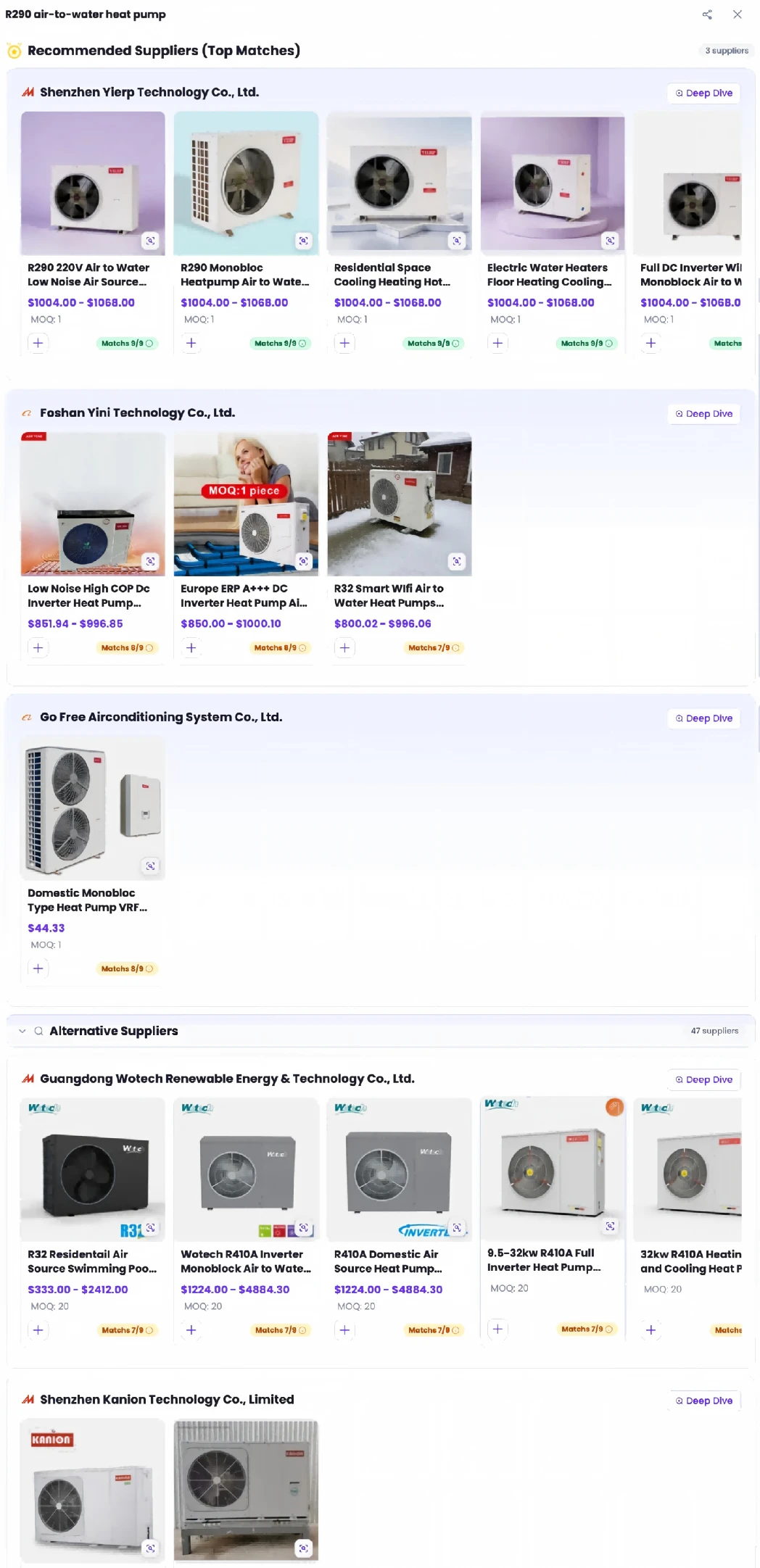
In one SourcingX sourcing task, similar heat-pump products were matched against a structured set of product requirements.
The comparison criteria included:
| Criterion | Requirement |
|---|---|
| Use case | Residential |
| Design type | Monobloc |
| Refrigerant | R290 |
| Power source | 220V |
| Origin | China |
| Noise level | Low |
| Efficiency | High |
| MOQ | 1 unit |
| Certifications | Verify |
The result included recommended suppliers whose public product listings showed visibly different prices.
These are public listing prices, not comparable RFQ quotations.
That distinction matters.
A much lower displayed price should not immediately be interpreted as:
This supplier is much cheaper.
Instead, it should trigger questions such as:
- Is it the same product configuration?
- Is it a complete unit?
- What capacity or model does the price cover?
- What accessories are included?
- Is packaging included?
- At what quantity?
- What delivery basis applies?
- Are certifications or testing included?
Until those fields are aligned, the price difference is a signal to investigate, not a sourcing conclusion.
A Very Low Quote Usually Needs More Questions, Not an Immediate Rejection
A significantly lower quotation does not necessarily mean the supplier is unreliable.
It may reflect:
- A genuinely lower production cost
- A different configuration
- Larger assumed quantity
- Lower-cost materials
- Different included services
- Excluded testing or certification
- Different delivery term
- A promotional or marketplace reference price
The correct next step is:
Clarify the difference.
For example:
Please confirm whether your quoted price includes the same R290 configuration, accessories, packaging, certification requirements, and delivery basis specified in our RFQ.
That question is more useful than simply asking:
Why are you cheaper?
Normalize the Quote Before Ranking the Supplier
Before comparing price, align the information that materially affects the deal.
| Comparison Area | Confirm Before Ranking |
|---|---|
| Product | Same specification and revision |
| Quantity | Same quantity or normalized tier |
| Price | Same currency and unit |
| Delivery | Same Incoterm / named place |
| Scope | Packaging, tooling, accessories included |
| Quality | Testing and certification basis |
| Timing | Same lead-time definition |
| Commercial | Payment terms and validity |
| Exceptions | Differences stated explicitly |
Only after those differences are visible does the price comparison become meaningful.
How SourcingX Helps
SourcingX can help buyers start from a product, image, or sourcing requirement and structure the attributes used to identify relevant supplier candidates.
The comparison process then becomes:
Match the requirement → Identify differences → Collect missing information → Normalize quotations → Compare suppliers
Supplier prices are useful evidence.
They are not useful in isolation from the product and commercial scope behind them.
Related Questions
Does a lower supplier quote usually mean lower quality?
No. Price alone does not establish quality. A lower price may reflect cost advantages, different scope, volume assumptions, materials, or exclusions. Clarify the quotation before drawing conclusions.
Should I ask suppliers why their price is higher or lower?
Yes, but ask specific questions about differences in specification, included scope, quantity, tooling, delivery, testing, or other cost drivers instead of asking only for a general explanation.
Can I compare marketplace listing prices with supplier quotations?
Use listing prices as reference signals, not as directly comparable quotations. Confirm the actual model, quantity, scope, commercial terms, and delivery basis with the supplier.
What should I do if one supplier is much cheaper than every other supplier?
Check whether the offer covers the same specification and scope first. If it does, investigate the supplier's cost basis and capability further rather than automatically accepting or rejecting the quotation.