How to Write an RFQ That Makes Supplier Quotes Comparable
To make supplier quotes comparable, an RFQ should do more than ask for a price.
It should give every supplier the same product specification, quantity basis, commercial terms, quality requirements, delivery assumptions, and response fields — while requiring suppliers to state any exceptions clearly.
A practical RFQ should answer six questions before it is sent:
- What exactly are suppliers quoting?
- At what quantity?
- What is included in the price?
- Under what delivery and payment terms?
- What quality or compliance requirements apply?
- Where must the supplier explicitly state differences or exclusions?
If suppliers answer different questions, the quotations will not become comparable just because they appear in the same spreadsheet.
Why Supplier Quotes Become Difficult to Compare
One of the most common problems in supplier comparison is not a lack of quotations.
It is receiving several quotations that are based on different assumptions.
Recent procurement discussions repeatedly highlight specification revision, MOQ and price tiers, Incoterm plus named place, tooling and sample charges, payment terms, lead time, quote validity, quality documents, and explicit exceptions as fields that often prevent quotations from being directly comparable.
For example:
- Supplier A quotes 1,000 units.
- Supplier B quotes 5,000 units.
- Supplier C uses a different material grade.
- Supplier D excludes packaging and testing.
- Supplier E quotes EXW while another quotes DDP.
All five suppliers may appear to be quoting the “same product.”
They are not necessarily quoting the same scope.
That is why the first job of an RFQ is not to obtain the lowest price.
It is to create a common comparison basis.
Start With a Sourcing Requirement Suppliers Can Actually Price
A vague inquiry such as:
Please send your best price for this product.
gives suppliers too much room to make their own assumptions.
A stronger RFQ starts with a clear sourcing brief.
Lock the Product Specification
Include the exact specification suppliers should quote against.
Depending on the product, this may include:
- Model or drawing number
- Specification revision
- Material
- Dimensions
- Tolerances
- Performance
- Components
- Voltage
- Finish
- Customization
- Packaging
- Target-market requirements
If you use drawings or specification files, identify the revision clearly.
Otherwise, three suppliers may unknowingly quote three different product versions.
Define the Quantity Basis
Do not ask only for:
MOQ and best price.
Tell suppliers which quantities you actually want quoted.
| RFQ Field | Requirement |
|---|---|
| Trial order | 500 units |
| Expected first order | 2,000 units |
| Price tiers requested | 500 / 2,000 / 5,000 units |
| Supplier MOQ | Supplier to state |
This allows you to distinguish what the supplier requires from what your project actually needs.
Make the Commercial Basis Explicit
A quotation is not decision-ready if the buyer does not know what the number includes.
Ask for the Same Price Basis
For each supplier, request:
- Currency
- Unit of measure
- Quoted quantity
- Unit price
- Price tiers
- MOQ
- Quote validity
Specify the Incoterm and Named Place
Do not ask simply for:
FOB price
Ask for:
FOB Ningbo, Incoterms® 2020
If suppliers are allowed to propose different Incoterms, ask them to state the complete term and named place so quotations can later be normalized.
Separate Additional Costs
Ask suppliers to itemize costs that may sit outside the unit price.
Typical examples include:
- Tooling
- Mold
- Samples
- Artwork or setup
- Packaging
- Labeling
- Testing
- Certification
- Inspection
- Inland transportation
- Freight
- Accessories
- Spare parts
A quotation that includes these costs should not be compared directly with one that excludes them.
Collect Payment Terms
Ask suppliers to state:
- Deposit
- Balance timing
- Payment method
- Milestone payments, if applicable
Two suppliers with the same unit price can still offer materially different commercial terms.
Define Delivery and Lead Time Precisely
“Lead time: 20 days” is incomplete.
The RFQ should clarify what event starts the clock.
For example:
Production lead time after deposit and final artwork approval.
Where relevant, separate:
- Sample lead time
- Tooling lead time
- Production lead time
- Shipping time
Also ask suppliers to identify any conditions that could change the stated lead time.
Make Quality and Compliance Requirements Part of the RFQ
Quality requirements should not be left until after price comparison.
Depending on the product, the RFQ may need to specify:
- Required certification
- Testing standards
- Inspection requirements
- AQL or acceptance criteria
- Required documentation
- Warranty
- Defect handling
- Rework or replacement expectations
For certifications, distinguish between:
Required
Supplier claims available
and
Verified
The RFQ gathers the evidence.
Verification happens separately.
Require Suppliers to State Exceptions
Add:
Exceptions to Requirement
and ask every supplier to state explicitly where its quotation differs from the RFQ.
Examples include:
- Different material
- Different model
- Alternative component
- Higher MOQ
- Longer lead time
- Packaging excluded
- Tooling excluded
- Different certification
- Different warranty
- Different Incoterm
A useful rule is:
If a difference changes specification, cost, risk, quality, or delivery, it should appear in the quotation comparison.
Standardize the Supplier Response
A strong RFQ does not only tell suppliers what you need.
It also tells them how to respond.
| RFQ Section | Supplier Should Provide |
|---|---|
| Product | Exact model and specification quoted |
| Quantity | MOQ and requested price tiers |
| Price | Unit price, currency, validity |
| Delivery | Incoterm, named place, lead time |
| Additional costs | Tooling, sample, packaging, testing |
| Quality | Certifications, testing, warranty |
| Commercial | Payment terms |
| Exceptions | Anything different from the RFQ |
| Missing information | Anything supplier cannot yet confirm |
The goal is not to force every supplier to use identical formatting.
It is to ensure that the same decision fields are answered by every supplier.
Real SourcingX Case: Turning a Product Match Into an RFQ-Ready Requirement
In one sourcing task, a buyer started from an existing product page and product image and used SourcingX to find similar products.
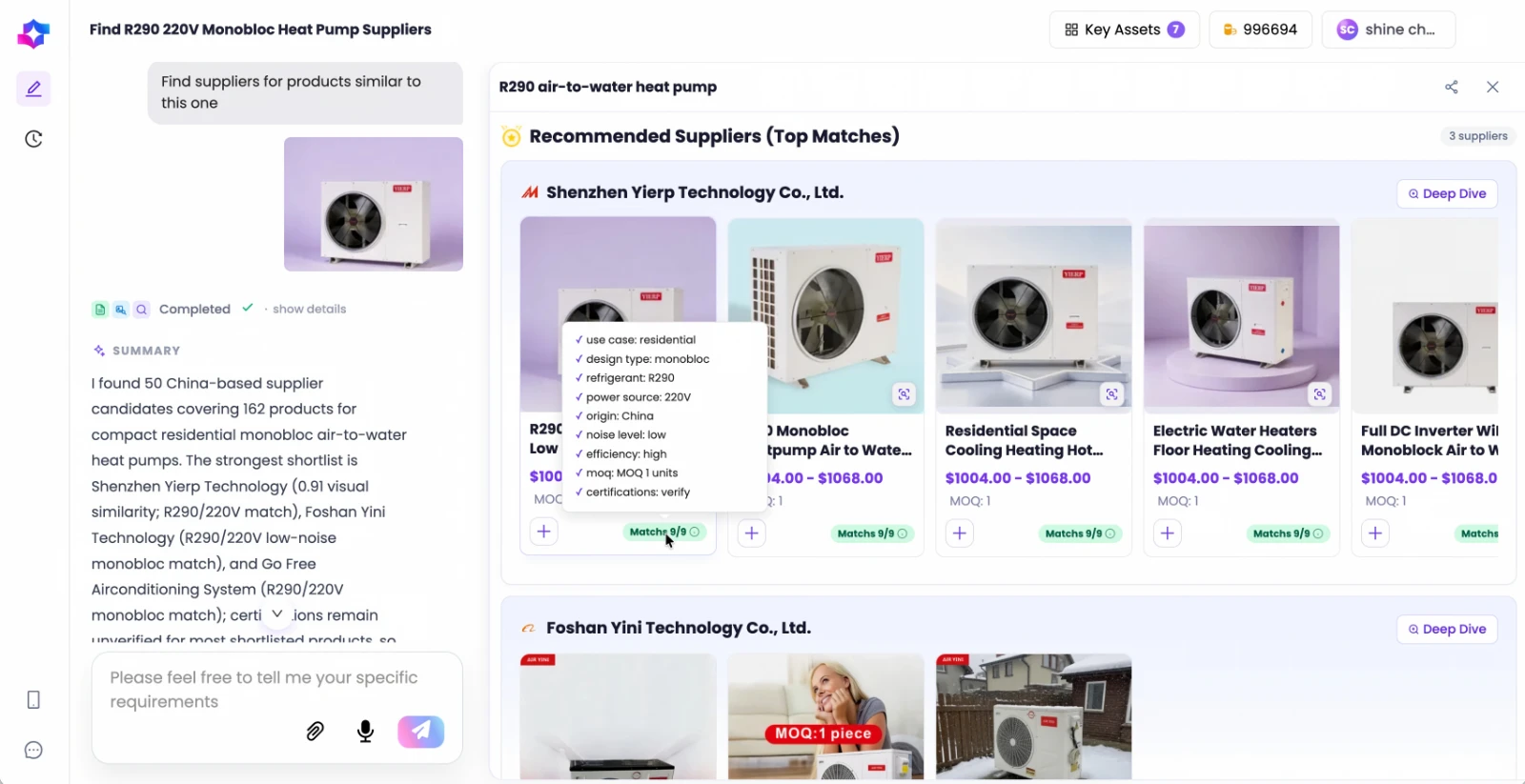
Image placeholder: Replace with the final SourcingX case screenshot before publishing.
SourcingX extracted nine matching requirements:
| Requirement | Extracted Information |
|---|---|
| Use case | Residential |
| Design type | Monobloc |
| Refrigerant | R290 |
| Power source | 220V |
| Origin | China |
| Noise level | Low |
| Efficiency | High |
| MOQ | 1 unit |
| Certifications | Verify |
Those criteria were enough to help identify similar products and narrow the supplier pool.
But they are not yet enough to create fully comparable supplier quotations.
What Is Still Missing Before Sending an RFQ
| Missing RFQ Field | Why It Matters |
|---|---|
| Exact target order quantity | Required to compare price tiers |
| Full technical specification | Prevents different configurations being quoted |
| Destination / named place | Required for comparable delivery terms |
| Packaging requirement | Can materially change total cost |
| Included accessories | Defines quotation scope |
| Sample requirement | Clarifies sample cost and timing |
| Payment terms | Affects commercial comparison |
| Production lead time basis | Prevents different definitions of “lead time” |
| Required certification evidence | Separates claims from verification |
| Warranty / quality requirements | Prevents cheaper but narrower offers |
| Quote validity | Ensures prices refer to the same decision period |
| Exceptions | Makes differences explicit |
The matching task answers:
Who appears relevant?
The RFQ must then answer:
What exactly should every relevant supplier quote?
A Practical RFQ Structure
For most sourcing projects, an RFQ can be organized into six blocks.
1. Buyer Requirement
What product and quantity are required?
2. Product Specification
What exact technical requirement should suppliers quote?
3. Commercial Information
What price tiers, MOQ, additional costs, payment terms, and validity should be returned?
4. Delivery
Which Incoterm, named place, and lead-time basis should apply?
5. Quality and Compliance
Which certificates, tests, quality requirements, and warranty conditions are required?
6. Exceptions and Missing Information
Where does the supplier differ from the requested scope, and what can it not yet confirm?
How to Know Whether an RFQ Is Comparison-Ready
Before sending the RFQ, ask:
Could another member of the sourcing team compare the returned quotations without needing to remember what was said in private emails or calls?
Before sending, check:
- Is the specification version clear?
- Are suppliers quoting the same quantities?
- Is the Incoterm and named place defined?
- Are additional costs requested separately?
- Is lead time defined consistently?
- Are certification and quality requirements clear?
- Are payment terms requested?
- Is quote validity requested?
- Is there an exceptions field?
If not, clarify the RFQ before sending it.
How SourcingX Fits Into the RFQ Process
SourcingX can help structure the information that comes before the RFQ:
Understand the product or sourcing request → Extract comparable requirements → Match relevant suppliers → Identify missing fields → Prepare a clearer RFQ basis
The supplier-comparison process then continues:
RFQ → Supplier Responses → Normalize Quotes → Compare → Verify → Decide
A good RFQ does not try to collect every possible supplier detail.
It makes sure the fields that affect specification, price, risk, quality, and delivery are answered on the same basis.
The practical sequence is:
Define → Standardize → Ask → Expose Exceptions → Compare
Frequently Asked Questions
What is the difference between an RFQ and a supplier inquiry?
A general inquiry may ask whether a supplier can provide a product. An RFQ should define enough technical and commercial detail for suppliers to return quotations that can be meaningfully compared.
Should I send the same RFQ to every supplier?
The core requirements and comparison fields should be the same for every candidate.
Should I include a target price in an RFQ?
It depends on the sourcing strategy. The more important requirement is that all suppliers quote the same scope and quantity basis.
How many suppliers should receive an RFQ?
There is no fixed number. It is usually more useful to send a structured RFQ to a manageable set of qualified candidates than to send a vague inquiry to a large supplier list.