Source 14mm 60si2mn Leaf Spring for Trucks, Trailers, and Buses
Find 30 verified listings for the 14mm 60si2mn Leaf Spring suitable for medium duty trucks, semi-trailers, and full trailers. Buyers can compare steel grades, heat treatment processes, and customization options from suppliers in China.
Key considerations
Products List


$50.00 - $56.00
MOQ: 50 Pieces


Comprehensive Sourcing Guide
Strategic Sourcing Guide for 14mm 60Si2Mn Leaf Springs
Understanding Material Specifications and Technical Standards
The core keyword "14mm 60si2mn Leaf Spring" directs procurement teams toward a specific subset of suspension components defined by precise metallurgical and dimensional requirements. In the context of heavy-duty vehicle manufacturing, the material designation "60Si2Mn" represents a high-quality silicon-manganese alloy steel. This material is selected for its superior elasticity, fatigue resistance, and toughness, making it ideal for applications requiring high load-bearing capacity and repeated stress cycles. The "14mm" dimension typically refers to the thickness of the individual leaf within the spring assembly, a critical parameter that directly influences the spring rate and overall stiffness of the suspension system.
When sourcing these components, buyers must verify that the supplier adheres to established steel standards. The provided product data indicates that manufacturers often cite standards such as 65Mn, 60Si2Mn, Sup9, 50crva, 51CRV4, and 55CrMnA. While 60Si2Mn is the specific alloy requested, a robust supplier should demonstrate the capability to produce springs meeting these various international standards depending on the target market. The thickness of 14mm is a specific instance of the broader dimensional variations observed in the market, which include widths and thicknesses such as 1875, 2090, 20120, 1575, 2075, and 1560. Buyers should not assume that all 60Si2Mn springs are identical; the specific geometry, including width and length, must be cross-referenced with the vehicle's suspension design to ensure proper fitment and performance.
The manufacturing process for these springs is equally critical. The supplied facts highlight "Quenched & Tempered" as the standard heat treatment process. This thermal treatment is essential for achieving the desired mechanical properties in 60Si2Mn steel. Without proper quenching and tempering, the spring may suffer from premature failure, loss of elasticity, or brittleness. Procurement teams should request mill test reports or process validation documents that confirm the heat treatment parameters were strictly followed to ensure the material properties match the 60Si2Mn specification.
Compliance, Certification, and Regulatory Verification
Navigating the regulatory landscape is a fundamental step in sourcing automotive suspension components. The market data reveals a diverse array of certifications held by suppliers, ranging from ISO and CE to more specific industry standards like ISO/Ts16949, DOT, ISOCE, GCC, and ECE. When sourcing a 14mm 60si2mn Leaf Spring, buyers must determine which certifications are mandatory for their specific end market. For instance, if the destination is the European Union, CE and ECE certifications are likely non-negotiable. For North American markets, DOT compliance is a primary requirement.
The presence of ISO/Ts16949 (now often superseded by IATF 16949) is a strong indicator of a supplier's commitment to quality management systems specific to the automotive industry. This certification suggests that the manufacturer has established processes for continuous improvement, defect prevention, and reduction of variation and waste in the supply chain. However, the existence of a certification on a product listing does not guarantee that every specific SKU, such as a 14mm leaf spring, is individually certified. Buyers must verify that the specific batch or model number they intend to purchase carries the relevant certification status.
Furthermore, the product data lists certifications such as ISO/TSCCC and DOT, which may apply to different product lines or vehicle types, including semi-trailers and full trailers. It is crucial to distinguish between certifications for the raw material and certifications for the finished suspension assembly. A supplier may hold ISO 9001 for general quality management but lack specific type approval for the suspension component in the target region. Procurement teams should explicitly request certification documents that are valid for the specific product configuration, ensuring that the 14mm 60Si2Mn spring meets the regulatory requirements of the final vehicle application.
Cost Drivers and Pricing Dynamics
The pricing of leaf springs is influenced by a complex interplay of material costs, manufacturing complexity, and order volume. The observed price range in the market spans from $0.01 to $700, a wide variance that reflects differences in product scale, from individual replacement leaves to complete suspension assemblies. For a specific component like a 14mm 60si2mn Leaf Spring, the cost is heavily driven by the weight of the steel and the precision required in the forming and heat treatment processes.
Material costs for 60Si2Mn steel fluctuate based on global commodity markets. Since this is a high-alloy steel, its price is generally higher than standard carbon steels. The thickness of 14mm adds significant material volume compared to thinner leaves, directly impacting the unit cost. Additionally, the customization factor plays a major role. The data indicates that "Customization" is available and "Provide" is an option, meaning that non-standard dimensions or specific curvature requirements will incur higher costs due to the need for custom tooling and setup.
Order volume is another critical cost driver. The observed Minimum Order Quantity (MOQ) ranges from 1 to 1000 units. Buyers ordering small quantities, such as single units or small batches for repair purposes, will face a higher per-unit cost compared to those placing bulk orders that meet the higher MOQ thresholds. The lead time, typically ranging from 7-15 working days to 15-30 days, also influences pricing. Rush orders that require expedited production or air freight may carry a premium. Buyers should negotiate based on their projected annual volume to secure better pricing tiers, as the data suggests that suppliers are flexible with customization and packing, which can be leveraged in cost discussions.
Typical Applications and Vehicle Compatibility
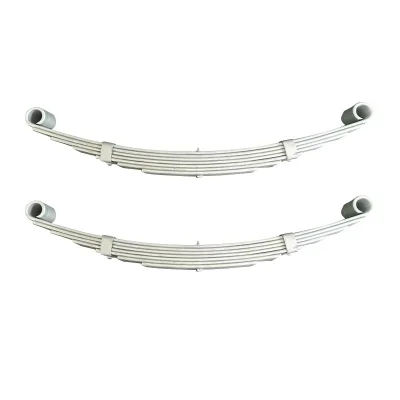
The 14mm 60si2mn Leaf Spring is primarily utilized in medium-duty truck applications, as indicated by the product attributes. These springs are designed to support the weight of the vehicle and its cargo while providing a stable ride quality. The data specifies applications for "Medium Duty Truck," "Semi-Trailer," and "Full Trailer," suggesting that this material and dimension combination is versatile enough for various commercial transport scenarios. The "Self-dumping" attribute is listed as both available and not available, indicating that these springs are used in both standard cargo trailers and specialized self-dumping dump trucks.
The compatibility of the spring with the vehicle's suspension system is paramount. The data mentions "Leaf Spring Suspension" as the type, with variations including "Multi-Leaf," "Parabolic," and "Tapered Leaf" designs. A 14mm leaf is likely part of a multi-leaf assembly, where the number of leaves and their varying lengths determine the spring's load characteristics. The "Tire Number" of 6 and "Axle Number" of 2 mentioned in the data suggest that these springs are often part of a tandem axle configuration common in heavy-duty trailers.
Buyers must ensure that the 14mm thickness aligns with the vehicle's design specifications. The load capacity is noted as "30T" in some contexts, which implies that a single spring or a set of springs must be capable of handling significant weight. The "Grade" is specified as "Medium Duty" or "Light Duty," and selecting the correct grade is essential to prevent over-stressing the suspension or under-utilizing the component's potential. The "Color" is often "Black" or "Custom Made," which may be relevant for corrosion protection and aesthetic matching, though the primary function remains mechanical.
Supplier Evaluation and Geographic Considerations
When evaluating potential suppliers for 14mm 60Si2Mn leaf springs, geographic location and production capacity are key factors. The data indicates that products originate from "Jinan China" and "Shandong China," regions known for their robust manufacturing infrastructure and automotive supply chains. These locations are strategic hubs for steel processing and automotive component manufacturing, offering buyers access to a concentrated pool of suppliers with specialized expertise.
Supplier evaluation should extend beyond location to include their production capabilities and quality control measures. The "After-sales Service" of "One Year Structural Warranty" is a significant indicator of supplier confidence in their product quality. Buyers should verify the terms of this warranty, including what constitutes a structural failure and the process for claims. The "Payment" terms of T/T (Telegraphic Transfer) and LC (Letter of Credit) are standard in international trade, but buyers should negotiate terms that align with their cash flow and risk management strategies.
The "ODM" (Original Design Manufacturer) and "Customization" capabilities are also critical. Suppliers offering ODM services can assist in designing custom suspension solutions, which is valuable for buyers with unique vehicle requirements. The "Brand Name" is listed as "OEM / Aftermarket," indicating that suppliers can produce parts for original equipment manufacturers or for the replacement market. Buyers should assess whether the supplier has experience in both sectors, as the quality standards and volume requirements can differ significantly.
Quality Control and Long-Term Procurement Strategy
Ensuring the long-term reliability of 14mm 60Si2Mn leaf springs requires a rigorous quality control strategy. The "Condition" is listed as "New," but buyers must verify that the springs are free from defects such as cracks, surface irregularities, or improper heat treatment. The "Heat Treatment" process of "Quenched & Tempered" must be consistently applied to every batch. Buyers should request quality inspection reports, including hardness tests and fatigue life data, to validate the supplier's quality control processes.
Packaging is another aspect of quality assurance. The data mentions "Export Standard Packing by Pallet" and "Standard Packing for Ocean Shipment," which are essential for protecting the springs during transit. Improper packaging can lead to damage, corrosion, or deformation, rendering the springs unusable. Buyers should specify packaging requirements in their purchase orders to ensure that the products arrive in pristine condition.
Long-term procurement considerations involve building a sustainable relationship with suppliers. The "Lead Time" of 15-30 days or 7-15 working days should be factored into inventory planning to avoid stockouts. Buyers should aim for a balance between maintaining safety stock and minimizing holding costs. The "Main Market" being "South Asia" suggests that suppliers have experience exporting to diverse regions, but buyers should confirm that the supplier can meet the specific logistical and regulatory needs of their own market.
| Feature | Observation from Data | Procurement Action |
|---|---|---|
| Material | 60Si2Mn, 65Mn, Sup9, etc. | Verify mill test reports for 60Si2Mn specifically. |
| Thickness | 14mm (Core Keyword) | Confirm 14mm is standard or custom; check width/length. |
| Heat Treatment | Quenched & Tempered | Request process validation and hardness test results. |
| Certifications | CE, ISO, DOT, ECE, etc. | Match specific certifications to target market regulations. |
| Warranty | One Year Structural Warranty | Review warranty terms and claim procedures. |
| Origin | Jinan, Shandong, China | Assess logistics costs and lead times from these regions. |
| MOQ | 1-1000 units | Negotiate volume discounts based on projected annual usage. |
By adhering to these guidelines and leveraging the available data, buyers can make informed decisions when sourcing 14mm 60Si2Mn leaf springs, ensuring they receive high-quality components that meet their technical, regulatory, and operational requirements.
FAQs
What materials are used for 14mm 60si2mn leaf springs?
These springs are primarily manufactured using 60Si2Mn steel, though other standards like 65Mn and Sup9 are also available. The material is selected for its superior elasticity and fatigue resistance, ensuring durability under heavy load conditions typical for medium-duty trucks.
Which certifications are available for these suspension components?
Common certifications include CE, ISO, ISO/Ts16949, DOT, ECE, and GCC depending on the specific product line. Buyers should verify that the specific batch holds the required certification for their target market, as some listings may only include general quality standards.
How long is the lead time for custom orders?
The standard delivery time ranges from 7 to 30 working days depending on the order specifics and customization level. While some suppliers offer a 7-15 day window, others may require up to 30 days for complex customizations or larger volume orders.
Can suppliers provide customization for these leaf springs?
Yes, customization is available and can be provided for various specifications including dimensions and load capacities. Buyers can request specific designs for semi-trailers or full trailers, with options for self-dumping or non-self-dumping configurations based on their vehicle needs.
What is the typical MOQ for purchasing these springs?
The minimum order quantity ranges from 1 to 1000 units, offering flexibility for both small repair orders and bulk procurement. Lower MOQs may result in higher per-unit costs, while larger orders often benefit from better pricing tiers and streamlined production schedules.
Where are these 14mm leaf springs manufactured?
Products originate from manufacturing hubs in Jinan and Shandong, China, which are known for robust automotive supply chains. These locations provide access to specialized steel processing and ensure efficient logistics for ocean shipment to global destinations.
What heat treatment process is applied to these springs?
The standard process involves quenching and tempering to achieve the desired mechanical properties and toughness. This thermal treatment is critical for preventing premature failure and ensuring the spring maintains its elasticity under repeated stress cycles in medium-duty applications.