Source 3-in-1 Kitchen Faucet for Hotels, Homes, and Offices
Compare 30 listings of 3-in-1 Kitchen Faucet options featuring ceramic valves, stainless steel bodies, and modern designs. Buyers can evaluate specifications like single-hole installation, 360 swivel capabilities, and varied color finishes for family hotels and residential projects.
Key considerations
Products List
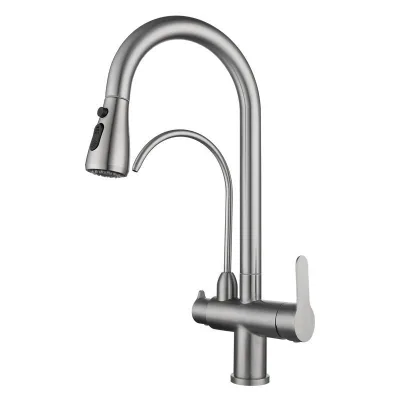
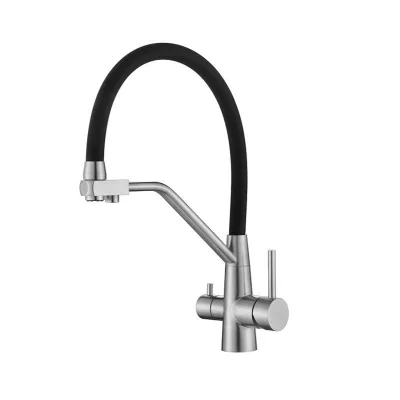


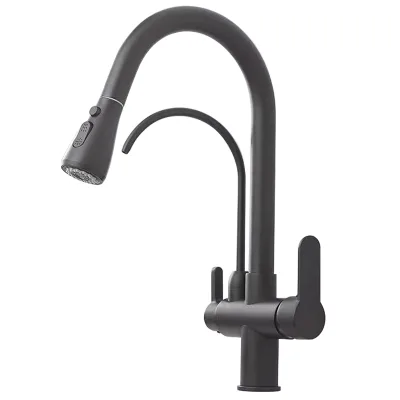
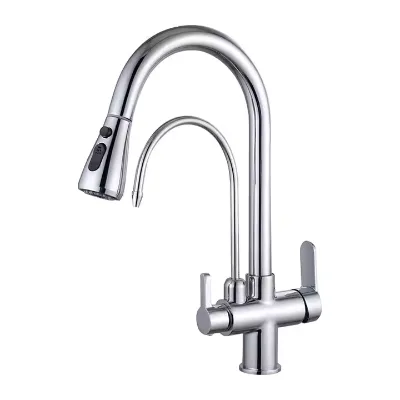


One Inlet and Two Outlets Special Double Faucet Automatic Water Stop Valve
$0.50 - $1.50
MOQ: 3000 Pieces





Comprehensive Sourcing Guide
Strategic Sourcing Guide for 3-in-1 Kitchen Faucets
The global market for kitchen fixtures has seen a significant shift toward integrated solutions that combine traditional water delivery with advanced filtration capabilities. The "3-in-1 kitchen faucet" has emerged as a dominant category, representing a convergence of hot water, cold water, and purified water delivery within a single unit. For B2B procurement professionals, sourcing these units requires a nuanced understanding of technical integration, material durability, and supply chain logistics. This guide synthesizes observed market data and technical specifications to provide a disciplined framework for evaluating potential suppliers and products without relying on unverified claims or specific vendor recommendations.
Technical Architecture and Functional Integration
The defining characteristic of a 3-in-1 faucet is its ability to deliver three distinct water streams: standard hot water, standard cold water, and purified water. This integration is not merely cosmetic; it requires a complex internal valve system and precise engineering to prevent cross-contamination and ensure flow stability. Based on observed product attributes, the core valve material is frequently ceramic. Ceramic valve cores are industry-standard for their durability and resistance to wear, ensuring that the switching mechanism between the three water types remains smooth over years of use.
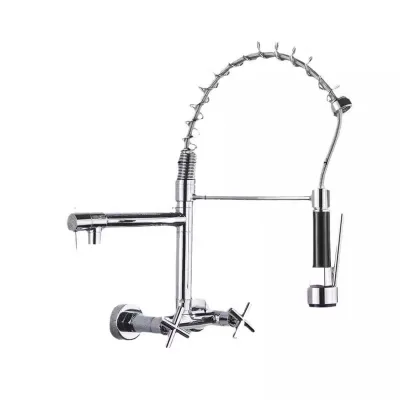
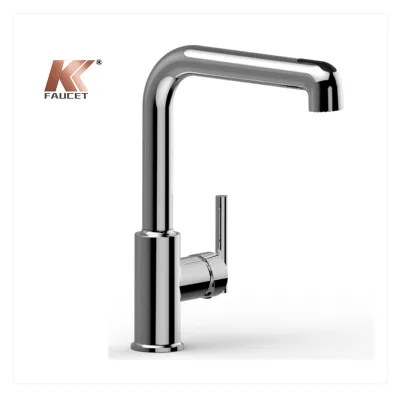
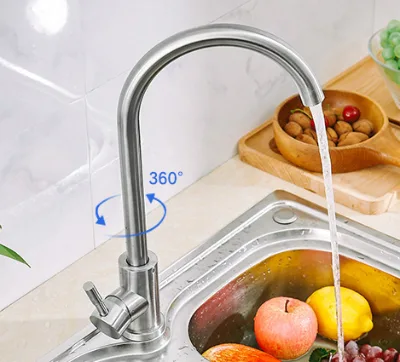
The physical configuration of these units varies significantly. Some models feature a "single hole" installation requirement, which is ideal for modern countertops where space is at a premium. Others may utilize a "deck mounted" approach, requiring specific cutouts in the sink or countertop. A critical technical observation involves the "Outlet Style," which is often described as "retractable" or featuring a "pull-out spray" mechanism. However, market data indicates a divergence in this feature; some 3-in-1 units are designed without a pull-out spray, relying instead on a fixed or swivel spout. Buyers must verify if the specific model includes a "360 swivel" capability, as this is a common feature for maximizing sink utility.
The water purification aspect is another critical technical variable. The "Purified Water Outlet" is a dedicated channel that connects to an external filtration system, often located under the sink. The flow rate for these units is a key performance metric, with observed specifications reaching up to 6000 gallons per day (gpd) in high-capacity models. This metric is essential for commercial applications where high throughput is required. The "Control Method" is typically manual, utilizing a single handle for temperature and flow adjustment, though some industrial variants may utilize a "wrench" for installation or adjustment. The "Opening Way" is generally a "revolving type," allowing the spout to rotate for access to different areas of the sink.
Material Composition and Surface Engineering
Durability in a kitchen environment is heavily dependent on the materials used for the faucet body and the surface treatment applied. The primary body material observed in the market includes "Stainless steel" and "Brass." Stainless steel models are often marketed for their modern aesthetic and resistance to corrosion, while brass bodies are traditionally favored for their structural integrity and ability to withstand high water pressure. The "Body Material" selection directly impacts the weight, feel, and longevity of the fixture.
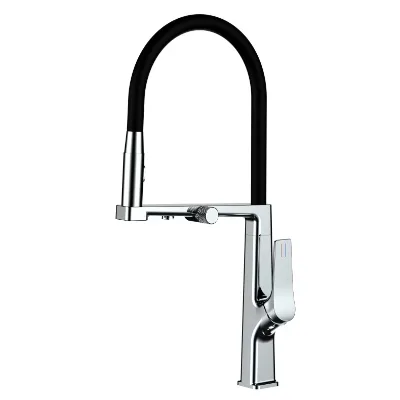
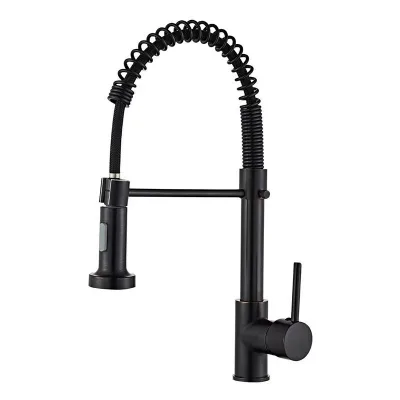
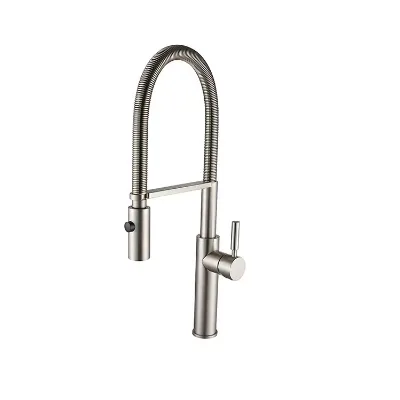
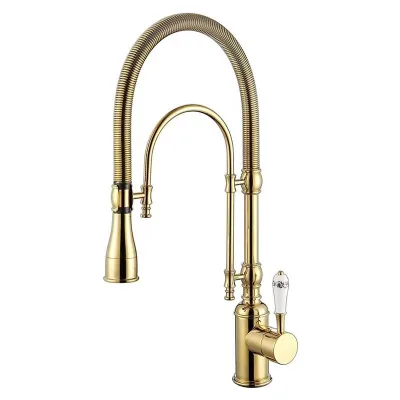
Surface finishing is equally critical for both aesthetics and maintenance. The "Surface Treatment" and "Surface Finishing" processes vary widely. Common finishes include "Brushed" stainless steel, which offers a matte look that hides fingerprints and water spots effectively. Other observed finishes include "Metallic Painted" options in colors such as black, gun gray, and gold. The "Color" options are extensive, ranging from standard brushed finishes to customized colors. For instance, specific models are available in "brushed three-in-one," "black three-in-one," and "gray three-in-one" configurations. The "Surface Finishing" process must be robust to prevent peeling or fading, especially in high-humidity kitchen environments.
A specific observation regarding the "Surface Finishing" is the inclusion of "With cold and hot pipe 60cm" or "Not including hot and cold pipes" as part of the finishing or packaging specification. This indicates that the supply chain for these faucets often involves bundled accessories. Buyers must clarify whether the "flexible hoses" with lengths of 370mm, 500mm, or 600mm are included in the standard package or sold separately. The "Standard" for the product is often listed as "Stainless Steel," but this may refer to the material grade rather than a specific certification standard.
Compliance, Certification, and Safety Standards
In the B2B sector, compliance is non-negotiable. While the provided data does not list specific certification bodies (such as NSF, WQA, or ISO), the presence of "Project Solution Capability" and "total solution for projects" suggests that suppliers are equipped to handle large-scale commercial installations where regulatory compliance is paramount. Buyers must verify that the "Purified Water Outlet" meets local health and safety regulations regarding drinking water quality. The "Flow Rate" of 6000 gpd must be validated against local plumbing codes to ensure it does not exceed pressure limits or violate water conservation standards.
The "Standard" field in product data often lists "Stainless Steel" or "flexible hoses," which are material descriptions rather than regulatory certifications. Procurement teams should explicitly request documentation confirming that the materials used in the "Valve Core" and "Body Material" are lead-free and compliant with relevant international standards for potable water systems. The "Warranty" period observed is up to 5 years, which serves as a proxy for the manufacturer's confidence in their product's longevity and compliance. A 5-year warranty typically implies that the product has undergone rigorous testing, but buyers should still request specific test reports to validate this claim.
Cost Drivers and Procurement Economics
The pricing structure for 3-in-1 kitchen faucets is influenced by several variables, including material composition, surface treatment complexity, and the inclusion of accessories. The observed price range in the market spans from $0.20 to $107.00 USD. This wide disparity suggests that the market includes both basic, entry-level units and high-end, feature-rich models. The lower end of the spectrum likely corresponds to units with simpler finishes or fewer included components, while the higher end reflects premium materials like solid brass, complex "brushed gold" finishes, and integrated filtration systems.
The "MOQ" (Minimum Order Quantity) is another significant cost driver, with observed ranges from 1 to 3000 units. This flexibility allows buyers to scale their orders based on project size. For small renovations or pilot projects, suppliers with low MOQs are essential. Conversely, large-scale commercial projects may benefit from the economies of scale offered by suppliers willing to accept orders up to 3000 units. The "Selling Units" are typically listed as "Single item," which simplifies inventory management but requires careful calculation of total unit costs versus bulk discounts.
Additional cost factors include the "Surface Treatment" process. "Metallic Painted" finishes may be more expensive than standard brushed finishes due to the additional labor and material costs involved. Similarly, "Customized Color" options often incur a premium and may have longer lead times. The inclusion of "flexible hoses" with specific lengths (370mm, 500mm, 600mm) also affects the final unit price. Buyers should request a detailed breakdown of costs to understand how much of the price is attributed to the faucet body versus the accessories and packaging.
Supplier Evaluation and Geographic Considerations
Geographic origin plays a significant role in the supply chain dynamics for kitchen faucets. The observed "Place of Origin" for these products is primarily "Fujian, China" and "Guangdong, China." These regions are established manufacturing hubs for plumbing fixtures, offering a dense ecosystem of suppliers, raw material providers, and logistics networks. The concentration of manufacturers in these areas can lead to competitive pricing and shorter lead times, but it also requires rigorous supplier vetting to ensure quality consistency.
When evaluating suppliers, the "After-sale Service" capability is a critical differentiator. The data indicates that many suppliers offer "Online technical support," which is essential for troubleshooting installation issues or resolving product defects. For large projects, the "Project Solution Capability" should be assessed. Suppliers offering "total solution for projects" are better equipped to handle complex logistics, custom specifications, and large-scale delivery schedules. The "Brand Name" is another factor; while some products are branded (e.g., "HY," "Jsento"), many are sold as generic or OEM products. Buyers should determine if brand recognition is a priority for their end clients or if cost efficiency is the primary goal.
The "Customization" availability is a key indicator of a supplier's flexibility. The data confirms that "Customization" is available for these products, allowing buyers to tailor the "Color," "Surface Finishing," and even the "Model Number" to specific project requirements. However, customization often comes with higher MOQs and longer lead times. Buyers must balance the desire for customization with the need for timely delivery and budget constraints.
Quality Control and Long-Term Procurement Strategy
Ensuring consistent quality in 3-in-1 faucets requires a proactive approach to quality control. The "Warranty" of 5 years is a strong indicator of expected product life, but it should be supported by a robust quality assurance process. Buyers should implement a pre-shipment inspection protocol that verifies the "Valve Core Material" is ceramic, the "Body Material" matches the specification (Stainless steel or Brass), and the "Surface Treatment" is free from defects. The "Flow Rate" should be tested to ensure it meets the claimed 6000 gpd, and the "360 Swivel" mechanism should be checked for smooth operation.
Long-term procurement considerations include the availability of spare parts and the reliability of the "After-sale Service." The "Online technical support" mentioned in the data is a positive sign, but buyers should establish clear communication channels and response time expectations. The "Packing" method, described as "Box Carton" or "Standard Export Packing," must be sufficient to protect the faucet during international shipping. Damage during transit can negate the benefits of a high-quality product, so packaging integrity should be a key inspection point.
The "Application" of these faucets ranges from "Kitchen" to "Family Hotel Kitchen," indicating versatility. Buyers should ensure that the selected model is suitable for the intended environment. For example, a "Family Hotel Kitchen" may require a more durable finish and a higher flow rate than a residential application. The "Design Style," described as "Modern" or "Contemporary," should align with the overall aesthetic of the project.
Comparative Analysis of Product Attributes
To facilitate decision-making, the following table summarizes the key attributes observed in the market for 3-in-1 kitchen faucets. This comparison highlights the diversity in specifications and helps buyers identify the features that align with their specific project needs.
| Attribute Category | Observed Options | Key Considerations for Buyers |
|---|---|---|
| Installation Type | Deck Mounted, Single Hole | Verify countertop cutout requirements and available space. |
| Valve Core Material | Ceramic | Essential for durability and leak prevention; verify authenticity. |
| Body Material | Stainless steel, Brass | Brass offers higher durability; Stainless steel offers modern aesthetics. |
| Surface Finish | Brushed, Metallic Painted, Black, Gold, Gray | Consider maintenance requirements; brushed hides fingerprints better. |
| Water Output | Hot, Cold, Purified | Ensure the "Purified Water Outlet" connects to a compatible filtration system. |
| Swivel Capability | 360 Swivel, Revolving Type | 360 swivel provides maximum sink coverage; verify rotation smoothness. |
| Spray Feature | With/Without Pull Out Spray | Determine if a retractable spray is necessary for the application. |
| Warranty | 5 Year | A strong indicator of quality; verify terms and conditions. |
| Origin | Fujian, China; Guangdong, China | Established manufacturing hubs; verify logistics and lead times. |
| Customization | Available (Color, Model) | Factor in potential cost increases and longer lead times for custom orders. |
Conclusion
Sourcing 3-in-1 kitchen faucets requires a balanced approach that weighs technical specifications, material quality, and supplier reliability. The market offers a wide range of options, from basic single-hole models to complex, customized units with advanced surface treatments. Buyers must prioritize the verification of core components like the ceramic valve and the integrity of the surface finish. By focusing on the observed attributes such as the 5-year warranty, the specific flow rates, and the geographic concentration of manufacturers in Fujian and Guangdong, procurement teams can build a resilient supply chain. The ability to customize and the availability of online technical support further enhance the value proposition of these products. Ultimately, successful procurement depends on rigorous due diligence, clear communication of requirements, and a commitment to quality control at every stage of the supply chain.
FAQs
What materials are used for the 3-in-1 Kitchen Faucet body?
The body material is typically stainless steel or brass. Stainless steel models offer a modern brushed finish, while brass bodies provide structural integrity for high water pressure applications in family or hotel kitchens.
How is the valve core constructed for durability?
The valve core is constructed from ceramic material. This ceramic core ensures smooth switching between hot, cold, and purified water streams and resists wear over years of daily use in a kitchen environment.
Can the faucet be customized for specific projects?
Yes, customization is available for these units. Buyers can request specific colors, surface finishes like metallic painted options, and tailored model numbers to meet unique project solution capabilities and design styles.
What is the warranty period for these kitchen faucets?
The warranty period is up to five years. This coverage reflects the manufacturer's confidence in the product's longevity, provided the ceramic valve core and stainless steel body are installed correctly.
Which installation types are supported for single hole setups?
These faucets support deck mounted installation for single hole setups. They are designed to fit modern countertops with a single hole requirement, often featuring a 360 swivel spout for maximum sink utility.
How does the flow rate compare for high capacity needs?
The flow rate can reach up to 6000 gallons per day. This high capacity is suitable for commercial applications, though buyers must verify local plumbing codes to ensure compliance with water conservation standards.
What surface treatments are available for the faucet finish?
Available surface treatments include brushed stainless steel and metallic painted finishes. Options range from standard brushed colors to customized black, gun gray, or gold finishes to match contemporary design styles.