Source Automatic 120cm DTF Printer for textiles, paper, and film
Find 30 Automatic 120cm DTF Printer options from verified suppliers. Compare specifications like print speed, resolution, and ink types for textile, paper, and film applications.
Key considerations
Products List


300mm Dtf Printer China Dtf Printing Machine High Quality Very Low Cost
$3000.00 - $3900.00
MOQ: 1 Pieces


Dtf Printer 60cm Dtf Printer Printing Automatic Machine All in One Dtf Printer
$7746.00 - $7988.00
MOQ: 1 Pieces




Comprehensive Sourcing Guide
Strategic Sourcing Guide for Automatic 120cm DTF Printers
Understanding the Technical Landscape of 120cm DTF Solutions
When sourcing an automatic 120cm Direct-to-Film (DTF) printer, buyers must navigate a complex matrix of technical specifications that define performance, versatility, and integration capabilities. The core keyword "Automatic 120cm DTF Printer" implies a machine capable of handling wide-format media with automated feeding or processing, yet the actual market offerings often vary significantly in their structural design and operational parameters. Based on observed product data, the market presents machines with varying print widths, such as 330mm models, and wider formats up to 60cm or potentially larger, though specific 120cm configurations require careful verification against the supplier's actual technical sheet.
A critical observation in the current supply base is the diversity in printhead technology. High-performance units often utilize Epson F1080-A1 printheads, which are known for reliability in industrial settings. However, buyers must verify if the specific 120cm model they are considering utilizes this or an equivalent industrial-grade head. The printing interface is another area of divergence; while some units are configured with USB 2.0 connections, others in the same category may support USB 3.0 or USB 2.0 variants, impacting data transfer speeds and workflow efficiency. The resolution standards observed in the market typically hover around 8 Pass at 720*1440dpi, which is a standard benchmark for high-quality textile and film printing.
The ink system is paramount for DTF applications. The supply data indicates a prevalence of Pigment Ink systems, which are essential for durability and color fastness on various substrates. The operating mode is consistently described as Liquid Piezoelectric, a technology that offers precision and longevity compared to thermal inkjet systems. Furthermore, the RIP software ecosystem is a significant differentiator; standard configurations may include Riin 10.5, while Flexiprint and Maintop are often listed as optional upgrades. Buyers should not assume all machines come with the same software suite and must confirm the specific version and licensing terms during the procurement process.
Compliance, Certification, and Operational Standards
In the realm of industrial printing equipment, compliance and certification are often the most misunderstood aspects of the procurement process. While the supplied product facts do not explicitly list specific international certifications (such as CE, UL, or ISO) for the 120cm DTF printers, the absence of such data in the provided facts necessitates a rigorous verification step by the buyer. The observed product origin is Zhengzhou, China, a major manufacturing hub, but the specific compliance status of the machinery must be confirmed directly with the manufacturer.
Buyers must verify that the electrical systems meet the voltage and frequency standards of their local market. The observed power consumption for similar units is listed as 200W, but this figure may vary for larger 120cm models. The working environment is specified with a temperature range of 15 to 35 degrees Celsius, a critical parameter for maintaining ink viscosity and printhead health. If the buyer's facility operates in a climate outside this range, additional environmental controls may be required, which should be factored into the total cost of ownership.
Regarding safety and environmental standards, the ink type is identified as Pigment Ink. While this is a standard classification, the specific chemical composition and safety data sheets (SDS) must be reviewed to ensure compliance with local occupational health and safety regulations. The packaging standards observed include Plywood Cases and Wooden Boxes, which are robust for international shipping, but the buyer should verify if the packaging meets ISPM 15 standards for wood treatment if importing into regions with strict phytosanitary regulations. The "prod_standard" listed as 700500300mm in the data appears to be a dimension reference rather than a regulatory standard, and buyers should not interpret this as a certification mark without further clarification from the supplier.
Cost Drivers and Pricing Dynamics
The pricing landscape for automatic 120cm DTF printers is influenced by several key variables, including printhead configuration, software licensing, and the level of automation integrated into the system. The observed price range in the market spans from $885 to $10,396 USD. This wide disparity suggests that the lower end of the spectrum likely corresponds to smaller format machines or entry-level configurations, while the higher end reflects industrial-grade units with advanced features, larger print widths, and comprehensive software suites.
For a specific 120cm model, the cost will be heavily driven by the printhead count and type. A single Epson F1080-A1 head, as seen in some observed models, will be less expensive than a dual-head or multi-head configuration required for high-speed 120cm production. Additionally, the inclusion of optional RIP software like Flexiprint or Maintop can add significant value and cost to the base machine price. Buyers should also consider the "Automatic Grade" of the machine; units described as "Automatic" often command a premium over manual or semi-automatic counterparts due to the integrated feeding and processing mechanisms.
The Minimum Order Quantity (MOQ) observed in the data is consistently 1 unit, indicating that these machines are generally available for single-unit procurement, which is favorable for small to medium enterprises. However, the lead time is a critical cost driver; the observed delivery time is 7 days, but this is likely for stock items or standard configurations. Customized 120cm models may require extended lead times, impacting the overall project timeline and cash flow. Buyers should also factor in the cost of consumables, such as the specific pigment inks and DTF films, which are recurring expenses that can significantly affect the long-term operational budget.
Typical Applications and Production Versatility
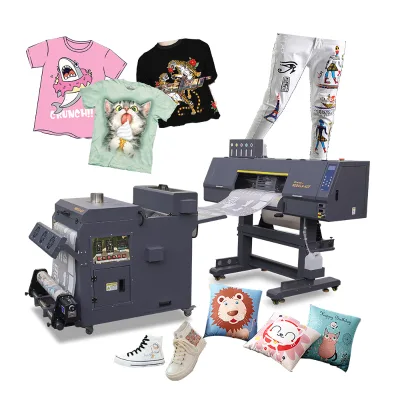
The versatility of automatic 120cm DTF printers makes them suitable for a broad spectrum of applications, ranging from textile printing to promotional products. The observed usage categories include "Cloths Printer," "Paper Printer," and "Textile Printer," indicating a multi-functional capability. The ability to print on Pet Film is a standard feature, which is the foundational step in the DTF process before the transfer is applied to the final substrate.
The print width of 330mm observed in some models suggests that while the core keyword is 120cm, the actual market may offer a range of widths, and buyers must ensure the selected machine meets their specific production volume and media size requirements. The "Max. Paper Size" of A3 or 60cm observed in the data highlights that not all machines in the category are capable of 120cm output; therefore, verification of the maximum media width is essential. The "Automatic Two-Sided Printing" feature is noted as "Not Support" in some observed models, which limits the application to single-sided printing unless the operator manually flips the media.
The "Supply Paper Mode" is described as "Automatic and Manual Integration" or "Automatic," which is crucial for high-volume production environments. The "Continuous Inkjet" technics and "Liquid Inkjet" type suggest a system designed for consistent flow and high-speed operation. The "Image Format" support, including JPG, TIF, and PDF, ensures compatibility with standard design workflows. The "Style" of "Digital Printing" confirms the machine's capability to produce high-resolution, full-color graphics without the need for screens or plates, making it ideal for short-run, high-mix production scenarios common in the custom apparel and signage industries.
Supplier Evaluation and Quality Assurance
Evaluating a supplier for an Automatic 120cm DTF Printer requires a focus on technical competence, after-sales support, and manufacturing transparency. The observed "After-Sales Service" is described as "Permanent Service," and the "Warranty" period is typically 1 Year. These are baseline expectations, but buyers should seek detailed service level agreements (SLAs) that define response times, on-site support availability, and the scope of warranty coverage. The "prod_origin" of Zhengzhou, China, indicates a concentration of manufacturing in this region, but the specific factory's quality control processes should be audited.
Quality control should extend beyond the initial purchase to include the verification of the "Print Head Cleaning" mechanism, which is listed as "Automatic." This feature is critical for maintaining printhead health and preventing costly downtime. The "Structure" of the machine, whether "Platen Press" or "Pressure Wheel," impacts the stability and precision of the printing process. Buyers should request video demonstrations or site visits to observe the machine in operation, specifically looking for noise levels, as the "Feature" list includes "Low Noise" and "Simple" operation.
The "System Configuration" of Win10/Win11 or Windowsxp64 compatibility is another area for scrutiny. While the data shows support for older systems like Windows XP, modern procurement should prioritize machines compatible with current operating systems to ensure security and software support. The "Feature" of "Small Volume" and "Low Noise" suggests a design focus on space efficiency and operator comfort, which are valuable for smaller production facilities. Buyers should also verify the "prod_packing" details, ensuring that the Plywood Case or Wood Box provides adequate protection for international shipping to prevent damage during transit.
Long-Term Procurement and Operational Sustainability
Sourcing an Automatic 120cm DTF Printer is not merely a one-time transaction but an investment in long-term production capability. The "Delivery Time" of 7 days is a positive indicator for supply chain agility, but buyers must plan for the long-term availability of spare parts and consumables. The "Ink Type" being Pigment Ink is a standard, but the specific brand and compatibility of the ink with the printer's system should be confirmed to avoid issues with clogging or color inconsistency.
The "RIP Software" options, such as Riin 10.5, Flexiprint, or Maintop, represent a critical component of the workflow. Buyers should assess the upgrade path for these software suites, as the industry evolves rapidly. The "Print Speed" of 1.2 Square Meter/H observed in some models provides a benchmark, but for a 120cm machine, the actual throughput will depend on the resolution and pass count settings. Buyers should calculate the cost per square meter of print to determine the economic viability of the machine for their specific business model.
Finally, the "Working Environment" constraints, specifically the temperature range of 15 to 35 degrees Celsius, must be maintained consistently to ensure the longevity of the machine. The "Automatic Cleaning" feature helps mitigate maintenance issues, but regular professional servicing is still recommended. By focusing on these long-term considerations, buyers can ensure that their investment in an Automatic 120cm DTF Printer delivers consistent value and operational efficiency over its lifespan.
| Feature Category | Observed Specification | Verification Requirement |
|---|---|---|
| Printhead | 1*Epson F1080-A1 | Confirm head count and model for 120cm width |
| Print Interface | USB 2.0 / USB 3.0 | Verify port type and data transfer speed |
| Ink Type | Pigment Ink | Check compatibility and consumable supply chain |
| RIP Software | Riin 10.5 (Std), Flexiprint (Opt) | Confirm license terms and version compatibility |
| Warranty | 1 Year | Review SLA details and on-site support scope |
| Working Temp | 15 to 35°C | Ensure facility climate control meets requirements |
| Packaging | Plywood Case / Wood Box | Verify ISPM 15 compliance for import |
FAQs
What is the print resolution for the Automatic 120cm DTF Printer?
The print resolution is 8 Pass at 720*1440dpi. This standard ensures high-quality output suitable for textile and film applications while maintaining consistent color accuracy across different media types.
Which ink type is used in the Automatic 120cm DTF Printer?
The printer utilizes Pigment Ink for durability and color fastness. This ink type is essential for ensuring the printed designs remain vibrant and resistant to washing on various fabric substrates.
How long is the delivery time for the Automatic 120cm DTF Printer?
The standard delivery time is 7 days for available units. Buyers should note that customized configurations or specific model requests may require extended lead times beyond this baseline period.
Can the Automatic 120cm DTF Printer support automatic two-sided printing?
No, the observed models do not support automatic two-sided printing. Operators must manually flip the media if double-sided printing is required for their specific production workflow.
What is the warranty period for the Automatic 120cm DTF Printer?
The standard warranty period is 1 Year for the machine. This coverage is typically accompanied by permanent after-sales service to assist with maintenance and technical support needs.
Which software options are available for the Automatic 120cm DTF Printer?
Standard configuration includes Riin 10.5, with Flexiprint and Maintop available as optional upgrades. Buyers should verify the specific software license included with their order to ensure workflow compatibility.
What is the power consumption of the Automatic 120cm DTF Printer?
The observed power consumption is 200W for similar units. This energy rating helps in planning electrical requirements for the production facility where the machine will be installed.
Where is the Automatic 120cm DTF Printer manufactured?
The product origin is Zhengzhou, China. This location is a major manufacturing hub, though buyers should verify specific factory details and compliance standards before finalizing procurement.