Source Commercial Grade Smith Machine for Gym Home Community
Source 30 Commercial Grade Smith Machine options from verified Chinese manufacturers. Compare specifications, weights, and certifications like CE and ISO for home, gymnasium, and community applications.
Key considerations
Products List


Gym Multi Functional Smith Machine Gym Fitness Equipment Smith Machine
$819.00 - $869.00
MOQ: 1 Pieces


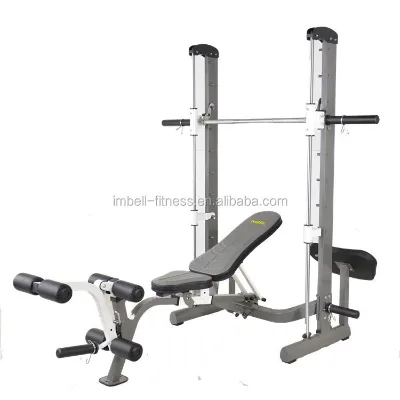


Training Gym Machine Gym Commercial Fitness Equipment for Smith Machine
$970.00 - $1270.00
MOQ: 1 Pieces


Comprehensive Sourcing Guide
Strategic Sourcing Guide for Commercial Grade Smith Machines
Understanding the Technical Architecture of Commercial Smith Machines
When evaluating commercial-grade Smith machines, buyers must first distinguish between residential and professional specifications. The core mechanical difference lies in the load-bearing capacity and the stability of the vertical guide rails. In the observed product data, machine weights range significantly, with specific models listed at 215kg, 260kg, and 300kg. These weight figures are critical indicators of stability; a heavier frame generally correlates with reduced vibration during heavy lifting, which is essential for a commercial environment where the equipment sees high-frequency usage.
The structural composition is predominantly steel, as noted in the product attributes. This material choice is non-negotiable for commercial applications, as it ensures durability against the rigors of daily gym operations. The dimensions of these units vary, with observed standard sizes including 143022052185mm, 109023002600mm, and 200012502280mm. Buyers should verify that the footprint of the selected model aligns with their facility's floor plan, as commercial spaces often have strict spatial constraints. Furthermore, the "Exercise Part" attribute indicates that while some units are designed for general full-body use, specific models are optimized for targeting the waist, legs, or arms. Understanding these functional specializations allows procurement teams to select equipment that matches the specific training modalities of their target demographic.
Compliance and Certification Verification Protocols
Safety and regulatory compliance are paramount when sourcing equipment for public or semi-public use. The product data consistently highlights CE and ISO certifications across multiple models, including those with model numbers HQ-F1063, HQ-1092, and HQ-3009. The presence of RoHS certification is also observed in specific listings, indicating compliance with restrictions on hazardous substances. However, buyers must treat these certifications as observations of specific listed products rather than universal guarantees for all inventory.
It is the responsibility of the procurement team to verify that the specific batch of equipment being purchased carries valid, current certification documents. The "Exercise Part" and "Certification" fields often appear together in the data, suggesting that safety testing may be specific to the mechanical configuration of the machine. For instance, a model designed for leg exercises may undergo different stress testing protocols than one designed for arm exercises. Buyers should request the actual test reports associated with the CE and ISO marks to ensure they are not merely marketing claims. Additionally, the "Standard" field in the data lists dimensions rather than safety standards; therefore, buyers must explicitly ask suppliers for the specific safety standard numbers (e.g., EN 957 or ASTM F1163) that the machine meets, rather than relying solely on the dimensional data provided in initial listings.
Cost Drivers and Pricing Structure Analysis
The pricing landscape for commercial Smith machines is influenced by several distinct factors, primarily material density, mechanical complexity, and customization levels. The observed price range in the market data spans from $123.24 to $1,650. This wide variance suggests a significant difference between entry-level commercial units and high-end, fully featured systems. The lower end of the spectrum may correspond to lighter-weight frames or simpler mechanical systems, while the upper end likely reflects heavier, more robust units with advanced safety features or custom configurations.
Machine weight serves as a primary cost driver. Models weighing 300kg are likely priced higher than those at 215kg due to the increased volume of steel required and the enhanced stability they offer. Customization is another critical variable; the data indicates that customization is available, and one model explicitly lists its standard as "customizable." Custom orders typically incur higher costs due to the additional engineering and production time required. Furthermore, the "Appliance" attribute shows that some units are designed for home use, while others are specified for gymnasiums and community centers. Equipment marketed specifically for "Gymnasium" and "Community" use often commands a premium due to the higher durability requirements associated with public access.
Typical Applications and Operational Environments
The versatility of commercial Smith machines allows them to serve diverse operational environments, from private fitness centers to community recreation facilities. The product attributes clearly delineate three primary application sectors: Home, Community, and Gymnasium. While some models are listed for "Home" use, the commercial-grade designation implies that these units must withstand the wear and tear of public use. Models with the "Appliance" attribute listed as "Home, Gymnasium, Community" represent the most versatile options, suitable for multi-use facilities.
The specific exercise parts targeted by the machine also dictate its application. Units designed for "Waist," "Leg," or "Arm" exercises allow facilities to create specialized training zones. For example, a facility focusing on rehabilitation or physical therapy might prioritize machines with specific ergonomic adjustments for waist or leg work. The "Folded" attribute indicates that some units are "Unfolded," suggesting a fixed installation, while others may offer foldable capabilities for space-saving in community centers. Buyers should assess whether their facility requires permanent, heavy-duty installations or flexible, space-efficient solutions. The "Export Market: Global" attribute suggests that these machines are designed to meet international usage patterns, but the specific "Appliance" designation should guide the final selection to ensure the equipment matches the intended user base.
Supplier Evaluation and Logistics Considerations
Selecting a reliable supplier is as critical as selecting the machine itself. The data provides several logistical markers that buyers can use to evaluate potential partners. The "prod_origin" is consistently listed as China, with specific mentions of "China Shandong Dezhou" and "Cn." This geographic concentration suggests a robust manufacturing hub, but buyers should verify the specific factory location to ensure it aligns with their quality expectations. The "Port of Loading" is identified as Tianjin, which is a major shipping hub, facilitating international logistics.
Lead times are a crucial factor in procurement planning. The data specifies a "Delivery Time" of "Within 25 Days After Receiving Deposite." This timeframe should be treated as a baseline for standard orders, but buyers must confirm if this applies to customized models, which may require additional production time. The "MOQ" (Minimum Order Quantity) is listed as "1 Set" for several models, which is favorable for smaller facilities or those testing a new product line. However, buyers should be aware that bulk orders may offer different pricing tiers or shipping advantages. The "prod_packing" varies between "Plywood Case," "Wooden Case," and "Carton Box." For heavy commercial equipment like a 300kg Smith machine, a plywood or wooden case is essential to prevent damage during transit. Buyers should explicitly request plywood or wooden packaging for all heavy units to ensure the equipment arrives in pristine condition.
Quality Control and Long-Term Procurement Strategy
Ensuring long-term value requires a rigorous quality control (QC) strategy that extends beyond the initial purchase. The "Machine Weight" and "Material" attributes provide a starting point for QC, but visual inspection and functional testing are necessary. Buyers should verify that the steel construction is free from weld defects and that the guide rails are perfectly aligned to prevent bar binding. The "Colour: Optional" attribute indicates that finish quality is a variable; buyers should inspect sample units for paint durability and resistance to corrosion, especially in humid gym environments.
Long-term procurement considerations include the availability of spare parts and the manufacturer's support infrastructure. While the data lists the "Machine Brand" as "Tianzhan" for one model, buyers should not assume this is the only brand available or that all models share the same support network. Establishing a relationship with a supplier that offers comprehensive after-sales support is vital. The "Customization: Available" attribute suggests that suppliers are willing to adapt products, which is a positive sign for long-term partnership potential. Buyers should negotiate service level agreements (SLAs) that cover maintenance, part replacement, and technical support. Finally, the "Standard" field lists dimensions that must be verified against the facility's layout to ensure the equipment fits and functions correctly over its lifespan. By focusing on these tangible attributes and verifying them through direct communication with suppliers, buyers can mitigate risks and secure high-quality commercial-grade Smith machines that meet their operational needs.
Comparative Analysis of Key Product Attributes
To facilitate decision-making, the following table summarizes the key attributes observed in the product data, highlighting the variations that impact procurement strategy.
| Attribute Category | Observed Variations | Procurement Implication |
|---|---|---|
| Machine Weight | 215kg, 260kg, 300kg | Heavier units offer better stability for commercial use; verify weight matches intended load capacity. |
| Dimensions | 109023002600mm, 143022052185mm, 200012502280mm | Must match facility floor plan; check clearance for bar travel and user movement. |
| Certification | CE, ISO, RoHS | Verify specific test reports; ensure certifications apply to the specific model being purchased. |
| Packing | Plywood Case, Wooden Case, Carton Box | Heavy units require Plywood/Wooden Case; Carton Box may be insufficient for 300kg+ machines. |
| Exercise Part | Waist, Leg, Arm, General | Select based on target training zones; some models are specialized, others are multi-functional. |
| Appliance Use | Home, Community, Gymnasium | "Gymnasium" and "Community" models are built for higher durability and public access. |
| Lead Time | Within 25 Days (after deposit) | Confirm if this applies to custom orders; plan inventory and installation schedules accordingly. |
| MOQ | 1 Set | Allows for single-unit procurement; verify if bulk discounts apply for multiple units. |
This comparative view underscores the importance of matching specific product attributes to the buyer's operational requirements. By systematically evaluating these factors, procurement teams can navigate the complex landscape of commercial fitness equipment sourcing with confidence and precision.
FAQs
What certifications do commercial grade smith machines typically have?
Most listed models carry CE and ISO certifications, with some also including RoHS compliance. Buyers must verify that specific batches possess valid test reports rather than assuming universal coverage for all inventory.
How much do commercial grade smith machines weigh?
Observed machine weights range from 215kg to 300kg, with heavier frames generally offering better stability for commercial environments. Selecting a unit with sufficient mass is critical for reducing vibration during heavy lifting.
Can I customize the dimensions of a Commercial Grade Smith Machine?
Customization is available for certain models, with some specifications explicitly listed as customizable. Buyers should confirm if custom orders extend the standard lead time of 25 days after receiving the deposit.
Which packaging types are used for shipping heavy commercial units?
Heavy commercial units are typically packed in plywood or wooden cases to ensure transit safety. Carton boxes are observed for lighter models but may be insufficient for machines weighing over 200kg.
What is the minimum order quantity for these machines?
The minimum order quantity is 1 set for several models, allowing for single-unit procurement. Buyers should verify if bulk orders offer different pricing tiers or shipping advantages beyond the base MOQ.
Where are commercial grade smith machines manufactured and shipped from?
Products originate from China, with specific manufacturing hubs in Shandong Dezhou and loading ports in Tianjin. This geographic concentration facilitates international logistics but requires verification of specific factory locations for quality assurance.