Find Explosion-Proof Low Profile Floor Scale for Warehouse, Factory, and Lab
Source 30 Explosion-Proof Low Profile Floor Scale units from verified Chinese manufacturers. Compare stainless steel and carbon steel models with capacities up to 10 tons, IP68 protection, and LED displays for industrial weighing needs.
Key considerations
Products List


Chinese Platform Floor Scale Industrial Digital Floor Weighing Scale with Good Price
$250.00 - $270.00
MOQ: 2 Pieces

Chinese Floor Weighing Scale 1ton 5ton 10ton Carbon Steel Floor Scales
$190.00 - $200.00
MOQ: 2 Pieces


High-Protection Washable Waterproof IP68 Electronic Weighing Floor Scale
$300.00 - $510.00
MOQ: 10 Pieces

SL-Dch Ultra-Low Double-Layer Wheeled Platform Scale High Quality Floor Scale
$250.00 - $500.00
MOQ: 10 Pieces


Comprehensive Sourcing Guide
Strategic Sourcing Guide for Explosion-Proof Low Profile Floor Scales
Understanding Technical Specifications and Structural Design
When sourcing an explosion-proof low profile floor scale, the primary objective is to identify equipment that balances high-capacity weighing with rigorous safety features for hazardous environments. The core product category identified in the market data is the electronic platform scale, specifically designed for industrial applications where precision and safety are paramount. These units are characterized by their low profile structure, which facilitates the movement of pallet jacks, forklifts, and other material handling equipment over the weighing surface without requiring ramps or elevated platforms.
The structural integrity of these scales is often defined by the material composition. Market observations indicate that the primary construction materials include stainless steel and carbon steel. Stainless steel variants are frequently selected for environments requiring high corrosion resistance, while carbon steel options may be utilized for general industrial use where cost is a factor. The standard production models identified include the PCC, PCS, PLS, EXD ID511, and SCS series. These model designations often correlate with specific capacity ranges and functional capabilities. For instance, certain configurations support weighing ranges from 30 kg up to 300 kg, while heavy-duty industrial units extend capacities to 500 kg, 1 ton, 5 tons, and even up to 10 tons.
The physical dimensions of the weighing platform are critical for integration into existing workflows. Available sizes in the observed market data include 0.75m x 0.75m, 1m x 1m, 1m x 1.2m, and 1.5m x 1.2m, with custom sizing often available to meet specific facility requirements. The scale height is a defining feature of the "low profile" designation, with specific observations noting a height of approximately 120mm. This minimal vertical footprint ensures that the scale does not obstruct traffic flow or create trip hazards. The shape of the platform is typically square or rectangular, optimized for stability and load distribution.
Compliance and Certification Verification for Hazardous Environments
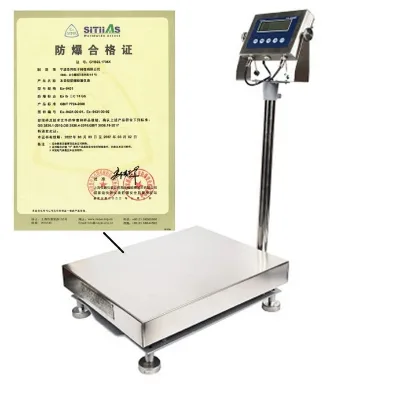
The defining characteristic of the target product is its explosion-proof capability. Sourcing guides must emphasize that "explosion-proof" is not a generic marketing term but a specific engineering standard requiring rigorous verification. The observed product data explicitly mentions an "Explosion Proof Option" and specific models where the status is confirmed as "It Is Explosion Proof." Buyers must verify that the specific unit they procure carries the appropriate certification for the hazardous zone in which it will operate.
In the context of the provided data, the model EXD ID511 is highlighted with a "Special Definition Code" for its number system, suggesting a specialized compliance framework. While specific certification bodies (such as ATEX, IECEx, or UL) are not explicitly named in the supplied facts, the presence of the "Ex" designation in the model name and the explicit mention of explosion-proof status indicate that the unit is engineered to contain internal explosions and prevent ignition of the surrounding atmosphere. Buyers should demand documentation proving that the electrical components, including the display and load cells, are rated for the specific gas or dust group and temperature class of their facility.
The protection level is another critical compliance metric. The data indicates a Protection Level of IP68 or IP69K. An IP68 rating implies complete protection against dust ingress and continuous immersion in water, while IP69K denotes protection against high-pressure, high-temperature water jets. This level of ingress protection is essential for industrial settings where washdown procedures are common, ensuring that the internal electronics remain safe from moisture and contaminants that could compromise the explosion-proof seal.
Cost Drivers and Pricing Dynamics
The pricing for explosion-proof low profile floor scales is influenced by a complex interplay of factors, including capacity, material, and safety certification. The observed market data shows a wide price range, with listed prices varying from $40 to $2,335 USD. This significant variance suggests that the base price is heavily dependent on the specific configuration and capacity of the unit. Lower-priced items likely correspond to smaller capacity scales (e.g., 30-300 kg) with standard carbon steel construction and basic electronic displays. Conversely, the higher end of the price spectrum likely reflects heavy-duty units with capacities exceeding 500 kg, constructed from stainless steel, and featuring certified explosion-proof components.
Material costs are a primary driver. Stainless steel is generally more expensive than carbon steel due to the raw material costs and the additional processing required to ensure corrosion resistance. The data notes that the standard can be "stainless or carbon steel," and the choice between these materials will directly impact the final cost. Furthermore, the customization options available, such as specific colors (blue, silver, or custom) and custom sizes, can add to the manufacturing time and cost.
The Minimum Order Quantity (MOQ) is another factor affecting procurement costs. The observed MOQ range is between 1 and 10 units. For buyers requiring a single unit for a pilot project or a specific hazardous zone, an MOQ of 1 is advantageous. However, for larger facilities requiring multiple scales, negotiating a lower unit price through a higher volume order within the 1-10 range may be possible. Buyers should also consider the packaging costs, as the data indicates options for both carton and wooden box packaging, with wooden boxes typically used for heavier, high-value units to ensure safe transport.
Typical Applications and Operational Requirements
Explosion-proof low profile floor scales are designed for environments where flammable gases, vapors, dusts, or fibers are present. The primary application is industrial weighing, but the specific use cases extend to sectors such as petrochemical processing, pharmaceutical manufacturing, grain handling, and paint manufacturing. In these environments, a standard electronic scale could generate a spark during operation or due to static discharge, posing a severe risk of explosion. The explosion-proof design mitigates this risk by containing any potential internal spark within the housing.
The functional classification of these scales includes measuring weight, mass, and price. This versatility allows them to be used not just for inventory management but also for direct transactional weighing in hazardous zones. The "Automatic" measure method ensures that the weighing process is streamlined, reducing the need for manual intervention in dangerous areas. The display type is typically LED, providing clear visibility even in low-light industrial conditions.
The capacity requirements vary significantly based on the application. Lighter loads, such as small drums or bags of chemicals, may require scales with a capacity of 300 kg. Heavier applications, such as weighing full pallets of raw materials or large tanks, may require units with capacities ranging from 1 ton to 10 tons. The data highlights specific capacity ranges of 600 kg, 1000 kg, and 1500 kg, as well as a broader range of 500 kg to 5 tons. The ability to handle lateral loads up to 300% of the safe load limit and a safety load measurement of 100% Fs ensures stability even when loads are not perfectly centered or when subjected to side impacts from forklifts.
Supplier Evaluation and Quality Assurance
Selecting a reliable supplier is critical for ensuring the safety and longevity of explosion-proof scales. The data indicates that the origin of these products is primarily China, with specific mentions of Qingdao, Shandong, as a production hub. While the specific supplier names are not provided, buyers should evaluate potential partners based on their ability to provide transparent documentation regarding the explosion-proof certification and the manufacturing process.
Quality control should focus on the manufacturing standards and material integrity. The data mentions a standard of "TCS" and "stainless steel/carbon steel," along with a heat treatment process described as "Topographic Normalize." This suggests a controlled metallurgical process to ensure the steel's durability and resistance to stress. Buyers should verify that the supplier adheres to these standards and can provide evidence of the heat treatment process.
The anticorrosion treatment is another quality indicator. The data specifies an "SA2.5" anticorrosion standard, which refers to a specific level of surface preparation and cleaning before painting or coating. This level of preparation is essential for ensuring the longevity of the scale in harsh industrial environments. Additionally, the hysteresis of the scale, noted as ≤0.02% Fs, indicates a high level of precision and repeatability, which is crucial for accurate weighing in commercial and safety-critical applications.
Long-Term Procurement and Maintenance Considerations
Procuring an explosion-proof scale is an investment that extends beyond the initial purchase price. Long-term considerations include maintenance, calibration, and the availability of spare parts. The "Customization" attribute suggests that buyers can tailor the scale to their specific needs, but they must ensure that any customizations do not compromise the explosion-proof integrity. For example, adding custom colors or modifying the display should be done in a way that maintains the IP68/IP69K rating.
The "Optional Function" of being washable is a significant long-term benefit. In industries where hygiene is critical, such as food processing or pharmaceuticals, the ability to wash down the scale without damaging the electronics is essential. Buyers should verify that the washdown capability does not void the explosion-proof certification.
Maintenance protocols should include regular calibration checks to ensure the accuracy remains within the specified limits, such as the observed accuracy of 0.1g for lighter units or 1kg for heavier ones. The "Accuracy: III" classification suggests a specific legal-for-trade or industrial accuracy class that should be maintained. Buyers should also plan for the replacement of load cells or electronic components, ensuring that the supplier can provide compatible parts that maintain the original safety ratings.
Comparative Analysis of Scale Configurations
To assist buyers in making informed decisions, the following table summarizes the key variations observed in the market data for explosion-proof low profile floor scales.
| Feature | Standard Industrial Model | Heavy-Duty Explosion-Proof Model |
|---|---|---|
| Typical Capacity | 30 kg - 300 kg | 500 kg - 10 Tons |
| Material | Carbon Steel / Stainless Steel | Stainless Steel (Preferred) |
| Protection Level | IP68 / IP69K | IP68 / IP69K |
| Explosion Proof | Optional / Standard | Certified (e.g., EXD ID511) |
| Platform Size | 0.75m x 0.75m | 1m x 1m to 1.5m x 1.2m |
| Accuracy Class | 0.1g to 1kg | Class III / 1kg |
| Packing | Carton | Wooden Box |
| Origin | China (General) | China (Qingdao, Shandong) |
This comparison highlights that while the fundamental structure remains consistent, the heavy-duty explosion-proof models require more robust materials, larger platforms, and stricter certification. Buyers must align their selection with their specific operational needs, ensuring that the chosen scale meets both the capacity requirements and the safety standards of their facility. By carefully evaluating these factors, procurement teams can secure reliable, safe, and efficient weighing solutions for their industrial operations.
FAQs
What capacity ranges are available for these scales?
Available capacities range from 30 kg to 10 tons depending on the model. Specific options include 30-300 kg, 500 kg to 5 tons, and units supporting up to 10 tons for heavy industrial applications.
Can I get an explosion-proof option for hazardous zones?
Yes, explosion-proof options are available and some models are certified as explosion-proof. Buyers must verify specific certifications for their hazardous zone requirements before procurement.
Which materials are used for the scale construction?
Scales are constructed from stainless steel or carbon steel to meet different durability needs. Stainless steel is preferred for corrosion resistance, while carbon steel serves general industrial use.
How low is the profile height of these floor scales?
The scale height is typically around 120mm, ensuring a low profile design. This minimal height facilitates easy movement of pallet jacks and forklifts over the weighing surface.
What protection level do these electronic scales offer?
These scales offer a protection level of IP68 or IP69K against dust and water ingress. This rating ensures the internal electronics remain safe during high-pressure washdown procedures.
Are customization options available for color and size?
Customization is available for colors like blue or silver, as well as specific platform sizes. Standard sizes include 0.75x0.75m and 1x1m, with other dimensions possible upon request.
What is the minimum order quantity for these products?
The minimum order quantity ranges from 1 to 10 units depending on the supplier. This allows buyers to purchase single units for pilot projects or larger batches for facility-wide deployment.