Source Folding Household Electric Kettle for Hotel, Home, and Motel
Explore 30 listings for the Folding Household Electric Kettle, featuring stainless steel and glass models with automatic shut-off. Buyers can compare heating methods, capacities, and certifications to find the right supplier for hotel, home, or motel needs.
Key considerations
Products List

360 Degree Rotational Base Hotel Electric Kettle Household Electric Kettle
$5.80 - $6.10
MOQ: 3000 Pieces


Various Color Double Layer Kettle Various Capacity Kettle for Household
$3.10 - $3.40
MOQ: 3000 Pieces


Glass Electric Kettle Hot Sell Home Appliance Water Electric Kettle Glass
$8.10 - $8.40
MOQ: 1200 Pieces


Hot Sale Stainless Steel Electric Water Kettle
$3.69 - $3.98
MOQ: 3000 Pieces
Guangzhou Kingray Electrical Appliances Technology Co., Ltd.




Comprehensive Sourcing Guide
Strategic Sourcing Guide for Folding Household Electric Kettles
The global market for portable and space-saving kitchen appliances has driven significant innovation in the electric kettle sector, with the Folding Household Electric Kettle emerging as a critical category for travelers, small-apartment dwellers, and hospitality operators. Sourcing this specific product type requires a nuanced understanding of mechanical engineering, material safety, and supply chain logistics that differs from standard rigid kettles. Buyers must navigate a landscape where the core value proposition—collapsible design—intersects with strict electrical safety standards and material durability requirements. This guide provides a structured approach to evaluating suppliers and products, grounded in verified product attributes and industry best practices.
Technical Architecture and Mechanical Design
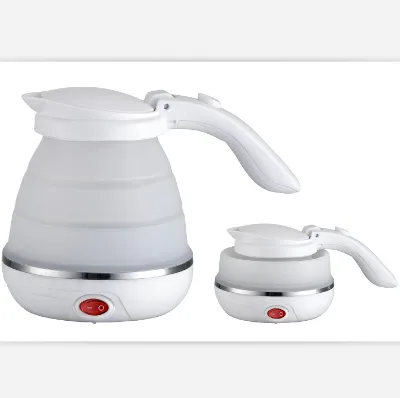
The defining characteristic of a folding electric kettle is its ability to reduce volume for storage and transport while maintaining full heating functionality. The mechanical structure typically relies on a telescopic or accordion-style heating element and a flexible body. In the observed product data, specific structural attributes such as "Rotary Type" and "Chassis Heating" or "Coil Heating" indicate the internal engineering approach. Buyers must verify the heating method, as "Chassis Heating" often implies a flat bottom that distributes heat evenly across the base, whereas "Coil Heating" utilizes a traditional exposed or semi-exposed element.
Material selection is paramount for folding kettles due to the stress placed on the hinge mechanisms and the flexible body. The supplied facts highlight "Stainless Steel" and "Glass" as primary materials, with specific grades like "304# Stainless Steel" noted for the kettle body. This grade is the industry standard for food contact safety, offering corrosion resistance and durability. However, the folding mechanism often introduces plastic components. The data indicates "ABS+PP" for tray materials and "Plastic" for inner coatings in some variants, while others feature "Glass" or "Stainless Steel" inner coatings. A critical technical evaluation point is the integrity of the hinge. The "Thickness" specifications observed, ranging from 0.4mm to 0.8mm, suggest that buyers should request detailed engineering drawings to ensure the metal thickness is sufficient to withstand repeated folding cycles without fatigue failure.
Power consumption is another technical variable. The observed power range of 1850-2200W is standard for rapid boiling. Buyers should confirm that the heating rate aligns with the power output, with data indicating a "Heating Rate" of 4-6 minutes for specific models. The "Cordless" attribute and "Cordless" base design are essential for user convenience, allowing the kettle to be lifted and poured without cable entanglement. The "Wire Cable" length of 0.75m is a specific observation that may vary; buyers must verify the cable length and flexibility to ensure it meets their specific usage environment.
Compliance and Certification Verification
Electrical safety is non-negotiable for household appliances, particularly those with moving parts and flexible bodies. The sourcing process must rigorously verify that products carry the necessary certifications for the target market. The observed product data lists a comprehensive array of certifications, including "CE/EU," "LFGB," "RoHS," "CB," "ETL," "CCC," "ISOGS," and "GS." These certifications are not merely marketing labels but legal requirements for market access in various regions.
For European markets, "CE" and "LFGB" (German Food and Feed Code) are critical, ensuring the product meets electromagnetic compatibility directives and food safety standards. The "RoHS" certification confirms compliance with restrictions on hazardous substances, which is vital for the plastic and electronic components used in folding mechanisms. In the United States, "ETL" is a widely recognized safety mark, while "CCC" is mandatory for products sold within China. The "CB" scheme facilitates global acceptance, and "GS" indicates German safety compliance.
Buyers should not assume that a single supplier's product line is uniformly certified. The data shows different certification combinations for different models (e.g., one model listing "CE/EU, LFGB, CE" while another lists "LFGB, ISOCE, RoHS, CB"). It is the buyer's responsibility to request valid, up-to-date test reports for the specific model number being procured. The "prod_model" identifiers such as "BM-208," "BM-202," "BM-207," and "BZ6119" serve as unique references for these reports. Without a specific test report matching the model, the certification claim cannot be treated as a verified fact.
Cost Drivers and Pricing Dynamics
The pricing of folding electric kettles is influenced by a complex interplay of material costs, manufacturing complexity, and certification expenses. The observed price range in the market spans from $2 to $45.9 USD. This wide disparity reflects differences in material quality, brand positioning, and feature sets. Lower-priced units often utilize "Plastic" materials with "Plastic" inner coatings and may have simpler heating elements. In contrast, premium units featuring "304# Stainless Steel" bodies, "Glass" inner coatings, and advanced "Automatic Shut-off" mechanisms command higher price points.
The "MOQ" (Minimum Order Quantity) is a significant cost driver, ranging from 1 to 3600 units in the observed data. Buyers with small order volumes may face higher per-unit costs but benefit from flexibility. Conversely, large orders can leverage economies of scale but require significant capital commitment. The "Customization" attribute being "Available" adds another layer to the cost structure. Customizing the "Logo," "Color" (e.g., "Chrome and Black Available"), or "prod_packing" (such as "3 Layers of Colorful Gift Box") incurs additional tooling and setup fees.
The "prod_packing" specifications also impact logistics costs. While some units use a "Carton Package," others utilize "5 Layers of Carton B" or "Standard Export Carton." The dimensions provided, such as "20.3cm16.5cm23cm" or "44x21x25.5cm," are crucial for calculating shipping volume and freight costs. Buyers must calculate the landed cost, which includes the unit price, packaging, freight, and duties, rather than focusing solely on the FOB price.
Typical Applications and Market Segmentation
The versatility of folding electric kettles makes them suitable for a diverse range of applications. The data explicitly lists "Hotel, Home, Motel" as primary application areas. For the hospitality sector, the compact storage capability is a major advantage, allowing hotels to provide hot water appliances in rooms with limited counter space. The "Automatic Shut-off" feature is a critical safety requirement for these environments to prevent fire hazards when guests are away.
Beyond hospitality, the "Folding" design is ideal for travelers, students, and individuals living in dormitories or small apartments. The "Cordless" design and "Plug" compatibility (listing "VDE/BS/American/Argentina/Philippine/South Africa") indicate that these products are designed for global mobility. Buyers targeting the travel market must ensure the supplier offers the correct plug types for their destination markets. The "Capacity" variations, observed at "2L" and "1.8L," allow buyers to select products based on the intended user group; larger capacities suit families or office use, while smaller capacities are better for individual travelers.
Supplier Evaluation and Operational Due Diligence
Evaluating a supplier for folding electric kettles requires more than just checking product photos. The "prod_origin" is consistently listed as "China," with specific locations like "Zhanjiang, Guangdong" noted. While this provides a geographic context, buyers should verify the supplier's manufacturing capabilities beyond the listed location. The "OEM" (Original Equipment Manufacturer) status being "Yes" suggests that the supplier can produce private-label goods, but buyers must assess their capacity for quality control and consistency.
Key evaluation criteria include the supplier's ability to handle the "Customization" requests, such as logo printing and color variations. The "Inner Coating" process, whether "Stainless Steel," "Glass," or "Plastic," must be consistent across batches. Buyers should request samples to test the folding mechanism's durability and the sealing integrity of the kettle. The "Standard" dimensions and "Thickness" specifications should be measured on physical samples to ensure they match the provided data.
Furthermore, the "prod_packing" method must be robust enough to protect the delicate folding hinges during transit. The "3 Layers of Colorful Gift Box" or "5 Layers of Carton B" options indicate different levels of protection and presentation. Buyers should inspect the packing samples to ensure the product arrives without damage, as a compromised hinge can render the kettle unusable.
Quality Control and Long-Term Procurement Strategy
Implementing a robust quality control (QC) strategy is essential for maintaining product integrity. The "Heating Rate" and "Power" specifications must be verified through third-party testing to ensure the kettle boils water efficiently and safely. The "Automatic Shut-off" function should be tested repeatedly to confirm it activates at the correct temperature or water level. For folding kettles, the mechanical stress test is particularly important; the product should undergo thousands of folding cycles to ensure the hinge does not crack or leak.
Long-term procurement considerations involve building a relationship with a supplier who can maintain consistency. The "Certification" status should be re-verified annually, as standards and regulations can change. Buyers should also monitor the "Material" supply chain to ensure that "304# Stainless Steel" and other raw materials remain consistent in quality. The "Color" and "Logo" customization options should be standardized to avoid confusion in the supply chain.
In conclusion, sourcing folding household electric kettles requires a balanced approach that prioritizes safety, durability, and compliance. By carefully analyzing the technical specifications, verifying certifications, understanding cost drivers, and implementing strict quality control measures, buyers can secure a reliable supply of high-quality products. The wide range of observed models, from "BM-208" to "BZ6119," offers flexibility, but the buyer's diligence in selecting the right specifications for their specific market needs is the ultimate determinant of success.
FAQs
What certifications are available for folding electric kettles?
Products carry certifications like CE, LFGB, RoHS, and CB for safety compliance. Specific models may also include ETL, CCC, or GS marks depending on the target region and manufacturing batch.
Which materials are used for the kettle body and inner coating?
Kettle bodies are typically made of 304 stainless steel or glass. Inner coatings vary by model, utilizing stainless steel, glass, or plastic to ensure food safety and durability during use.
Can the product logo and color be customized for bulk orders?
Yes, logo customization is available along with color options like chrome and black. Buyers can also request specific packing styles such as colorful gift boxes or standard export cartons.
What is the typical capacity and power consumption for these kettles?
Common capacities range from 1.8 liters to 2 liters for household use. Power consumption generally falls between 1850 and 2200 watts to achieve a heating rate of 4 to 6 minutes.
How does the heating method affect the kettle performance?
Heating methods include chassis heating for even distribution or coil heating for traditional boiling. The structure is often rotary type, ensuring efficient heat transfer and automatic shut-off functionality.
What are the standard dimensions and packaging details?
Standard dimensions vary, with sizes around 20 to 22 cm and heights near 23 cm. Packaging options include single cartons, multi-layer gift boxes, or standard export cartons for safe shipping.