Source Food Sealing Vertical Film Sealer for Seasoning, Rice, and Flour
Find and compare 30 Food Sealing Vertical Film Sealer options for seasoning, rice, and flour packaging. These automatic and manual models offer adjustable sealing heights and temperature control for various solid and paste applications; compare the available evidence and request quotations based on your requirements.
Key considerations
Products List


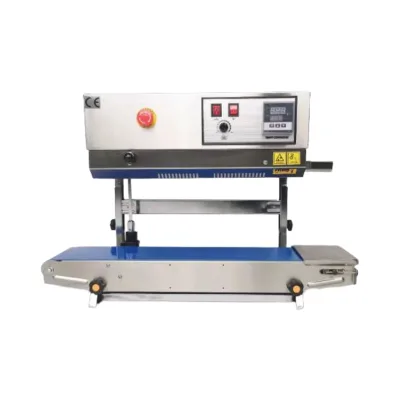
Professional Vertical Continuous Sealer for High-Volume Food Packaging
$1000.00 - $1100.00
MOQ: 1 Pieces


Professional Food Vacuum Single Chamber Plastic Film Bag Sealer for Business Use
$4200.00 - $5120.00
MOQ: 1 Pieces


Advanced Automatic Tray Sealer for Efficient Food Packaging Solutions
$8800.00 - $16800.00
MOQ: 1 Sets

Durable Horizontal Sealer for Quick and Efficient Packaging Solutions
$7000.00 - $13500.00
MOQ: 1 Sets




Comprehensive Sourcing Guide
Food Sealing Vertical Film Sealer Sourcing Guide
The market for food sealing vertical film sealers presents a diverse range of automated and manual solutions designed for high-volume production environments. Observed listings indicate a strong presence of machines capable of handling bulk solids, liquids, powders, and pastes, with specific models identified as fully automatic filling and sealing units. Buyers should note that while some units are marketed with "low price" and "factory price" attributes, the actual observed price range spans significantly from $4.75 to $16,800, reflecting the variance between simple handheld devices and complex industrial lines.
Procurement decisions must account for the specific packaging material requirements, as observed data lists both plastic and film as primary materials for these sealing operations. The application scope is broad, covering items such as seasoning, rice, flour, snacks, fish, meat, vegetables, fruits, tea, and various dairy or cosmetic products. When evaluating a vertical film sealer, it is critical to distinguish between machines designed for outpacking versus those intended for inner packing, as the mechanical properties and sealing strength requirements differ substantially between these two distinct usage scenarios.
Product Scope and Observed Listing Signals
Buyers must carefully distinguish between the various functional classifications found in current listings, as the term "sealing machine" encompasses everything from basic bag sealers to full automatic filling and sealing systems. Some observed models are explicitly labeled as "Bags Sealing Machine" or "Packaging Sealing Machine," while others are described with specific model identifiers like QLF1680 or ZH-QR. This variation suggests that a single search query may return equipment with vastly different capabilities, requiring the buyer to verify whether the unit is a standalone sealer or a complete packaging line component.
The physical configuration and output capacity are equally critical signals for scope definition, with observed specifications ranging from manual operation to fully automatic grades. One observed unit features a speed of 1-5 pieces per minute with a weight of 8.5kg, suitable for low-volume or prototype applications, whereas other listings describe heavy-duty units with dimensions exceeding 10 meters in length. The presence of customizable options and the availability of different packing types, such as plywood cases or wooden crates, further indicates that the product scope extends beyond the machine itself to include specialized logistics and installation requirements.
Technical Specifications to Verify
Verification of the temperature control range is a primary technical requirement, as observed data indicates a capability spanning from 0 to 300 degrees Celsius. This wide range is essential for processing diverse food items, from heat-sensitive dairy products to high-temperature sealing of heavy-duty packaging films. Buyers should confirm that the specific unit's heating elements and control systems can maintain stability across this entire spectrum, as fluctuations can lead to seal failures or product degradation, particularly when handling pastes or liquids that require precise thermal management.
The mechanical dimensions and load-bearing capacity must also be rigorously checked against the intended production line throughput. Observed specifications include an adjustable sealing height of 180 to 630mm and a conveying load limit of up to 25kg, which defines the maximum package size and weight the machine can handle. Additionally, the sealing length of 450mm and the number of characters printed, capped at 20, are critical for ensuring the machine meets specific branding and labeling needs. Failure to match these physical constraints with the actual product dimensions can result in operational bottlenecks or the inability to seal larger commercial packages effectively.
Compliance and Safety Documentation
While specific certification status is not universally confirmed in the provided data, buyers must insist on documentation proving compliance with relevant electrical and mechanical safety standards. The presence of "Automatic Grade" machines implies complex electrical systems that require adherence to international safety protocols to prevent operator injury. It is the buyer's responsibility to request proof of conformity, such as CE certification or equivalent regional standards, before finalizing any purchase, as the absence of such documentation poses significant liability risks in a commercial manufacturing environment.
Safety features related to the machine's operation, such as emergency stops and guarding mechanisms, should be explicitly detailed in the technical manual. The observed data mentions the absence of an inflatable device in some models, which simplifies the mechanical design but requires verification that the sealing jaws and conveyor systems are adequately protected. Buyers should ensure that the supplier provides a comprehensive safety manual that outlines lockout/tagout procedures and maintenance protocols, ensuring that the equipment can be operated safely by staff with varying levels of technical expertise.
Cost Drivers and Commercial Terms
The commercial landscape for these machines is influenced heavily by the level of automation and the complexity of the sealing mechanism. Observed listings highlight "Factory Price" and "Low Price" attributes, yet the actual cost variance is substantial, driven by factors such as the inclusion of automatic filling capabilities versus simple sealing functions. Buyers should analyze whether the lower price points correspond to manual or semi-automatic units that may require higher labor costs, or if they represent genuine efficiencies in a fully automated system that reduces long-term operational expenses.
Customization availability is a significant cost driver that can alter the total cost of ownership. The data confirms that customization is available, which allows buyers to tailor the machine to specific packaging materials or product shapes. However, this flexibility often comes with a premium and may impact the lead time. Buyers must negotiate clear terms regarding the cost of custom tooling, the impact on the minimum order quantity, and the warranty coverage for modified components to avoid unexpected expenses after the initial purchase agreement is signed.
Supplier Qualification and Quality Control
Supplier qualification should begin with a verification of the production origin, as observed data points to manufacturers located in Zhejiang, China. This regional concentration suggests a mature supply chain with established expertise in packaging machinery, but it also necessitates a thorough vetting process to ensure the specific factory meets quality expectations. Buyers should request evidence of the supplier's manufacturing capacity, including details on their assembly lines and quality assurance processes, to confirm they can consistently produce units that match the observed specifications.
Quality control extends to the physical condition and packaging of the delivered equipment. The data indicates that units are supplied in various packing configurations, including bags, cartons, and wooden cases, which must be robust enough to protect the machinery during international transit. Buyers should verify that the "New" condition claim is backed by a rigorous inspection protocol, ensuring that the machine arrives without defects. Additionally, the supplier should provide a clear inspection report detailing the final testing of the sealing temperature, speed, and mechanical integrity before shipment.
Long-Term Procurement Checks
Sustainability and maintenance requirements are critical for long-term procurement success, particularly given the diverse range of materials these machines handle. The ability to process bulk solids, liquids, and pastes means that the machine will require regular cleaning and part replacement to prevent cross-contamination and mechanical wear. Buyers should establish a maintenance schedule that aligns with the machine's operational intensity and ensure that the supplier provides a reliable supply chain for spare parts, such as sealing jaws and heating elements.
Future scalability is another key consideration, as the observed product range includes models with varying speeds and capacities. A buyer should assess whether the selected machine can be upgraded or integrated with additional modules as production demands grow. The availability of customization suggests that the supplier may offer modular upgrades, but this must be confirmed in the initial contract. Ensuring that the machine remains compatible with evolving packaging standards and product formulations will protect the investment and prevent the need for premature equipment replacement.
FAQs
What is the temperature control range for this sealing machine?
The temperature control range is 0-300℃, allowing precise sealing for various film types. This wide range ensures reliable performance for both sensitive materials and robust packaging needs. Operators can adjust settings to match specific product requirements, ensuring consistent seal quality across different production runs without compromising material integrity.
Can this machine handle different product states like powder or paste?
Yes, the machine supports solid, liquid, powdery, and paste object states. This versatility makes it suitable for diverse applications including seasoning, rice, flour, snacks, fish, meat, vegetables, fruit, tea, and dairy products. The design accommodates various material viscosities, ensuring effective sealing regardless of the product's physical form.
What are the packaging dimensions for the HI450-3 model?
The packaging dimensions for the HI450-3 model are 75*16*29mm. This compact packaging size facilitates efficient storage and shipping logistics. The small footprint allows for easy handling and integration into existing warehouse systems, reducing transportation costs and maximizing space utilization during distribution to various global markets.
Is customization available for the automatic sealing machine?
Customization is available for the automatic sealing machine to meet specific operational needs. Buyers can tailor features such as sealing height, which is adjustable from 180-630mm, to fit unique packaging requirements. This flexibility ensures the equipment integrates seamlessly into diverse production lines, enhancing efficiency and adapting to varying product specifications.
What is the conveying load capacity of the sealing machine?
The conveying load capacity is up to 25kg, supporting heavy-duty packaging operations. This robust capacity ensures stable performance when handling bulk solids or dense products like rice, flour, or meat. The machine maintains consistent speed and sealing quality even under maximum load, providing reliable throughput for high-volume manufacturing environments.
Where is the ZH-QR model manufactured?
The ZH-QR model is manufactured in Zhejiang, China. This location is a known hub for packaging machinery production, offering access to skilled labor and established supply chains. Buyers can leverage this origin for reliable quality control and efficient logistics, ensuring timely delivery and consistent product standards for international sourcing requirements.