Source Frame Type Chassis Straightening Machine for Workshop, 4s Shop, Garage
Compare 30 frame type chassis straightening machines from verified suppliers. These hydraulic units support lifting capacities from 3.5T to 50T with customizable worktables and CE certification for workshop and 4s shop applications.
Key considerations
Products List


Chassis Straightener with Measurement System Frame Correction Machine
$10999.00 - $11406.00
MOQ: 1 set

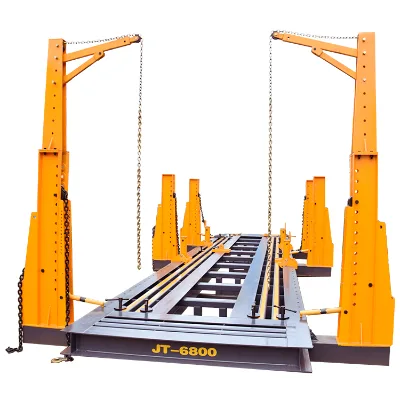

Automotive Frame Straightening Machine for Collision Repair and Chassis Alignment
$4800.00 - $4900.00
MOQ: 1 Pieces

Popular Collision Frame Straightening Machine Chassis Alignment System
$3350.00 - $3450.00
MOQ: 1 Pieces


New Collision Frame Straightening Machine - Chassis Alignment System
$5350.00 - $5450.00
MOQ: 1 Pieces

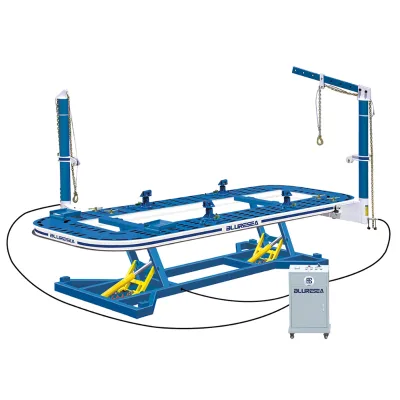
Auto Body Chassis Straightening Machine for Car Frame Metal for Machine Shop Use
$3350.00 - $3520.00
MOQ: 1 sets

Chassis Straightening Machine Auto Repair Equipment Car Frame Machine
$5469.00 - $6009.00
MOQ: 1 Pieces

Chassis Straightening Machine Auto Body Frame Machine for Repair Shop
$6373.00 - $7010.00
MOQ: 1 Pieces

Chassis Straightening Machine Auto Shop Tools Auto Body Frame Machine
$3717.00 - $4089.00
MOQ: 1 Pieces


Manufacturer Supply Collision Frame Machine Chassis Straightening Machine
$1500.00 - $1800.00
MOQ: 2 Pieces


Vehicle Body Auto Chassis Straightening Machine Auto Body Car Frame Machine
$2500.00 - $3800.00
MOQ: 1 Pieces
Comprehensive Sourcing Guide
Strategic Sourcing Guide for Frame-Type Chassis Straightening Machines
Understanding Core Technical Specifications and Variability
When sourcing a frame-type chassis straightening machine, buyers must first navigate the significant variance in technical specifications that define the machine's capability. The market presents a spectrum of models, ranging from compact units suitable for general workshop repairs to heavy-duty systems designed for high-tonnage industrial applications. Based on observed product data, the classification "Frame-type" indicates a structural design where the chassis is secured and manipulated within a rigid frame, often utilizing hydraulic power for precision alignment.
A critical parameter for evaluation is the maximum lifting capacity. The observed data reveals a wide disparity in capabilities, with specific models listing capacities of 3.5T, 4T, 5T, and even up to 50T. This range suggests that a single procurement strategy cannot apply to all buyers; a 4S shop may require a 5T unit, while a heavy vehicle repair center might necessitate a 50T system. Buyers must verify the specific lifting capacity against the heaviest vehicle they intend to service. Additionally, the weight of the machine itself is a logistical factor, with observed weights ranging from 800kg to 10T, directly impacting shipping costs and foundation requirements.
The hydraulic system is the heart of these machines. Specifications indicate the use of dual pumps in certain configurations, operating at hydraulic pressures up to 70Mpa (10000PSI). This pressure rating is essential for generating the necessary force to straighten bent frames without damaging the metal. The driving type is consistently hydraulic across the observed samples, ensuring smooth and controllable force application. Furthermore, the pulling mechanism varies; some units are equipped with 4 to 6 pulling towers, which allows for multi-directional force application. The worktable dimensions are equally critical, with lengths ranging from 6600mm to 11800mm and widths around 2580mm, often customizable to fit specific bay layouts.
Compliance, Certification, and Safety Standards
In the B2B machinery sector, compliance is not merely a formality but a prerequisite for operational legality and insurance validity. The observed product data explicitly lists CE and ISO certifications. The CE mark indicates conformity with health, safety, and environmental protection standards for products sold within the European Economic Area. The ISO reference, specifically linked to quality management in the background context, suggests adherence to systematic production controls. However, buyers should treat these as observations of specific listings rather than universal guarantees for every supplier.
When evaluating a potential supplier, the verification of these certifications must be rigorous. Buyers should request current, valid certificates from the manufacturer rather than relying on marketing claims. The "Standard" attribute observed in the data is listed as "Standard," which is a generic descriptor. In procurement, this requires clarification. Buyers must ask for the specific international or national standards the machine meets, such as ISO 9001 for quality management or specific machinery safety directives (e.g., Machinery Directive 2006/42/EC in Europe).
Safety features are integral to the machine's design. The "Post Working Range" of 360 degrees observed in the data suggests full rotational capability, which is a safety and efficiency feature allowing access to all sides of a chassis. However, the absence of Bluetooth support in the observed specifications highlights a potential limitation for modern digital integration. Buyers looking for IoT-enabled monitoring or digital load cells must explicitly verify if the specific model supports such connectivity, as the base models may lack these advanced digital interfaces.
Cost Drivers and Financial Considerations
The financial landscape of sourcing a frame-type chassis straightening machine is influenced by several distinct cost drivers. The observed price range is substantial, spanning from $1,450 to $54,000 USD. This variance is not arbitrary; it correlates directly with the machine's capacity, size, and feature set. A unit priced at the lower end of the spectrum likely corresponds to a smaller lifting capacity (e.g., 3.5T or 4T) and a shorter worktable, whereas the higher-end units align with the 50T capacity and extensive customization options.
Payment terms are a significant component of the financial negotiation. The observed standard payment structure involves a 30% deposit. This is a common practice in heavy machinery procurement to secure production slots and cover initial material costs. Buyers should be aware that the remaining balance is typically due upon completion or before shipment, though specific terms can vary. The "Selling Units" being listed as "Single item" indicates that these are not typically sold in bulk packages, but rather as individual, high-value assets.
Shipping and logistics represent a hidden but substantial cost driver. The "Product Packing" is listed as "Polywood," which is a standard for export packaging to prevent damage during transit. However, the physical dimensions and weight of the unit dictate the freight method. A machine weighing 10T with a worktable length of over 11 meters will require specialized heavy-lift shipping and potentially flat-rack containers, significantly increasing the landed cost compared to a lighter, more compact unit. Buyers must factor in these logistics costs when comparing the base price of different models.
Typical Applications and Operational Environments
The versatility of frame-type chassis straightening machines makes them suitable for a diverse range of automotive and industrial environments. The observed "Suitable" attributes explicitly mention "Workshop" and "4s Shop," indicating that these machines are designed for professional automotive repair facilities. In a 4S shop (Sales, Spare parts, Service, Survey), the machine serves as a critical tool for collision repair, ensuring that vehicle frames are restored to factory specifications to maintain safety and structural integrity.
Beyond standard automotive repair, the high-tonnage models (up to 50T) suggest applications in heavy-duty sectors. These include fleet maintenance for trucks, buses, and specialized construction vehicles. The "Product name: Truck frame machine" confirms that specific models are tailored for the robust frames of commercial transport. The ability to customize the worktable length (6600-11800mm) allows these machines to accommodate the varying lengths of different vehicle chassis, from compact cars to long-haul trucks.
The "Material" attribute, noted as Stainless Steel in some listings, points to durability and resistance to corrosion, which is beneficial in environments where chemical exposure or moisture is common. However, buyers should verify if the structural frame is stainless steel or if this refers to specific clamps or table surfaces, as the primary load-bearing structure is typically high-strength carbon steel. The "Condition" is consistently listed as "New," implying that buyers should expect to source from manufacturers producing fresh inventory rather than refurbished units, unless explicitly stated otherwise.
Supplier Evaluation and Operational Capabilities
Selecting the right supplier requires a deep dive into their operational capabilities and reliability. The "Brand Name: HYA" and "Product Origin: China" provide a starting point for supplier identification, but buyers should not limit their search to a single brand. The "Customization: Available" attribute is a crucial differentiator. It indicates that the supplier can modify the machine to fit specific buyer requirements, such as adjusting the worktable width or height. This flexibility is vital for workshops with unique spatial constraints or specialized repair needs.
Lead time is another critical factor in supplier evaluation. The observed delivery time is "15 Working Days." While this provides a baseline, buyers must confirm if this is a standard lead time or if it fluctuates based on order volume or customization requirements. The "Market: Global" attribute suggests the supplier has experience with international logistics, but buyers should still verify their experience with shipping to their specific region.
The "Warranty: 18 Months" is a strong indicator of supplier confidence in their product quality. A warranty period of this length suggests that the manufacturer expects the machine to perform reliably for at least a year and a half. However, buyers must scrutinize the warranty terms. Does it cover the hydraulic pumps? What about the structural frame? Are labor costs for repairs included? These details are often omitted in general summaries and require direct negotiation.
Quality Control and Long-Term Procurement Strategy
Ensuring long-term value requires a robust quality control (QC) strategy. Given the hydraulic nature of these machines, the integrity of the seals, hoses, and pumps is paramount. The observation of "2 Pumps" in some models suggests redundancy or increased power, but it also introduces more potential points of failure. Buyers should request detailed maintenance schedules and spare parts lists before finalizing a purchase. The "Single gross weight" of 1.900 kg for a single package (likely a component or accessory) versus the total machine weight highlights the importance of understanding the full scope of what is included in the shipment.
Long-term procurement considerations extend beyond the initial purchase. The "Customized" color and "Standard 4 Clamp" configurations suggest that while the core machine is standard, accessories and finishes can be tailored. Buyers should consider the availability of replacement clamps and the ease of sourcing them. The "Platform height" of 600mm is a standard ergonomic consideration, but buyers should verify if this height is adjustable, as this can impact operator comfort and safety over long shifts.
Finally, the "30% Deposit" and "30% Depsoit" (likely a typo for Deposit in the source data) payment structure implies a standard commercial relationship. Buyers should ensure that the contract clearly defines the milestones for the remaining payment. A clear understanding of the "Standard" dimensions (e.g., 2800500750mm or 42001000520mm) is essential for facility planning. Buyers must measure their workshop bays to ensure the machine, including its operational range, fits without obstruction.
Comparative Analysis of Key Machine Attributes
To assist in the decision-making process, the following table summarizes the key observed attributes across the different model ranges. This comparison highlights the trade-offs between capacity, size, and weight.
| Attribute | Low-Capacity / Compact Models | Mid-Capacity / Standard Models | High-Capacity / Heavy Duty Models |
|---|---|---|---|
| Max. Lifting Capacity | 3.5T - 4T | 5T | 50T |
| Machine Weight | 800kg - 2000kg | ~2000kg | 10T |
| Worktable Length | Standard (approx. 2.8m) | Standard (approx. 4.2m) | 6600mm - 11800mm (Customizable) |
| Hydraulic Pressure | Standard | Standard | Up to 70Mpa (10000PSI) |
| Pulling Towers | Standard (4 Clamps) | Standard (4 Clamps) | 4pcs ~ 6pcs |
| Typical Application | Light vehicle repair | General workshop / 4S Shop | Heavy truck / Bus repair |
| Platform Height | 600mm | 600mm | 600mm |
This table illustrates that while the platform height and basic clamping mechanisms remain consistent, the lifting capacity and physical footprint scale significantly with the intended application. Buyers must align their choice with the specific vehicle types they service to avoid under-capacity issues or unnecessary over-investment in oversized machinery.
Final Procurement Recommendations
Sourcing a frame-type chassis straightening machine is a complex decision that balances technical requirements, financial constraints, and long-term operational needs. The observed data provides a solid foundation for understanding the market landscape, from the 3.5T units suitable for small workshops to the 50T behemoths designed for heavy industry. However, the variability in specifications necessitates a tailored approach for each buyer.
Buyers should prioritize verifying the specific lifting capacity and worktable dimensions against their actual facility constraints. The presence of CE and ISO certifications should be confirmed with valid documentation, and the 18-month warranty terms should be scrutinized for coverage details. The 30% deposit structure is standard, but the total cost of ownership, including shipping and potential customization fees, must be calculated before committing.
Ultimately, the success of the procurement lies in matching the machine's capabilities to the specific demands of the workshop. Whether it is a 4S shop requiring precision for passenger cars or a heavy-duty facility needing to straighten truck frames, the right choice depends on a thorough analysis of the technical data, a clear understanding of the supplier's capabilities, and a realistic assessment of the operational environment. By adhering to these evidence-based guidelines, buyers can make informed decisions that ensure safety, efficiency, and long-term value in their chassis straightening operations.
FAQs
What is the maximum lifting capacity for these machines?
The maximum lifting capacity varies by model, ranging from 3.5 tons to 50 tons. Buyers must verify the specific capacity against the heaviest vehicle they intend to service to ensure the machine meets their operational needs.
Can I customize the worktable dimensions for my workshop?
Yes, customization is available for worktable length and width to fit specific bay layouts. Lengths can range from 6600mm to 11800mm, and widths are often adjustable around 2580mm to accommodate different chassis sizes.
Which certifications are typically included with these machines?
Observed listings include CE and ISO certifications for compliance with safety and quality standards. Buyers should request valid certificates from the manufacturer rather than relying on general marketing claims to ensure operational legality.
How long is the delivery lead time for a new order?
The standard delivery lead time is 15 working days from order confirmation. This timeline may fluctuate based on order volume or specific customization requirements, so buyers should confirm the exact schedule before purchasing.
What payment terms are required for these heavy machinery units?
The standard payment structure requires a 30% deposit to secure production slots. The remaining balance is typically due upon completion or before shipment, though specific terms can vary between different suppliers and models.
Which models support hydraulic pressure up to 70Mpa?
Some models operate at hydraulic pressures up to 70Mpa to generate necessary force for straightening. This pressure rating is essential for aligning bent frames without damaging the metal, though not all listed units may share this specific specification.
What is the warranty period for the hydraulic system?
The standard warranty period is 18 months for the machine. Buyers must scrutinize the specific terms to understand if this covers hydraulic pumps, structural frames, and labor costs for repairs during the warranty duration.