Source Gravity Concentration Shaking Table for Gold Tin and Iron
Find 30 verified listings for the Gravity Concentration Shaking Table to compare specifications like deck separation ranges, voltage, and delivery times. Buyers can evaluate options for processing zirconium, titanium, copper, and quartz ores with customizable features and warranty terms.
Key considerations
Products List


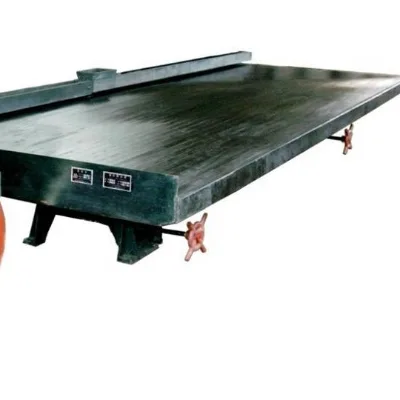
Shaker Table Gravity Separation Mining Equipment Mineral Processing Gold Shaking Table
$1000.00 - $1600.00
MOQ: 1 Pieces


Comprehensive Sourcing Guide
Strategic Sourcing Guide for Gravity Concentration Shaking Tables
Understanding the Core Technology and Operational Mechanics
Gravity concentration shaking tables are essential pieces of equipment in the mineral processing industry, designed to separate valuable minerals from gangue based on differences in specific gravity and particle size. These machines utilize a combination of a reciprocating motion and a flowing water film to stratify and transport particles across a sloping deck. The deck is typically divided into specific zones, each optimized for a particular particle size range. In the observed market data, the separation decks are clearly defined: the coarse deck handles mineral particles between 2.0mm and 0.5mm, the fine sand deck processes particles from 0.5mm down to 0.074mm, and the slime deck is dedicated to separating particles smaller than 0.074mm. This multi-deck approach allows for a high degree of precision in sorting complex ore mixtures.
The operational efficiency of these units relies heavily on the drive mechanism. The standard configuration observed utilizes an electrical motor to generate the necessary stroke, which typically ranges from 8mm to 36mm depending on the specific model and feed characteristics. The stroke length is a critical variable that buyers must verify against their feed material; a stroke that is too short may fail to stratify the ore, while one that is too long can cause excessive wear and inefficient separation. The feeding density is another crucial parameter, with observed specifications indicating an optimal range between 10% and 55%. This variability suggests that the equipment is adaptable to different processing stages, from rougher concentration to cleaner finishing. The production capacity for these units is observed to range from 20kg/H to 100kg/H, though this is heavily dependent on the specific model selected and the density of the feed material.
Technical Specifications and Model Variations
When evaluating the technical specifications of gravity shaking tables, buyers must look beyond the generic "6-S" designation often found in product listings. The market data reveals specific model identifiers such as "6-S," "6-S 7.6," and "6-S7.6," which likely correspond to the effective beneficiation area. One prominent specification notes a beneficiation area of 7.6 square meters, indicating a large-scale unit suitable for high-volume operations. The feeding size requirements also vary, with some models accepting a maximum feed size of 0.15mm, while others are optimized for finer feeds of 0.074mm. This distinction is vital for matching the equipment to the upstream grinding circuit; a table designed for fine feeds cannot effectively process coarse ore without significant re-grinding.
The physical construction of the table is equally important for long-term durability. The primary material observed in the supply chain is carbon steel, which provides the necessary structural integrity to withstand the continuous vibration and water flow. The weight of these units is substantial, with observed specifications listing a weight of 1 ton, reflecting the heavy-duty nature of the machinery. The packing standards vary between "Standard Container," "Standard Export Packing," "Steel Frame Packing," and "Wooden Cases or Plastic Membrane." These variations indicate that the packaging is often customized based on the shipping destination and the specific dimensions of the unit. Buyers should ensure that the packing method aligns with their logistics requirements to prevent damage during transit, especially for units with delicate deck surfaces or precision-machined components.
Compliance, Certification, and Regulatory Standards
In the international B2B market for mineral processing equipment, compliance and certification are non-negotiable prerequisites for procurement. The supply data indicates that reputable manufacturers adhere to international quality management standards, specifically ISO9001. Some listings explicitly reference ISO9001:2008 alongside SGS certification, suggesting a rigorous approach to quality control and product verification. Additionally, the CE mark is frequently cited, which is a mandatory conformity marking for products sold within the European Economic Area. This certification implies that the equipment meets EU safety, health, and environmental protection requirements.
However, buyers must exercise caution when interpreting certification data. The provided facts show variations in certification descriptions, such as "CE, ISO9001:Color:Blue" or "CE, ISO9001:Color:Black." These color descriptors are likely marketing attributes or internal product codes rather than indicators of certification validity. A valid ISO9001 or CE certification is a document issued by an accredited body, not a color code on the machine. Therefore, buyers should request official certification documents from the supplier rather than relying on product images or color-coded labels. Furthermore, the origin of the equipment is predominantly listed as China, with specific mentions of Jiangxi, a region known for its mineral processing industry. While the location is a known hub for such manufacturing, the specific origin (e.g., Jiangxi vs. general China) should be verified to ensure the supply chain meets any local content or trade compliance requirements.
Cost Drivers and Pricing Structure Analysis
The pricing for gravity concentration shaking tables exhibits a wide range, observed between 12 USD and 300,000 USD. This massive variance is not indicative of a single product type but rather reflects the diversity in scale, capacity, and customization options available in the market. The lower end of the price spectrum likely corresponds to small-scale laboratory units or basic models with minimal features, while the upper end represents large industrial units with significant beneficiation areas, advanced automation, or custom engineering. The minimum order quantity (MOQ) is observed to range from 1 to 12 units, suggesting that suppliers are flexible with small orders but may offer volume discounts for larger procurement batches.
Several factors drive the final cost of these units. First, the customization level is a primary cost driver. The data confirms that customization is available, and products are often listed as "Customized." This can include modifications to the deck length, the number of riffles, the drive system, or the material thickness. Second, the warranty period significantly impacts pricing. Listings show warranty options of either 1 year or 2 years. A longer warranty period often correlates with a higher initial purchase price but reduces the total cost of ownership by covering potential repair costs. Third, the delivery time influences cost; units listed as "in stock" may command a premium due to immediate availability, whereas those with a standard delivery time of 30 days might be priced lower but require longer lead times. Buyers must balance the urgency of their project timeline against the budget constraints, understanding that expedited delivery or custom specifications will invariably increase the total expenditure.
Typical Applications and Ore Compatibility
Gravity shaking tables are versatile machines designed to process a wide array of minerals. The observed applications cover a broad spectrum of commodities, including gold, silver, tin, tungsten, tantalum, niobium, columbium, titanium, iron, copper, zirconium, quartz, and coal. The specific application determines the configuration of the table. For instance, the separation of gold and tin often requires precise control over the water flow and deck slope to recover fine particles that might otherwise be lost. The data highlights specific applications for zirconium, titanium, and iron ore, as well as copper and quartz, indicating that these tables are suitable for both precious metal recovery and base metal processing.
The compatibility of the table with different ores depends on the particle size and density of the feed. The multi-deck design allows for the separation of coarse, fine, and slime fractions simultaneously. This is particularly useful in complex ore bodies where the valuable mineral is distributed across different particle sizes. For example, the coarse deck handles 2-0.5mm particles, making it suitable for recovering coarse gold or tin, while the fine sand and slime decks are essential for recovering fine gold or columbium-tantalum minerals. The feeding density range of 10% to 55% allows the table to adapt to different slurry conditions, ensuring efficient separation regardless of the ore's initial water content. Buyers should verify that the specific model selected matches the particle size distribution of their ore to maximize recovery rates.
Supplier Evaluation and Quality Control Protocols
Selecting the right supplier is critical for ensuring the reliability and performance of gravity shaking tables. The market data indicates that suppliers often provide after-sales services, including overseas service centers, which is a strong indicator of a supplier's commitment to long-term support. The availability of spare parts is another key factor, with "Supply" listed as a standard attribute. Buyers should prioritize suppliers who can demonstrate a robust supply chain for spare parts, as downtime due to missing components can be costly.
Quality control should be a central part of the evaluation process. Buyers must verify that the supplier adheres to the claimed standards, such as ISO9001, and that the equipment is in "New" condition. The warranty period, ranging from 1 to 2 years, serves as a proxy for the manufacturer's confidence in their product. A supplier offering a 2-year warranty is likely more confident in the durability of their carbon steel construction and drive systems than one offering only 1 year. Additionally, the "Customization" attribute suggests that the supplier is capable of tailoring the equipment to specific site requirements. Buyers should request detailed technical drawings and factory audit reports to validate the supplier's manufacturing capabilities. The origin of the product, specifically from Jiangxi, China, is a known manufacturing hub, but buyers should still conduct due diligence to ensure the specific factory meets international quality standards.
Long-Term Procurement and Operational Considerations
Procuring a Gravity Concentration Shaking Table is not a one-time transaction but the beginning of a long-term operational relationship. The lead time, observed to be around 30 days for standard orders or "in stock" for immediate needs, must be factored into the project schedule. For large-scale mining projects, a 30-day lead time may require early procurement to avoid delays in the commissioning phase. The production capacity, ranging from 20kg/H to 100kg/H, should be aligned with the overall throughput requirements of the processing plant. If the plant is designed for higher capacities, multiple tables or larger models may be necessary.
Energy efficiency is another long-term consideration. The "Energy Saving" attribute is listed in the product data, suggesting that modern designs incorporate motors and drive systems that minimize power consumption. Over the lifespan of the equipment, which is supported by a 2-year warranty and the availability of spare parts, energy savings can result in significant cost reductions. Furthermore, the condition of the equipment upon arrival should be verified. The "New" condition and "Standard Container" or "Wooden Cases" packing ensure that the machine arrives in optimal working order. Buyers should establish a clear acceptance protocol upon delivery, checking for any damage during transit and verifying that all components, including the electrical motor and deck surfaces, are intact. Finally, the availability of an overseas service center ensures that technical support is accessible, reducing the risk of prolonged downtime and ensuring the equipment continues to operate at peak efficiency for years to come.
FAQs
What certifications do gravity concentration shaking tables typically have?
Most units carry CE and ISO9001 certifications to ensure safety and quality standards. Some listings also reference ISO9001:2008 and SGS verification. Buyers should request official documents rather than relying on color-coded labels found in product images.
Can I customize the specifications of a Gravity Concentration Shaking Table?
Yes, customization is available for these machines to meet specific processing needs. Suppliers can adjust deck configurations, drive systems, and material thickness. This flexibility allows buyers to tailor the unit to their unique ore characteristics and site requirements.
How long is the delivery time for a Gravity Concentration Shaking Table?
Standard delivery time is typically around 30 days for custom orders. Some models may be available in stock for immediate shipment. Buyers must verify the specific lead time with the supplier as it depends on the chosen model and customization level.
Which ore types can a Gravity Concentration Shaking Table separate effectively?
These tables separate gold, tin, tungsten, tantalum, niobium, titanium, iron, and coal. They handle coarse, fine, and slime fractions using specific deck zones. The machine is suitable for zirconium, copper, and quartz processing as well as precious metal recovery.
What is the warranty period for a Gravity Concentration Shaking Table?
Warranty periods typically range from one to two years depending on the supplier. A longer warranty often indicates higher confidence in the carbon steel construction and drive systems. Buyers should confirm the specific term before finalizing the purchase agreement.
How does the feeding size affect the performance of a Gravity Concentration Shaking Table?
Feeding size must match the deck design, with options for 0.15mm or 0.074mm maximum sizes. Coarse decks handle 2-0.5mm particles while fine decks process smaller fractions. Mismatched feed sizes can reduce recovery rates and increase wear on the equipment.
What is the typical production capacity of a Gravity Concentration Shaking Table?
Production capacity ranges from 20kg per hour to 100kg per hour based on the model. This output depends heavily on feed density and the specific ore being processed. Larger units with 7.6 square meters of area generally offer higher throughput capabilities.