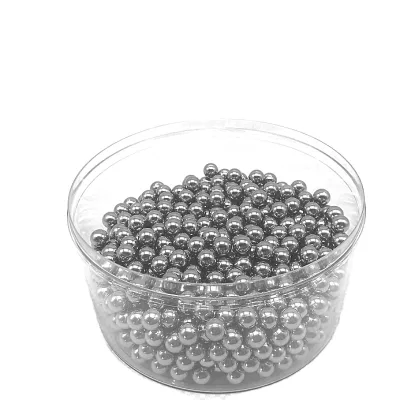
Source High Polished Stainless Steel Ball for Car, Bearing, Furniture
Compare 30 listings for High Polished Stainless Steel Ball available in sizes from 0.5mm to 150mm. Buyers can evaluate grades, surface treatments, and packaging options from verified suppliers in China.
Key considerations
Products List




Comprehensive Sourcing Guide
Strategic Sourcing Guide for High Polished Stainless Steel Balls
Understanding Technical Specifications and Material Grades
When sourcing high polished stainless steel balls, the primary focus must be on the precise material composition and the resulting mechanical properties. The market offers a variety of grades, with the supplied data indicating a range from G10 to G1000 for general bearing applications and G25 to G1000 for specific industrial uses. These grades denote the precision of the ball's geometry, where a lower number indicates higher precision. For a "high polished" finish, the surface treatment is critical; the observed data lists processes such as polishing, nickel plating, chrome plating, and sand blasting. Buyers should verify that the specific supplier can deliver the "Shine Bright" or "Polished" finish required for their application, as this directly impacts friction and wear characteristics.
The physical dimensions are equally vital. The available product data suggests a broad size spectrum, ranging from micro-sizes of 0.5mm up to large industrial balls of 150mm. Specific listings highlight diameters between 2.0mm and 25.4mm, while others note sizes from 1.5mm to 25.4mm. When defining a procurement request, it is essential to confirm the exact diameter tolerance and roundness, as the "Rotundity" attribute is a standard expectation for bearing-grade balls. Furthermore, the hardness of the material is a key performance indicator. While some data points mention a hardness range of HRC 10°-20°, this appears to be an outlier or specific to a different material context, as stainless steel typically requires significantly higher hardness for bearing applications. Buyers must explicitly request the Rockwell C hardness value for the specific stainless steel grade being offered to ensure it meets the load-bearing requirements of the machinery.
Compliance, Certification, and International Standards
In the B2B procurement of precision components, certification serves as the primary verification of a supplier's quality management systems. The observed market data frequently lists CE, ISO, and CCC certifications. Specifically, ISO and CE are the most common attributes found in the product listings, with some suppliers also holding CCC certification. These certifications indicate that the manufacturing process adheres to specific safety and quality protocols. However, buyers should not assume that every listed product automatically satisfies every standard mentioned in a general category description. Instead, the procurement strategy should involve a direct request for valid, current certification documents for the specific batch of stainless steel balls being purchased.
Regarding industry standards, the data references "National and International Standard" compliance. While specific standard numbers like ISO 9001 or ISO 14001 are mentioned in background knowledge, they should not be asserted as facts for every product without verification. The procurement guide must emphasize that the buyer should verify if the supplier adheres to relevant dimensional standards, such as DIN or ASTM standards for steel balls, depending on the target market of the final product. The "Standard Parts" attribute suggests that many suppliers offer off-the-shelf solutions that conform to established norms, but for custom applications, the "Customized" attribute indicates that dimensions and specifications can be tailored. Buyers must ensure that any custom order explicitly references the specific international standard it is intended to meet, rather than relying on a generic "International Standard" claim.
Cost Drivers and Pricing Dynamics
The pricing of high polished stainless steel balls is influenced by several interconnected factors, primarily material costs, manufacturing complexity, and order volume. The observed price range in the market spans from $0 to $1000, which reflects the vast difference between small, low-volume orders and large, bulk industrial shipments. The Minimum Order Quantity (MOQ) is a significant driver, with observed ranges extending from 1 unit to 10,000 units. Suppliers often offer "Stock or Talk Together" options, indicating flexibility for smaller buyers, but larger volumes typically secure better unit economics.
Material grade is another critical cost determinant. Higher precision grades (e.g., G10) require more rigorous grinding and polishing processes, which increase production time and cost compared to lower grades (e.g., G1000). The surface treatment also impacts the final price; a simple polished finish is generally less expensive than a multi-step process involving nickel or chrome plating. Additionally, the origin of the product plays a role in the cost structure. The data indicates that many products originate from Taian City, Shandong Province, China, a known hub for steel ball manufacturing. While this location offers competitive pricing due to established supply chains, buyers must factor in logistics, import duties, and lead times when calculating the total landed cost. The "Customized Diameters" feature also introduces a variable cost, as non-standard sizes often require dedicated tooling or setup, potentially raising the unit price unless the order volume is substantial.
Typical Applications and Usage Scenarios
High polished stainless steel balls are versatile components used across a diverse array of industries. The observed usage data highlights applications in mechanical systems, bearings, automotive sectors, furniture, and even cosmetic devices. In mechanical and automotive applications, the durability and low friction of polished stainless steel are essential for ensuring smooth operation and longevity. The "Bearing Ball" and "Bearing Roller" attributes confirm their primary role in reducing friction between moving parts. In the furniture industry, these balls are often used in drawer slides and swivel mechanisms where smooth movement and resistance to corrosion are paramount.
The "Four-Way" type mentioned in the data suggests specialized applications, possibly in directional control mechanisms or specific valve systems. The "Low Temperature" attribute indicates suitability for environments where standard materials might become brittle, making these balls ideal for cryogenic or extreme cold applications. Furthermore, the "Cosmetic" usage points to applications in high-end consumer goods where aesthetics and hygiene are critical, as stainless steel resists rust and maintains its "Silvery White" or "Sliver" appearance. Buyers should match the specific grade and finish to the environmental conditions of the application; for instance, a high-polish finish is preferable for cosmetic devices to prevent bacterial buildup, while a higher hardness grade is necessary for heavy-duty automotive bearings.
Supplier Evaluation and Origin Verification
Evaluating a supplier requires a deep dive into their operational capabilities and geographical location. The data consistently points to China, specifically Taian City and Shandong Province, as the primary origin for these products. This concentration of manufacturing in a specific region suggests a mature supply chain with specialized expertise in steel ball production. However, buyers should verify the specific factory location and capacity to ensure they are dealing with a direct manufacturer or a reputable distributor. The "Customized" attribute implies that the supplier has the engineering capability to produce non-standard sizes, which is a strong indicator of technical competence.
When assessing suppliers, the "Quality: Very Good" attribute observed in some listings should be treated as a marketing claim rather than a verified fact. Buyers must request third-party test reports or quality assurance documentation to substantiate quality claims. The "Sample: Available" attribute is a crucial tool for evaluation; it allows buyers to physically inspect the surface finish, roundness, and hardness before committing to a large order. Additionally, the packaging methods, ranging from "Paper Box/Woven Bag+Wooden Crates" to "Steel Drum" or "Plywood Case," indicate the supplier's attention to protecting the product during transit. A supplier that offers robust packaging options is more likely to handle the delicate polished surfaces of stainless steel balls without damage.
Quality Control and Long-Term Procurement Considerations
Implementing a rigorous quality control (QC) process is essential for maintaining the integrity of the supply chain. The "Feature: Durability" attribute underscores the need for products that withstand repeated stress and environmental exposure. Buyers should establish clear acceptance criteria based on the observed specifications, such as the size range of 2mm to 25.4mm or the broader 0.5mm to 150mm spectrum. Regular audits of the supplier's production line can help ensure that the "Polished" or "Shine Bright" finish remains consistent across batches. The "Standard: 25kg" or "20kg/25kg" packaging standards suggest a need for precise weight verification to ensure the correct quantity is received.
For long-term procurement, building a relationship with a supplier who offers "Talk Together" flexibility is advantageous. This approach allows for ongoing dialogue regarding market fluctuations, material availability, and design changes. The "OEM: Customized Diameters" capability ensures that the supplier can adapt to evolving product designs without requiring a complete change in vendor. Buyers should also consider the environmental impact of their procurement, noting that while specific environmental certifications like ISO 14001 are mentioned in background knowledge, they should be verified directly with the supplier. Finally, maintaining a buffer stock of critical sizes can mitigate the risk of supply chain disruptions, ensuring that the "Mechanical" and "Car" applications remain operational without interruption.
Comparative Analysis of Product Attributes
To assist buyers in making informed decisions, the following table summarizes the key attributes observed in the market for high polished stainless steel balls. This comparison highlights the variability in specifications and helps buyers identify the features most relevant to their specific needs.
| Attribute Category | Observed Options | Key Considerations for Buyers |
|---|---|---|
| Material | Stainless Steel, Chrome Steel, Carbon Steel | Verify the specific alloy grade for corrosion resistance and hardness. |
| Surface Finish | Polished, Shine Bright, Nickel Plating, Chrome Plating | Match the finish to the application's friction and aesthetic requirements. |
| Size Range | 0.5mm-150mm, 2mm-25.4mm, 1.5mm-25.4mm | Confirm exact diameter tolerances and availability of custom sizes. |
| Grade/Precision | G10-G1000, G25-G1000 | Lower numbers indicate higher precision; select based on load requirements. |
| Certification | ISO, CE, CCC | Request valid certificates for the specific batch to ensure compliance. |
| Packaging | Paper Box, Woven Bag, Wooden Crates, Steel Drum | Ensure packaging protects the polished surface during shipping. |
| Origin | China (Taian City, Shandong Province) | Verify factory location and logistics capabilities for lead time planning. |
By carefully analyzing these attributes and cross-referencing them with the specific needs of the application, buyers can navigate the complex landscape of stainless steel ball procurement effectively. The focus should remain on verifying facts through direct communication and documentation, rather than relying on general market observations. This disciplined approach ensures the acquisition of high-quality components that meet the rigorous demands of modern industrial and commercial applications.
FAQs
What certifications do high polished stainless steel balls typically have?
These balls commonly hold ISO, CE, and CCC certifications. Buyers should verify valid certificates for specific batches rather than assuming all products meet every standard mentioned in general descriptions.
Which material grades are available for these steel balls?
Available grades range from G10 to G1000 for general use and G25 to G1000 for industrial applications. Lower numbers indicate higher precision, so select the grade based on your specific load and friction requirements.
How large can high polished stainless steel balls be manufactured?
Manufacturers offer sizes from 0.5mm up to 150mm in diameter. Specific listings often highlight ranges like 2mm to 25.4mm, but custom diameters are available upon request for unique applications.
Can I get custom sizes for high polished stainless steel balls?
Yes, suppliers offer customized diameters and dimensions to meet specific needs. This customization may involve dedicated tooling, so confirm the exact specifications and potential cost implications before placing a bulk order.
What surface finishes are available for these stainless steel balls?
Common finishes include polished, shine bright, nickel plating, chrome plating, and sand blasting. Choose the finish based on your application's need for low friction, corrosion resistance, or specific aesthetic qualities.
Where are high polished stainless steel balls typically manufactured?
Most products originate from Taian City in Shandong Province, China. This region is a known manufacturing hub, offering competitive pricing but requiring buyers to factor in logistics and import duties for total cost.
What is the minimum order quantity for these steel balls?
MOQs vary from 1 unit to 10,000 units depending on the supplier. Many vendors offer stock options or flexible terms, allowing smaller buyers to purchase samples or small batches before committing to large volumes.