Source Magnetic Curtain for Hotel, Home, and Office Use
Compare 30 Magnetic Curtain options featuring insect resistance, heat insulation, and easy installation. Buyers can evaluate specifications like mesh size and material to find suitable solutions for hotels, homes, and offices.
Key considerations
Products List


Modern Crystal Curtain Metal Tieback Tie Back Magnetic Curtain Tiebacks
$0.50 - $0.80
MOQ: 5000 Pieces


$98.00 - $138.00
MOQ: 1 Square Meters


Comprehensive Sourcing Guide
Strategic Sourcing Guide for Magnetic Curtain Systems
Understanding the Product Landscape and Core Specifications
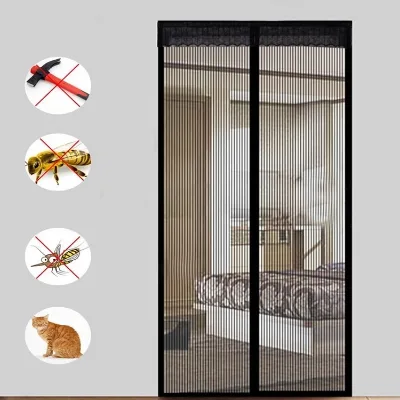
When initiating a procurement strategy for Magnetic Curtain systems, buyers must first distinguish between the various product categories that often share the core keyword. The market presents a diverse array of items ranging from insect-resistant door screens to decorative window treatments and folding room dividers. A critical initial step is to verify the specific functional intent of the product listing. For instance, certain listings explicitly identify the product as a "Magnetic Door Screen" designed for "Insect Resistant" and "Heat Insulation" applications. These units typically utilize a "Plain weaving" technique with a "Meshsize" of 1mm, constructed from "Polyester Material." In contrast, other products under the same search term may be classified as "Side Window Shades" or "Folding screens" intended for "Casement Window" applications or general room partitioning.
The technical specifications vary significantly based on the intended use. Door screens often come in standard dimensions such as "90cm210cm" or "100cm210cm," with a single package size of "28X20X8cm" and a gross weight of "0.650kg." These are frequently marketed with features like "Easy to Install" and "Nail Free" installation methods. Conversely, folding screen variants may adhere to standards like "1.2x2.2m" or offer "Customized" dimensions. The material composition is another vital differentiator; while door screens rely on polyester netting, other curtain tiebacks or shading solutions may utilize "Nylon" or "Alloy" components. Buyers must carefully cross-reference the "Product Name" and "Type" fields to ensure the procurement aligns with the specific functional requirement, whether it is "Dust-Proof," "Waterproof," or "Scratchproof" protection.
Compliance Verification and Certification Standards
In the B2B sector, verifying compliance is non-negotiable, particularly for products entering regulated markets. The supplied data indicates that a significant portion of the Magnetic Curtain and screen inventory carries certifications such as "ROHS," "ISO," and "CE." These certifications are critical for ensuring that the materials used do not contain hazardous substances and that the manufacturing processes meet international quality management standards. However, it is imperative to treat these certifications as observations of specific listings rather than universal attributes of all products found under the "Magnetic Curtain" keyword.
Buyers should not assume that every supplier or product model automatically satisfies these standards. The presence of "CE" and "ISO" marks suggests adherence to specific safety and quality protocols, but the exact standard version (e.g., ISO 9001) is not explicitly detailed in the general product attributes. Furthermore, while some listings mention "EN 12254" in background contexts, this should not be cited as a confirmed standard for the product without direct verification from the supplier. The procurement process must include a request for valid, current certification documents for the specific batch or model being ordered. This due diligence ensures that the "Magnetic Door Screen" or "Curtain Tieback" meets the regulatory requirements of the destination country, avoiding potential customs delays or legal liabilities.
Cost Drivers and Economic Parameters
The economic landscape for sourcing magnetic curtains is characterized by a wide variance in pricing and minimum order quantities (MOQ). The observed price range in the market spans from $0.04 to $300 USD, a disparity that reflects the difference between simple mesh screens and complex, customized shading systems. This broad range indicates that cost is heavily influenced by the complexity of the design, the material quality, and the level of customization required. For example, a standard "Plain weaving" polyester screen with fixed dimensions will likely fall on the lower end of the price spectrum, whereas a "Customized" folding screen with "Alloy" components and specific "Hook Style" requirements will command a higher price point.
MOQ values also fluctuate significantly, ranging from 1 unit to 5,000 units. This flexibility allows buyers to test the market with small orders or commit to large-scale procurement for hotel chains or construction projects. The "Packing" method, often described as "Plastic Bag+Carton" or "in Carton," also impacts the final landed cost. Bulk packaging reduces per-unit shipping expenses, but the "Single Gross Weight" of 0.650kg for individual units must be factored into logistics planning. Buyers should analyze the total cost of ownership, including shipping, duties, and potential volume discounts, rather than focusing solely on the unit price. The availability of "Customization" is a key cost driver; while it offers tailored solutions, it may increase the lead time and unit cost compared to standard "Pure Color" or "Havelock Pattern" options.
Typical Applications and Functional Use Cases
The versatility of Magnetic Curtain systems allows them to serve a multitude of applications across different sectors. The data highlights specific use cases such as "Hotel" environments, where "Insect Resistant" and "Heat Insulation" properties are highly valued for guest comfort and operational efficiency. These screens are often installed on doors to prevent pest entry while maintaining airflow, a feature described as "Breathable." In residential and commercial settings, the "Usage" extends to "Home," "Cafe," and "Office" spaces, where the aesthetic and functional needs differ.
For instance, "Curtain Tieback" products with "Question Mark Style" hooks are designed for decorative purposes in "Living Room" settings, while "Side Window Shades" provide sun protection for "Casement Windows." The "Sunshade Type" and "Screen Netting" materials are selected to match the specific environmental challenges of the location. A product designed for a "Hotel" application might prioritize durability and "Dust-Proof" capabilities, whereas a product for a "Cafe" might emphasize the "Havelock Pattern" and "Pure Color" aesthetics. Understanding these distinct application scenarios is essential for matching the right product to the client's needs. The "Installation" method, whether "Easy to Install" or "Nail Free," further dictates the suitability for temporary versus permanent installations in various building types.
Supplier Evaluation and Origin Verification
Evaluating suppliers requires a rigorous approach to verifying their capabilities and origins. The supplied information identifies "Hebei, China" and general "China" locations as the primary origins for these products. While this provides a geographical baseline, buyers must go beyond the stated location to assess the supplier's actual manufacturing capacity and quality control infrastructure. The presence of multiple product models, such as "HJX-Polyeaster," "CM," "vm," and "R&C," suggests a diverse product portfolio, but it also necessitates careful vetting to ensure the supplier can consistently deliver the specific model required.
Buyers should verify the "Customized" capabilities of the supplier. The data indicates that "Customized" and "Custom fit" options are available, but the extent of this customization—whether it involves changing the "Meshsize," altering the "Material," or modifying the "Hook Style"—must be clearly defined in the contract. The "Packing" requirements, such as "Packing as Customer's Requirement," indicate a level of flexibility, but this also requires clear communication to avoid errors in the final delivery. Furthermore, the "Standard" specifications, which range from fixed dimensions like "90*210cm" to "Customized" standards, must be explicitly agreed upon to prevent disputes. A reliable supplier will provide transparent documentation regarding their "Certification" status and their ability to meet specific "prod_standard" requirements.
Quality Control and Long-Term Procurement Considerations
Ensuring long-term quality in Magnetic Curtain procurement involves establishing robust quality control (QC) protocols. Given the wide range of materials from "Polyester" to "Nylon" and "Alloy," buyers must define clear acceptance criteria for each component. The "Feature" list, including "Insect Resistant," "Scratchproof," and "Waterproof," serves as a baseline for performance, but these attributes should be validated through sample testing before full-scale production. The "Single Package Size" and "Single Gross Weight" are critical for logistics planning and must remain consistent across batches to ensure efficient handling and storage.
Long-term procurement considerations also include the durability of the "Plain weaving" and the integrity of the magnetic components. Over time, exposure to environmental factors can degrade the "Screen Netting" or weaken the magnetic seal. Buyers should inquire about the lifespan of the product and the availability of replacement parts. The "Installation" method, particularly "Nail Free" options, should be tested for reusability and ease of removal without damaging the surrounding structure. Additionally, the "Customization" process should be reviewed for its impact on lead times and cost stability. A supplier that offers "Customized" solutions must demonstrate the ability to maintain quality and consistency across different production runs. By focusing on these long-term factors, buyers can build a sustainable supply chain that minimizes risk and maximizes value.
Comparative Analysis of Product Attributes
To facilitate decision-making, it is useful to compare the key attributes of different product types found under the Magnetic Curtain keyword. The following table summarizes the distinct characteristics based on the observed data:
| Attribute | Magnetic Door Screen | Side Window Shades / Folding Screens | Curtain Tiebacks |
|---|---|---|---|
| Primary Function | Insect Resistant, Heat Insulation | Sunshade, Privacy, Decoration | Decoration, Curtain Management |
| Material | Polyester Material | Nylon, Alloy, Polyester | Nylon, Alloy |
| Weaving/Structure | Plain weaving | Folding, Custom fit | Hook Style (Question Mark) |
| Standard Size | 90cm210cm, 100cm210cm | 1.2x2.2m, Custom fit | Variable (Customized) |
| Installation | Easy to Install, Nail Free | Nail Free, Custom fit | Hook Style |
| Certifications | ROHS, ISO, CE | ISO, CE, ROHS | ISO |
| Application | Hotel, Door | Casement Window, Living Room | Home, Cafe, Office |
| Key Features | Breathable, Dust-Proof, Waterproof | Sunshade Type, Scratchproof | Havelock Pattern, Pure Color |
This comparison highlights the necessity of precise specification matching. A buyer seeking a "Dust-Proof" solution for a "Hotel" door should prioritize the "Magnetic Door Screen" with its specific "Meshsize" and "Polyester" construction. Conversely, a buyer looking for decorative elements for a "Living Room" should focus on the "Curtain Tieback" with its specific "Hook Style" and "Havelock Pattern." The table underscores that while the core keyword is the same, the technical and functional requirements differ substantially, requiring a tailored sourcing approach for each category.
Final Procurement Recommendations
In conclusion, sourcing Magnetic Curtain systems requires a disciplined approach that balances technical specifications, compliance verification, and economic factors. Buyers must navigate a complex market where product attributes vary widely, from simple polyester screens to complex folding shades. The key to successful procurement lies in rigorous supplier evaluation, clear definition of customization requirements, and strict adherence to quality control standards. By leveraging the observed data on certifications, materials, and dimensions, buyers can make informed decisions that align with their specific project needs. The wide range of prices and MOQs offers flexibility, but it also demands careful cost analysis and risk management. Ultimately, a successful sourcing strategy for magnetic curtains depends on a deep understanding of the product landscape and a commitment to verifying every claim against the supplied facts and trusted industry standards.
FAQs
What certifications do Magnetic Curtain products typically hold?
Many Magnetic Curtain listings carry ROHS, ISO, and CE certifications. These marks indicate compliance with safety and quality standards, but buyers must verify specific documents for each batch to ensure regulatory adherence in their destination markets.
Which materials are used for magnetic door screens?
Magnetic door screens commonly utilize polyester material with plain weaving. Other variants may use nylon or alloy components for tiebacks and shades, so the specific material depends on the product type and intended application such as insect resistance or decoration.
Can buyers request custom sizes for magnetic curtains?
Yes, customization is available for many Magnetic Curtain products. Buyers can specify dimensions like 90cm by 210cm or request custom fits, though this may affect the unit price and lead time compared to standard pure color options.
How are magnetic curtains installed in hotels?
Installation is typically easy and often requires no nails. These units are designed for applications in hotels and homes, featuring features like insect resistance and heat insulation while allowing for breathable airflow through the mesh netting.
What is the price range for Magnetic Curtain systems?
The observed price range spans from 0.04 to 300 USD depending on the product complexity. Simple mesh screens cost less, while customized folding screens with alloy components command higher prices based on material quality and design specifications.
Where are Magnetic Curtain products manufactured?
Most products originate from Hebei, China or other regions within China. Buyers should verify the specific origin of their order to ensure logistics planning aligns with the supplier's location and to confirm the authenticity of the manufacturing source.
What packaging is used for single Magnetic Curtain units?
Single units are often packed in plastic bags inside cartons. The single gross weight is typically around 0.650kg with a package size of 28 by 20 by 8cm, which helps in calculating shipping costs and storage requirements for bulk orders.