Source Pallet Nailing Machine for Euro, US, and Custom Pallets
Find 30 Pallet Nailing Machine options from Chinese manufacturers offering semi-automatic and fully automatic models. Buyers can compare specifications like PLC control, pallet sizes up to 1200x1000mm, and automation levels for Euro, US, or custom pallet production.
Key considerations
Products List

Pallet Machine Wood Pallet Assembly Nailing Machine
$4399.00 - $7750.00
MOQ: 1 Pieces
Shandong Zouping Shuanghuan Machinery Manufacturing Co., Ltd.


Wooden Pallet Nailing Machine for Stringers Pallet
$7700.00 - $7900.00
MOQ: 1 set
Shandong Zouping Shuanghuan Machinery Manufacturing Co., Ltd.


1300mm Pallet Nailer Machine Pallet Nailing Stacking Machine with PLC System
$31000.00 - $32000.00
MOQ: 1 Sets


Wood Pallet Nailing Machine Pallet Nailing Machine Wood Pallet Machine
$25500.00 - $27500.00
MOQ: 1 Pieces
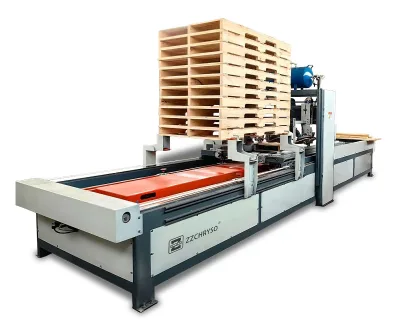


Automatic Vertical Stringer Wooden Pallet Nailer Wood Pallet Nailing Making Machine
$4100.00 - $20800.00
MOQ: 1 Set


Hicas Hot Sale Automatic Pallet Nailing Machine Block Pallet Nailing Machine
$48000.00 - $54000.00
MOQ: 14 Pieces


Wood Pallet Processing Equipment Full Automatic Pallet Nailing Machine
$7900.00 - $21800.00
MOQ: 1 Sets

Fully Automatic Wood Pallet Nailing Machine Wooden Pallets Machine Line
$8000.00 - $30000.00
MOQ: 1 Sets

Comprehensive Sourcing Guide
Strategic Sourcing Guide for Pallet Nailing Machines
Understanding Core Technical Specifications and Operational Modes
When evaluating pallet nailing machines for industrial procurement, the first step is to distinguish between the various automation levels and operational configurations available in the current market. The supply landscape presents a spectrum ranging from semi-automatic systems to fully automatic production lines, each serving distinct throughput requirements. Buyers must carefully assess whether their production volume justifies the capital expenditure of a fully automatic line or if a semi-automatic unit with manual feeding suffices.
The observed product data indicates that automation levels vary significantly. Some units are classified as semi-automatic, often requiring manual feeding of wood components, while others are designated as fully automatic with automated stacking capabilities. The operational mode is a critical differentiator; while some machines operate on a pneumatic basis, others utilize electric power types. The power supply requirements are equally diverse, with options ranging from 380V to 240V or 415V, and in some cases, custom voltage configurations are available to match local grid standards.
The mechanical architecture of these machines is defined by specific structural parameters. The number of beams in the pallet structure is a fundamental design choice, with options typically limited to three or four beams. This structural decision directly impacts the load-bearing capacity and the specific pallet type being manufactured, such as Euro or US style pallets. The nailing mechanism itself is a focal point of technical evaluation. High-performance models feature nail gun speeds reaching up to 7 times per second, ensuring rapid cycle times. The nail capacity is another vital metric, with observed figures indicating a capacity of 3,000 nails per operation cycle or magazine load, which influences the frequency of operator intervention.
Air pressure requirements are standardized in many high-end models, with 0.8MPa being a common specification for pneumatic operation. This requirement necessitates that the buyer's facility has adequate compressed air infrastructure. The control system is another critical component, with PLC (Programmable Logic Controller) systems being a standard feature for precise operation. Some advanced configurations offer CNC controlling modes, providing higher levels of precision and repeatability. The physical layout of the machine also varies, with vertical layouts being a common design choice to optimize floor space usage.
Compliance, Certification, and Standard Verification
In the global procurement of industrial machinery, verifying compliance with international standards and certifications is non-negotiable. While specific certification statuses can vary by manufacturer, the presence of ISO certification is a documented attribute in the current market supply. Buyers should treat this as a baseline requirement for quality management systems rather than a guarantee of product safety, though it indicates a commitment to standardized processes.
The physical dimensions of the machinery and the pallets it produces must align with established international standards. The maximum pallet size supported by the machines in the observed data is 1200x1000mm, which corresponds to the standard Euro pallet dimensions. However, the market also supports a broader range of pallet sizes, with specifications indicating a capability to produce pallets between 800mm and 1250mm. This flexibility allows manufacturers to produce both European and US style pallets on the same line, provided the mold type is customized accordingly.
It is crucial to note that while ISO is a verified attribute, other certifications such as CE are mentioned in background contexts but should not be assumed without direct verification from the supplier. Buyers must explicitly request current certification documents for the specific model they intend to purchase. The production standards for the machinery itself are also defined by physical dimensions, with some units adhering to a standard footprint of 22506001700mm. Understanding these dimensional constraints is essential for factory floor planning and logistics.
Furthermore, the material composition of the pallets produced is a key compliance factor. The machines are designed to manufacture wooden pallets, which must meet specific forestry and treatment standards depending on the destination market. While the machine itself is the tool, the output must comply with ISPM 15 standards for international shipping, a requirement that depends on the operator's adherence to treatment protocols rather than the machine's inherent certification.
Cost Drivers and Financial Considerations
The financial landscape of sourcing pallet nailing machines is influenced by a complex array of variables beyond the sticker price. The observed price range in the market is substantial, spanning from approximately 4,100 USD to over 368,000 USD. This wide disparity is not arbitrary but reflects the differences in automation levels, component quality, and production capacity. A semi-automatic machine with manual feeding will naturally command a lower price point compared to a fully automatic line with CNC control and automated stacking.
Production capacity is a primary cost driver. Machines with a stated capacity of 20-40 pallets per hour represent a mid-range investment, whereas fully automatic lines capable of higher throughput will incur significantly higher costs. The number of constituent parts, with some models comprising five distinct parts, also influences the complexity and price. Buyers must balance the initial capital outlay against the long-term operational savings provided by automation. A higher-priced, fully automatic machine may reduce labor costs and increase consistency, offering a better return on investment for high-volume operations.
Additional cost factors include the customization options available. Customizable mold types and color options allow for branding and specific pallet designs but add to the unit cost. The power requirements also play a role; machines requiring custom voltage configurations or specialized electrical components may incur higher shipping and installation costs. The warranty period, typically observed as one year or 12 months, is a standard inclusion, but extended warranty services often come at an additional premium.
Shipping and packaging costs are significant considerations. The observed data indicates that machines are shipped either naked or wrapped in stretch film, with some options for iron frame packaging for heavy-duty transport. The load capacity for shipping, noted as LCL (Less than Container Load) or 20gp (20-foot general purpose container), affects the logistics cost. Buyers should factor in the destination port fees and inland transportation costs, which can vary widely depending on the origin, typically identified as Shandong, China, for the majority of these units.
Typical Applications and Production Versatility
Pallet nailing machines are versatile tools designed to meet the diverse needs of the logistics and manufacturing sectors. The primary application is the mass production of wooden pallets for storage and transportation. The machines are capable of producing Euro pallets, US style pallets, and other custom types, making them suitable for a wide range of industries including agriculture, manufacturing, and retail distribution.
The ability to customize the pallet type is a significant advantage for buyers with specific logistical requirements. The function of the machine is explicitly defined as making Euro or US pallets, or other types, depending on the mold configuration. This flexibility allows a single facility to serve multiple clients with different pallet specifications without needing to invest in separate machinery. The feeding type, whether manual or automatic, dictates the suitability for different production environments. Manual feeding is often preferred for smaller batch sizes or custom orders, while automatic feeding is essential for high-volume, continuous production runs.
The stacking type is another application-specific feature. Automatic stacking ensures that finished pallets are neatly arranged and ready for immediate shipment or storage, reducing the need for manual handling. This is particularly beneficial for facilities with limited floor space or those aiming to minimize labor costs. The precision of the nailing process ensures that the structural integrity of the pallet is maintained, which is critical for heavy loads and long-distance shipping.
Furthermore, the machines are designed to handle various wood types and dimensions, provided they fall within the specified maximum pallet size of 1200x1000mm. This adaptability makes them suitable for both domestic and international supply chains. The high precision of the machines ensures consistent quality, reducing waste and rework. For buyers in the export market, the ability to produce pallets that meet specific international standards is a key application benefit.
Supplier Evaluation and Quality Assurance Protocols
Selecting the right supplier is as critical as selecting the right machine. Buyers should prioritize suppliers who demonstrate transparency in their product attributes and are willing to provide detailed technical documentation. The origin of the machinery, often identified as Shandong or China, should be verified to ensure it aligns with the buyer's sourcing strategy and risk tolerance.
Quality assurance should be a central part of the evaluation process. Buyers must verify the condition of the machines, which are typically listed as new. The precision of the machines, described as high precision, should be validated through sample production runs or third-party testing. The warranty terms, typically one year or 12 months, should be clearly understood, including the scope of coverage and the process for claiming service.
After-sales service is a critical factor in long-term procurement. The availability of 24-hour service or online support indicates a commitment to customer satisfaction. Buyers should inquire about the availability of spare parts and the lead time for replacements. The number of nail guns and their speed, such as 7 times per second, should be verified to ensure they meet the production requirements. The control system, whether PLC or CNC, should be user-friendly and supported by comprehensive training materials.
Suppliers should also be evaluated on their ability to provide customization. The availability of customizable mold types and colors suggests a flexible manufacturing process. Buyers should request case studies or references from other clients who have purchased similar machines to gauge the supplier's reliability and performance. The production capacity, ranging from 20 to 40 pallets per hour, should be matched against the buyer's projected demand to ensure the supplier can meet volume requirements.
Long-Term Procurement and Operational Sustainability
Sourcing a Pallet Nailing Machine is a long-term investment that requires careful consideration of operational sustainability and future scalability. The automation level of the machine will determine the labor requirements and the potential for future expansion. A fully automatic machine with automated stacking and CNC control offers the highest level of scalability, allowing for increased production without a proportional increase in labor costs.
Maintenance and lifecycle management are essential for long-term success. The warranty period of one year provides a baseline for support, but buyers should plan for ongoing maintenance costs. The air pressure requirements, typically 0.8MPa, and the power supply needs must be sustainable within the facility's infrastructure. The nail capacity of 3,000 nails per cycle should be balanced with the availability of consumables to ensure uninterrupted production.
The environmental impact of the machinery and the pallets it produces should also be considered. The use of wood as the primary material aligns with sustainable practices, provided the wood is sourced responsibly. The energy efficiency of the machine, particularly in electric models, can contribute to lower operational costs and a reduced carbon footprint.
Finally, buyers should consider the potential for technology upgrades. The modular nature of some machines, with five constituent parts, allows for future upgrades or modifications. This flexibility ensures that the investment remains relevant as production needs evolve. By focusing on these long-term factors, buyers can secure a Pallet Nailing Machine that not only meets current needs but also supports future growth and operational efficiency.
Comparative Analysis of Machine Configurations
To assist buyers in making informed decisions, the following table compares key attributes of the observed Pallet Nailing Machine configurations. This comparison highlights the differences in automation, control systems, and operational modes to facilitate a clearer understanding of the available options.
| Feature | Semi-Automatic Configuration | Fully Automatic Configuration |
|---|---|---|
| Automation Level | Semi-Automatic | Fully Automatic |
| Feeding Type | Manual Feeding | Automatic Feeding |
| Stacking Type | Manual or Semi-Auto | Automatic Stacking |
| Control System | PLC Control | CNC Controlling Mode |
| Operation Model | Pneumatic Operation | Electric Power Type |
| Nail Gun Speed | Variable (up to 7/sec) | High Precision (up to 7/sec) |
| Capacity | 20-40/H | Higher throughput (implied) |
| Precision | Standard | High Precision |
| Typical Use | Custom batches, lower volume | High volume, continuous production |
This table underscores the trade-offs between cost and efficiency. While semi-automatic machines offer a lower entry price and flexibility for custom orders, fully automatic machines provide superior throughput and consistency for large-scale operations. Buyers should align their choice with their specific production volume and quality requirements.
Final Procurement Considerations
In conclusion, sourcing a Pallet Nailing Machine requires a meticulous approach that balances technical specifications, compliance requirements, and financial considerations. The wide range of available options, from semi-automatic to fully automatic systems, offers flexibility for buyers with diverse needs. By carefully evaluating the automation level, control systems, and operational modes, buyers can select a machine that optimizes their production efficiency.
Compliance with international standards and certifications is essential for ensuring the quality and safety of the machinery. Buyers must verify these credentials directly with the supplier to avoid potential risks. The cost drivers, including automation level and customization options, should be weighed against the long-term operational savings and scalability.
Supplier evaluation and quality assurance protocols are critical for ensuring a successful procurement experience. Buyers should prioritize suppliers who offer robust after-sales support and transparent product information. Finally, long-term procurement considerations, such as maintenance, sustainability, and technology upgrades, should be integrated into the decision-making process to ensure the machine remains a valuable asset for years to come. By following these guidelines, buyers can make informed decisions that align with their strategic objectives and operational needs.
FAQs
What automation levels are available for pallet nailing machines?
Both semi-automatic and fully automatic models are available. Semi-automatic units often require manual feeding, while fully automatic lines include automated stacking and CNC control for higher precision and throughput.
Which pallet sizes can these machines produce?
Machines can produce pallets ranging from 800mm to 1250mm, with a maximum supported size of 1200x1000mm. Custom molds allow for the manufacture of Euro, US style, or other specific pallet types.
Can the machines be customized for specific needs?
Yes, customization is available for mold types, colors, and power configurations. Buyers can select specific beam counts, such as three or four, and choose between pneumatic or electric operation modes.
What is the typical production capacity of these units?
Typical capacity ranges from 20 to 40 pallets per hour. Fully automatic lines may offer higher throughput, while semi-automatic models with manual feeding are suited for lower volume or custom batch production.
How is the nailing mechanism configured in these machines?
The nailing mechanism features automatic nailing with speeds up to 7 times per second. Units typically hold a nail capacity of 3000 nails and operate with an air pressure requirement of 0.8MPa.
What certifications do these machines typically hold?
ISO certification is a documented attribute for many units in the supply. Buyers should verify specific certification documents for safety and quality management systems before finalizing procurement decisions.
What warranty and after-sales services are provided?
A standard warranty of one year or 12 months is typically included. After-sales support often includes 24-hour service availability and online assistance for troubleshooting and maintenance guidance.