Source Petrol Hand Held Earth Auger for Drilling Poles, Fences, and Trees
Explore 30 listings of petrol hand held earth augers with varying stroke types, power outputs, and drill sizes. Buyers can compare specifications like displacement, fuel tank capacity, and emission standards to find the right equipment for post hole drilling tasks.
Key considerations
Products List


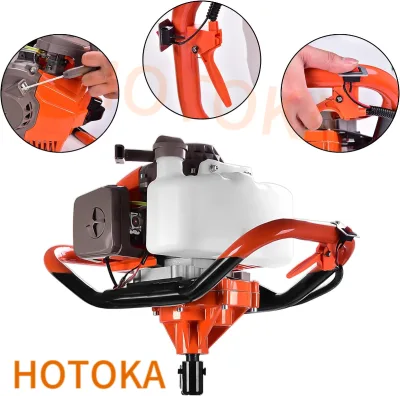


Agricultural Forest Machinery Earth Drill Auger Auger Bits Earth Auger
$57.00 - $59.00
MOQ: 100 Pieces


Gasoline Post Hole Digger Soil Digging Machine Earth Auger with Ground Drill
$70.00 - $180.00
MOQ: 2 Pieces


Comprehensive Sourcing Guide
Strategic Sourcing Guide for Petrol Hand-Held Earth Augers
Procuring a petrol hand-held earth auger requires a disciplined approach that balances mechanical specifications with supply chain reliability. These machines are essential for construction, agriculture, and landscaping, where efficiency in drilling holes for posts, piles, and fencing is critical. The market offers a wide spectrum of units, ranging from compact 2-stroke models to more robust 4-stroke variants. Buyers must navigate a complex landscape of engine types, emission standards, and logistical parameters to ensure the selected equipment meets operational demands without compromising on safety or compliance. This guide outlines the critical factors for evaluating suppliers and products, grounded in verified market data and technical realities.
Technical Specifications and Engine Architecture
The core differentiator among petrol earth augers is the engine architecture, which dictates performance, weight, and maintenance requirements. Market observations indicate a clear bifurcation between 2-stroke and 4-stroke engine configurations. The 2-stroke models are often lighter and more compact, suitable for lighter-duty tasks, while 4-stroke engines typically offer better fuel efficiency and lower emissions, aligning with stricter environmental regulations.
When evaluating technical specifications, buyers should focus on displacement and power output. Verified data points to specific engine models such as the Tt-1e43f-B and the 508t code, with a displacement of 50.8cc. The rated power for these units is frequently observed at 1.7kw/7600rpm, providing sufficient torque for standard drilling operations. Fuel tank capacity is another critical metric; observed units often feature a 0.9-litre tank, which supports approximately 50 minutes of continuous operation before refueling is required.
The transmission system also varies significantly. Buyers must verify whether the unit utilizes a single or double belt drive system. The belt configuration influences the durability of the power transfer and the ability to handle high-torque loads without slippage. Furthermore, the drill size and diameter type are paramount. Standard drill sizes observed in the market include 100mm, 150mm, and 200mm, while the diameter type for the drive shaft is commonly 26mm or 28mm. The blade type is equally specific, with options ranging from 3t to 100t, indicating the capacity to handle different soil densities and depths.
Compliance, Emission Standards, and Safety Features
Regulatory compliance is a non-negotiable aspect of modern procurement, particularly regarding engine emissions. The market data highlights that some units are certified to Stage V emission standards, while others may offer Stage V as an optional feature. This distinction is vital for buyers operating in regions with strict environmental laws. Ensuring that the engine meets the specific emission tier required by the local jurisdiction prevents legal liabilities and operational shutdowns.
Safety features are equally critical. The design of the auger must include a deris guard, with the "I Type" being a specific configuration observed in the product listings. This guard is essential for protecting the operator from flying debris and accidental contact with the rotating blade. Additionally, the handle type, often described as a "Bicycle Type," provides the ergonomic leverage necessary for controlling the machine during operation. The color of the unit, typically orange or black, is often customizable, but the presence of high-visibility colors is a standard safety recommendation in industrial settings.
Buyers must also verify the origin of the product. A significant portion of the supply chain originates from Zhejiang, China, a major manufacturing hub. While this location is a source of high-volume production, it necessitates rigorous due diligence regarding the quality control processes employed by the specific factory. The product standard for packaging is often listed as 30x30x41CM or similar dimensions, but the actual physical standard of the machine itself must be verified against international safety norms.
Cost Drivers and Pricing Dynamics
The pricing of petrol hand-held earth augers is influenced by a complex interplay of factors, including engine type, customization, and order volume. The observed price range in the market spans from $4.96 to $1,050 USD. This wide disparity reflects the difference between basic, entry-level models and high-specification units with advanced features or custom branding.
The Minimum Order Quantity (MOQ) is a primary cost driver. Data indicates that MOQs can range from 1 unit for trial orders to 300 units for bulk procurement. However, specific supplier constraints may set the MOQ at 100 pieces, which can significantly impact the unit cost for smaller buyers. Volume discounts are typically available for larger orders, with loading quantities for a 20-foot container (20gp) observed at 220 pieces and a 40-foot high cube (40hq) at 504 pieces.
Customization is another factor that influences pricing. Options for custom branding, color, and packaging (such as brown boxes or carton boxes) add value but also increase the unit cost. Buyers should be aware that while the base price may be low, the total landed cost includes shipping, insurance, and potential tariffs. The trade terms, often quoted as FOB (Free on Board) or EXW (Ex Works), determine who bears the risk and cost during transit. Understanding these terms is essential for accurate budgeting.
Typical Applications and Operational Versatility
Petrol hand-held earth augers are versatile tools designed for a variety of applications across multiple industries. In construction, they are used for drilling holes for fence posts, signposts, and light structural supports. The ability to drill at depths of up to 100mm or more makes them suitable for a wide range of foundation tasks. In agriculture, these augers are indispensable for planting trees, installing irrigation posts, and setting up greenhouse structures. The 50-minute operating time per tank of fuel allows for extended use in large fields without frequent interruptions.
The blade type plays a crucial role in determining the suitability for specific soil conditions. The market offers blades ranging from 3t to 100t, suggesting that some models are designed for soft, sandy soils, while others are built for harder, clay-rich ground. The 4-stroke engines, in particular, are often preferred for agricultural applications due to their fuel efficiency and lower maintenance requirements over long periods.
For landscaping and gardening, the compact nature of the hand-held auger allows for maneuverability in tight spaces where larger machinery cannot reach. The customizable handle types ensure that operators of different heights and strengths can find a comfortable grip, reducing fatigue during prolonged use. The specific drill sizes, such as 100mm, 150mm, and 200mm, allow for precise hole sizing for different post diameters, ensuring a secure fit and stability.
Supplier Evaluation and Verification Protocols
Evaluating suppliers requires a systematic approach to verify their capability and reliability. The first step is to confirm the supplier's origin and manufacturing capacity. Many suppliers are based in Zhejiang, China, but the specific factory's track record must be assessed. Buyers should request documentation of the supplier's production history and capacity to handle the required order volume.
Quality control is paramount. While some suppliers may claim adherence to ISO 9001:2015 standards, buyers should verify this independently rather than relying solely on marketing claims. The presence of CE certification is another common indicator of compliance, but it must be validated against the specific product batch. Buyers should request test reports and quality assurance certificates for the specific models they intend to purchase.
Customization capabilities are also a key evaluation metric. Suppliers offering ODM (Original Design Manufacturing) or OEM (Original Equipment Manufacturing) services provide flexibility in branding and design. However, buyers must ensure that the customization process does not compromise the structural integrity or safety of the machine. The ability to customize colors, packaging, and branding should be balanced with the need for consistent product quality.
Quality Control and Long-Term Procurement Considerations
Ensuring long-term reliability involves rigorous quality control measures at every stage of the procurement process. Buyers should establish clear quality standards for materials, such as the steel used for the blades, and verify that the components meet the required specifications. The delivery time, typically ranging from 20 to 40 days after prepayment, must be factored into the project timeline to avoid delays.
Packaging is another critical aspect of quality control. The standard packaging often involves carton boxes, with specific dimensions like 830575285mm or 30x30x41CM. Proper packaging ensures that the product arrives in good condition, minimizing the risk of damage during transit. Buyers should also consider the environmental impact of the packaging, especially if sustainability is a priority for their organization.
Long-term procurement considerations include the availability of spare parts and after-sales support. Buyers should inquire about the lead time for replacement parts and the supplier's policy on warranty and repairs. The ability to source parts quickly is essential for minimizing downtime and maintaining operational efficiency. Additionally, buyers should evaluate the supplier's responsiveness to technical issues and their willingness to provide training or support for their products.
Conclusion
Sourcing a petrol hand-held earth auger is a multifaceted process that requires careful attention to technical specifications, compliance, cost, and supplier reliability. By focusing on engine architecture, emission standards, and operational versatility, buyers can select equipment that meets their specific needs. The wide range of prices and MOQs offers flexibility, but it also necessitates a thorough evaluation of the total cost of ownership. Ultimately, a disciplined approach to supplier evaluation and quality control ensures that the procured equipment delivers value and performance over the long term.
FAQs
What engine types are available for petrol hand held earth augers?
Both 2-stroke and 4-stroke engine configurations are available for these units. The 2-stroke models are often lighter, while 4-stroke variants typically offer better fuel efficiency and lower emissions to align with stricter environmental regulations.
Which specifications define the power output of these augers?
The rated power is frequently observed at 1.7kw/7600rpm with a displacement of 50.8cc. Specific engine models like Tt-1e43f-B are common, providing sufficient torque for standard drilling operations in construction and agriculture.
Can buyers customize the color and branding of the earth auger?
Yes, customization is available for color, branding, and packaging options. Units typically come in orange or black, but buyers can request custom colors and ODM or OEM branding services to meet specific corporate or regional requirements.
What is the typical delivery time for these machines after payment?
The delivery time ranges from 20 to 40 days after receiving the prepayment. This lead time allows for production and quality checks, ensuring the units are ready for shipment from manufacturing hubs like Zhejiang, China.
How does the fuel tank capacity affect operational time?
The fuel tank capacity is typically 0.9 litres, supporting approximately 50 minutes of continuous operation. This duration allows for extended use in large fields or construction sites before refueling is required to maintain workflow efficiency.
What emission standards do these petrol augers meet?
Some units are certified to Stage V emission standards, while others offer Stage V as an optional feature. Buyers must verify the specific emission tier to ensure compliance with local environmental laws and avoid legal liabilities.
Which drill sizes and blade types are offered for different soils?
Standard drill sizes include 100mm, 150mm, and 200mm with blade types ranging from 3t to 100t. These variations allow the auger to handle different soil densities, from soft sandy ground to harder clay-rich terrain effectively.