Source R4 Marine Chain for Offshore Platforms, Anchoring, and Mooring
Compare 26 listings for R4 Marine Chain suitable for offshore platforms, anchoring systems, and mooring applications. Buyers can review specifications like size, material, and certifications to find the right supplier for their needs.
Key considerations
Products List




Comprehensive Sourcing Guide
Strategic Sourcing Guide for R4 Marine Chain Procurement
The global maritime industry relies heavily on the integrity of mooring and anchoring systems, where the R4 Marine Chain represents a critical component for offshore stability and vessel safety. For procurement professionals, navigating the market for this specific grade of chain requires a disciplined approach that balances technical specifications with rigorous supplier verification. The term "R4" often appears in product listings alongside various model numbers and standard designations, necessitating a clear understanding of what these identifiers signify in a real-world procurement context. This guide outlines the essential factors for sourcing R4 marine chains, focusing on the observable data points available in the current market, compliance requirements, and the structural characteristics that define this category of equipment.
Technical Specifications and Model Identification
When sourcing R4 marine chains, the first step is to decode the technical nomenclature presented in supplier catalogs. The designation "R4" is frequently observed alongside other model identifiers such as G3, R3S, and R5, suggesting a classification system that may vary by manufacturer or regional standard. In the context of the available product data, the R4 model is explicitly linked to specific dimensional and structural attributes. Buyers must verify that the "R4" designation aligns with the required chain size, which can range from 1/2 inch to 2 3/4 inches in diameter, or span metric measurements from 17.5mm to 132mm depending on the specific supplier's inventory.
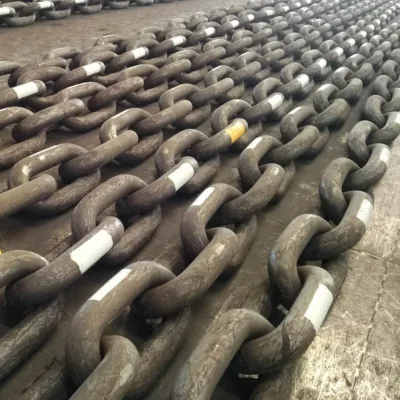
The structural integrity of the R4 chain is defined by its "Stud Link" configuration. This is a critical differentiator from welded wire or non-studded chains, as the studs prevent the links from twisting under load, ensuring uniform stress distribution. The product data confirms that the structure is a "Welded Chain" with a "Stud Link Anchor Chain" design, often described as "Anchor Stud Chain." This construction is essential for high-load applications where rotational freedom must be minimized. Furthermore, the material composition is a primary determinant of performance. While some listings cite "Cast Steel" as a general category, high-performance marine chains often utilize high-tensile steel grades such as CM490 or CM690. Procurement teams must explicitly request the material grade certificate to ensure the chain meets the yield strength requirements for the intended R4 classification.
Compliance and Certification Verification
In the marine industry, certification is not merely a formality but a legal and safety imperative. The R4 Marine Chain must comply with a stringent set of international classification society standards. The observed market data indicates that compliant products typically carry certificates from major classification societies including CCS, ABS, LRS (now LR), BV, GL, DNV, NK, and KR. These acronyms represent the Lloyd's Register, Bureau Veritas, Germanischer Lloyd, Det Norske Veritas, and Nippon Kaiji Kyokai, among others.
Buyers should not assume that a product labeled "R4" automatically possesses these certifications. The verification process requires a direct request for the specific certificate number and a cross-reference with the issuing society's database. The presence of multiple certifications in a single listing, such as "CCS.ABS.LRS.BV.GL.DNV.NK," suggests a high level of compliance, but the buyer must confirm that the specific batch of R4 chains ordered is covered under these certificates. Additionally, while some background knowledge suggests ISO 1704 as a relevant standard, this should be treated as a reference point for verification rather than a guaranteed attribute of every listed product. The primary focus must remain on the specific classification society approvals that are mandatory for the vessel's flag state and the port of entry regulations.
Cost Drivers and Pricing Dynamics
Understanding the cost structure of R4 marine chains is vital for budgeting and negotiation. The market data reveals a significant variance in pricing, with observed ranges extending from $0 to $50,000 USD. This wide spectrum is not indicative of a single product but rather reflects the diversity of order volumes, chain diameters, and material grades. The primary cost driver is the chain size; a chain with a diameter of 1/2 inch will cost significantly less per meter than a 2 3/4 inch chain. Similarly, the material grade plays a substantial role, with CM690 steel commanding a premium over standard cast steel due to its superior tensile strength.
Another critical factor influencing cost is the Minimum Order Quantity (MOQ). The data indicates that some suppliers require an MOQ of 100 tons, while others may accept orders as low as one unit. For buyers requiring smaller quantities, the unit price will likely be higher due to the fixed costs of production setup and logistics. Conversely, bulk purchasers can leverage the 100-ton threshold to negotiate more favorable pricing. It is also important to note that the "Selling Units" are often listed as "Single item," which can be misleading if the buyer does not clarify whether this refers to a single chain length or a single unit of measurement. Buyers must request a detailed quotation that breaks down costs by weight, diameter, and certification fees to avoid hidden expenses.
Typical Applications and Operational Context
The R4 Marine Chain is predominantly designed for heavy-duty offshore and maritime applications. The product data explicitly lists "Offshore platform" as a key application area, highlighting its role in securing floating structures against environmental forces. Beyond offshore platforms, the chain is essential for anchoring large vessels, where the "Stud Link Anchor Chain" structure provides the necessary holding power and resistance to abrasion. The keyword "marine&offshore" reinforces this positioning, indicating that these chains are engineered to withstand harsh saltwater environments and dynamic loading conditions.
The surface finish is another consideration for specific applications. Listings mention "Pitch," "Blacken," and "Self Colour" finishes. The choice of surface treatment depends on the operational environment; for instance, a painted or blackened finish may be required for corrosion resistance in specific coastal zones, while a self-color finish might be acceptable for internal storage or short-term use. The "Nude Packing" or "Transport Bag" options also influence the application, as the packaging must protect the chain during transit to prevent damage to the critical stud links before installation.
Supplier Evaluation and Geographic Considerations
Evaluating suppliers for R4 marine chains requires a focus on geographic origin and production capability. The data points to two primary regions of origin: Jiangsu and Shandong, both located in China. These regions are known for their robust steel manufacturing infrastructure. However, the presence of "Jiangshu" as a typo for Jiangsu in some listings underscores the need for buyers to verify the exact location of the manufacturing facility. A supplier based in Shandong, China, may have different logistical advantages compared to one in Jiangsu, particularly regarding access to ports and raw material supply chains.
Buyers should also scrutinize the brand names associated with the products. While "CSAC" and "LC" appear in the data, these should be treated as observed attributes rather than endorsements. The evaluation process must prioritize the supplier's ability to provide traceable documentation, including mill test reports and third-party inspection certificates. The "Samples: for Free" attribute mentioned in some listings can be a valuable tool for initial quality assessment, allowing buyers to physically inspect the weld quality, stud alignment, and surface finish before committing to a large order.
Quality Control and Long-Term Procurement
Ensuring the long-term reliability of R4 marine chains involves a robust quality control (QC) framework. The "Welded Chain" structure implies that the welding process is the most critical point of failure. Buyers must verify that the supplier employs automated welding techniques or has a rigorous manual inspection protocol to ensure weld integrity. The "Surface: Pitch" or "Blacken/Self Colour" treatments must be consistent to prevent premature corrosion.
For long-term procurement, lead time is a significant consideration. The data indicates delivery times ranging from "Within 20-30 days" to "Within 40 days," with some suppliers offering "15-30 days." These timelines can fluctuate based on order volume and raw material availability. Buyers should factor in these lead times when planning vessel maintenance schedules or offshore project timelines. Additionally, the "Customization: Available" attribute suggests that suppliers can tailor chain lengths and specifications, which is beneficial for unique project requirements. However, customization often extends lead times and may increase costs, requiring careful planning.
Comparative Analysis of Product Attributes
To facilitate decision-making, the following table summarizes the key attributes observed in the R4 Marine Chain market, highlighting the variations buyers must navigate.
| Attribute Category | Observed Values | Procurement Implication |
|---|---|---|
| Model Designation | R4, R3S, G3, R5, Mooring Chain | Verify that "R4" matches the specific engineering requirement; do not assume interchangeability with R3S or G3. |
| Chain Structure | Stud Link, Welded Chain, Anchor Stud Chain | Confirm "Stud Link" is present for high-load anchoring; "Welded Chain" is the base construction method. |
| Material Grade | Cast Steel, CM490, CM690 | Request Mill Test Reports to confirm CM490/690 for high-tensile applications; "Cast Steel" may be lower grade. |
| Certifications | CCS, ABS, LRS, BV, GL, DNV, NK, KR | Ensure the specific batch has valid certificates from the required societies for the vessel's flag state. |
| Dimensions | 1/2-2 3/4 inch, 17.5mm-132mm, Dia. 107mm | Match the chain diameter precisely to the winch and anchor system specifications. |
| Packing | Nude, Transport Bag, Nude Packing | Verify packaging prevents damage during transit; "Nude" implies no protective casing, requiring careful handling. |
| Origin | Jiangsu, China; Shandong, China | Verify exact factory location for logistics planning and potential tariff implications. |
| Lead Time | 15-30 Days, 20-30 Days, Within 40 Days | Plan procurement schedules based on the longest estimated lead time to avoid project delays. |
Final Procurement Considerations
Sourcing R4 marine chains is a complex process that demands attention to detail across technical, logistical, and compliance domains. The variability in model numbers, material grades, and certification requirements means that buyers cannot rely on generic descriptions. Instead, a proactive approach involving detailed specification requests, certificate verification, and physical sample inspection is essential. By focusing on the observable facts—such as the specific stud link structure, the confirmed classification society approvals, and the precise dimensional ranges—procurement professionals can mitigate risk and ensure the acquisition of high-quality marine chains that meet the rigorous demands of offshore and maritime operations. The ultimate goal is to secure a supply chain partner who can consistently deliver products that align with the safety and performance standards required for the R4 classification, ensuring the longevity and reliability of the vessel's mooring and anchoring systems.
FAQs
What certifications do R4 marine chains typically hold?
R4 marine chains typically hold certifications from major classification societies including CCS, ABS, LRS, BV, GL, DNV, NK, and KR. Buyers must verify that the specific batch ordered is covered under these certificates rather than assuming generic compliance.
Which material grades are used for R4 anchor chains?
High-performance R4 chains often utilize high-tensile steel grades such as CM490 or CM690. While some listings cite cast steel, procurement teams must request mill test reports to confirm the specific material grade for the intended application.
How long is the delivery time for R4 marine chains?
Delivery times for R4 marine chains typically range from 15 to 40 days depending on the supplier. Some vendors offer goods within 20 to 30 days, while others may require up to 40 days based on order volume and raw material availability.
Can I find R4 chains with customized specifications?
Customization is available for R4 marine chains, allowing buyers to tailor chain lengths and dimensions. This option is beneficial for unique project requirements but may extend lead times and increase costs compared to standard inventory items.
What is the minimum order quantity for R4 chains?
Minimum order quantities vary significantly, with some suppliers requiring 100 tons while others accept orders as low as one unit. Buyers requesting smaller quantities should expect higher unit prices due to fixed production and logistics costs.
Where are R4 Marine Chain manufacturers located?
Manufacturers are primarily located in Jiangsu and Shandong, China, regions known for robust steel manufacturing. Buyers should verify the exact factory location to plan logistics effectively and assess potential tariff implications for their specific import needs.