Source Retractable Aluminum Folding Ladder for Warehouses, Workshops, and Attics
Explore 30 Retractable Aluminum Folding Ladder options with varying capacities and safety features. Buyers can compare specifications like platform size, voltage, and folding mechanisms to find the right industrial or home solution.
Key considerations
Products List


Aluminum Multipurpose Foldable Step Ladder Multifunction Folding Ladder
$38.00 - $41.00
MOQ: 1000 Pieces


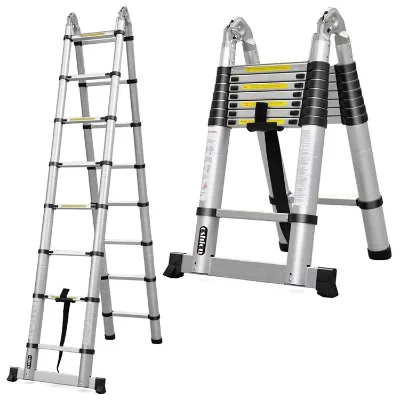


Extendable Folding Telescopic Ladder with 3.8m Length Multi Purpose Folding Ladder
$26.88 - $28.08
MOQ: 100 Pieces
Comprehensive Sourcing Guide
Strategic Sourcing Guide for Retractable Aluminum Folding Ladders
Understanding Core Technical Specifications and Design Variants
When sourcing a Retractable Aluminum Folding Ladder, the primary objective is to align the product's physical attributes with specific operational requirements. The market presents a diverse array of configurations, ranging from simple step ladders to complex multi-position systems. Based on current industry data, a critical technical observation is the material composition; aluminum is the dominant material choice due to its favorable strength-to-weight ratio and corrosion resistance. Buyers must verify the specific alloy and wall thickness, as observed specifications in the market include thicknesses around 2.1mm, which directly influences load-bearing capacity and durability.
The functional versatility of these ladders is a key differentiator. Products are frequently categorized by their deployment mechanisms, such as folding, telescopic, or combination styles. Some units are designed specifically as attic ladders, while others serve as platform ladders or multi-position systems capable of transforming into scaffolding. A notable design feature observed in high-quality units is the inclusion of a wide step design, often paired with a tool tray and a safety locking mechanism. The presence of anti-slip feet is another non-negotiable attribute for industrial applications. Furthermore, the stowing height is a critical dimension for storage logistics; observed data indicates compact folded heights, such as 587.3mm, which allows for efficient storage in tight warehouse aisles or vehicle compartments.
Platform dimensions also vary significantly based on intended use. Standard configurations may feature a platform size of 500*235mm, providing a stable standing area for tasks requiring two hands. In contrast, other models might offer different footprint dimensions to accommodate specific work environments. The structural integrity is often reinforced by features like handrails, which are essential for maintaining three points of contact during ascent and descent. Buyers should also consider the extension mechanism; while many retractable models rely on manual operation, some advanced systems may incorporate electric control features with voltage specifications of 12V or 24V, offering enhanced convenience for heavy-duty industrial use.
Compliance, Certification, and Safety Standards Verification
In the B2B procurement of industrial ladders, compliance with international safety standards is paramount. Unlike consumer-grade equipment, industrial retractable aluminum folding ladders must adhere to rigorous testing protocols to ensure worker safety. The market data highlights several specific certifications that buyers should actively seek. The EN131 standard is frequently cited as a benchmark for general ladder safety, while the EN131-6 standard specifically addresses the requirements for telescopic ladders, a common subtype of retractable designs. Additionally, the CE mark is a mandatory conformity indicator for products entering the European market, signifying that the manufacturer has met EU safety, health, and environmental requirements.
For buyers operating in North America, the ANSI standard is the primary reference point for ladder safety. It is crucial to verify that the supplier can provide documentation confirming compliance with these specific standards, rather than relying on generic claims. The presence of a certificate such as "En131" or "En131-6" should be cross-referenced with the product model number to ensure the certification applies to the specific unit being purchased. Some suppliers may also list compliance with ISO9001, which indicates a certified quality management system, though this is a process certification rather than a product safety certification.
Safety features are intrinsic to the design and must be verified during the sourcing process. High-confidence observations include the inclusion of safety indicators, robust locking mechanisms, and anti-slip feet. These features are not merely additive; they are integral to the ladder's ability to prevent falls and structural failure. Buyers should also note the distinction between insulated and non-insulated models. While some ladders are marketed as semi-insulating, others are explicitly non-insulated. For electrical work, verifying the insulation rating is critical to prevent electrocution hazards. The absence of insulation claims in certain product descriptions suggests these units are intended for general mechanical or construction tasks rather than electrical maintenance.
Cost Drivers and Pricing Dynamics in the Aluminum Ladder Market
The pricing of retractable aluminum folding ladders is influenced by a complex interplay of factors, including material costs, manufacturing complexity, and order volume. The observed price range in the market spans from approximately $11.50 to $4,000 USD. This wide variance reflects the difference between basic step ladders and highly specialized, electrically controlled, or heavy-duty industrial platforms. The lower end of the spectrum typically corresponds to simple, manual folding ladders with standard aluminum construction and minimal accessories. Conversely, the upper end of the price range often includes units with advanced features such as electric operation, larger platform sizes, or specialized certifications.
Volume is a significant driver of unit cost. The Minimum Order Quantity (MOQ) observed in the market ranges from 1 unit for sample orders to 1,000 units for bulk procurement. Suppliers often offer tiered pricing structures where the per-unit cost decreases as the order volume increases. For instance, an MOQ of 1,000 units may trigger a significantly lower price point compared to a single-unit purchase. Buyers must also consider the supply ability of the manufacturer. A supplier with a stated supply ability of 500,000 pieces per year is likely capable of handling large-scale orders with consistent pricing, whereas smaller manufacturers may have limited capacity, potentially affecting lead times and cost stability.
Packaging and logistics also contribute to the total cost of ownership. Observed packaging options include cartons, wooden cases, plastic bags with paper covers, and wooden pallets. The choice of packaging impacts shipping costs and product protection. Wooden cases and pallets are more expensive but offer superior protection for heavy or delicate units during international transit. Buyers should factor in the weight of the product, with observed own weights around 30kg, as this will influence freight charges. Additionally, customization availability is a key cost factor. While standard models are generally more affordable, requests for custom dimensions, colors, or branding can increase the unit price and extend the lead time.
Typical Applications and Operational Use Cases
Retractable aluminum folding ladders are versatile tools deployed across a wide spectrum of industries. The primary application identified in the market data is within warehouse environments, where space efficiency and mobility are critical. In these settings, the compact stowing height and folding mechanism allow ladders to be stored in narrow aisles or overhead racks, maximizing floor space. The platform size of 500*235mm is particularly suitable for warehouse tasks such as inventory management, picking, and stock rotation, providing a stable base for workers to access high shelves.
Beyond warehousing, these ladders are essential in industrial construction and maintenance. The combination ladder structure allows for multiple configurations, enabling workers to adapt the ladder to various job sites. For example, a unit can be set up as a straight ladder for reaching high ceilings or converted into a step ladder for stable, two-sided access. The inclusion of a tool tray is a specific feature that enhances productivity in these environments, allowing workers to keep tools within reach without needing a separate belt or pocket. This is particularly valuable for electricians, HVAC technicians, and general maintenance crews who require hands-free operation.
The insulation properties of the ladder dictate its suitability for specific high-risk applications. While some models are semi-insulating, others are non-insulated, limiting their use to non-electrical tasks. For general industrial use, the non-insulated aluminum construction offers excellent durability and resistance to environmental factors. However, for tasks involving live electrical components, buyers must specifically seek out insulated models that meet the relevant safety standards. The ability to fold and collapse makes these ladders ideal for mobile workforces, such as emergency response teams or field service technicians who need to transport equipment in vehicles with limited cargo space.
Supplier Evaluation and Geographic Sourcing Considerations
Selecting the right supplier is a critical step in the procurement process, requiring a thorough evaluation of their capabilities, location, and track record. The market data indicates that major manufacturing hubs for aluminum ladders are located in China, with specific origins noted in Changzhou, Jiangsu, and Qingdao. These regions have established supply chains for aluminum extrusion and metal fabrication, offering competitive pricing and high production volumes. Buyers should verify the specific origin of the product, as regional differences can impact quality control standards and shipping logistics.
When evaluating potential suppliers, buyers should look for evidence of strong technical support and after-sales service. A supplier offering a warranty of one year or even two years demonstrates confidence in their product quality. The availability of after-sales service is particularly important for industrial clients who rely on these ladders for daily operations. A breakdown in the field can halt productivity, so a supplier with a responsive support team is essential. Additionally, the supply ability of the manufacturer, such as a capacity of 500,000 pieces per year, serves as an indicator of their ability to meet large-scale demand without compromising quality.
Customization capabilities are another key factor in supplier selection. The market shows that customization is available for many retractable aluminum folding ladders, allowing buyers to tailor products to their specific needs. This could include custom branding, specific dimensions, or unique feature sets. However, customization often comes with higher MOQs and longer lead times. Buyers must balance the need for customization with the urgency of their procurement timeline. It is also advisable to check the supplier's history of certifications and standards compliance, ensuring they have a proven track record of meeting international safety requirements.
Quality Control and Long-Term Procurement Strategy
Implementing a robust quality control (QC) strategy is essential for mitigating risks associated with industrial ladder procurement. Given the safety-critical nature of these products, buyers should not rely solely on the supplier's self-reported certifications. Instead, they should request third-party test reports and audit the supplier's manufacturing processes. Key quality checkpoints include verifying the wall thickness of the aluminum tubes, the integrity of the locking mechanisms, and the effectiveness of the anti-slip feet. The observed thickness of 2.1mm should be confirmed through random sampling and measurement during the inspection phase.
Long-term procurement considerations extend beyond the initial purchase price. Buyers should evaluate the total cost of ownership, which includes maintenance, replacement costs, and potential downtime. A ladder with a robust warranty and a supplier offering strong technical support can significantly reduce long-term costs. The standardization of components is also important; using ladders that adhere to common standards like EN131 or ANSI ensures that replacement parts are readily available and compatible. Furthermore, buyers should consider the environmental impact of their procurement choices, looking for suppliers who utilize sustainable manufacturing practices and recyclable packaging materials.
To ensure consistency in quality, buyers should establish clear specifications in their purchase orders. This includes defining the exact model number, such as ASL-01 or Es-F-5-500*235, and specifying the required certifications. Regular audits and quality checks during the production process can help identify and rectify issues before the products are shipped. By maintaining a proactive approach to quality control and supplier relationship management, buyers can secure a reliable supply of high-quality retractable aluminum folding ladders that meet their operational needs and safety standards.
| Feature Category | Observed Specification | Verification Requirement |
|---|---|---|
| Material | Aluminum | Verify alloy type and wall thickness (e.g., 2.1mm) |
| Certification | CE, EN131, EN131-6, ANSI | Request third-party test reports for specific models |
| Load Capacity | >150kg, 150kg Capacity | Confirm rated load vs. actual test data |
| Dimensions | Platform: 500*235mm, Stowing: 587.3mm | Measure actual product against spec sheet |
| Safety Features | Locking Mechanism, Anti-slip Feet | Test mechanism engagement and slip resistance |
| Packaging | Carton, Wooden Case, Pallet | Ensure packaging meets shipping requirements |
| Origin | Changzhou, Qingdao, China | Verify factory location and supply chain transparency |
| Warranty | 1 Year, 2 Years | Review warranty terms and claim process |
FAQs
What certifications do retractable aluminum folding ladders typically have?
These ladders often carry CE and EN131 or EN131-6 certifications to ensure safety compliance. Buyers should verify that the specific model number matches the certificate provided by the supplier for accurate verification.
Can I customize the dimensions of a Retractable Aluminum Folding Ladder?
Customization is available for many models to meet specific operational needs. However, custom orders may require higher minimum order quantities and could extend the standard lead time for production and delivery.
How much weight can a Retractable Aluminum Folding Ladder support?
Most units support a loading capacity of over 150kg with an own weight around 30kg. The platform size is typically 500 by 235mm to ensure stability during use in warehouse or industrial environments.
What is the stowing height for a folded retractable aluminum ladder?
The stowing height is approximately 587.3mm, allowing for compact storage in tight spaces. This dimension is critical for fitting the ladder into vehicle compartments or narrow warehouse aisles efficiently.
Which safety features are included with retractable aluminum folding ladders?
Standard safety features include safety indicators, locking mechanisms, and anti-slip feet. Some models also offer handrails and tool trays to enhance stability and productivity during industrial tasks.
How does the MOQ affect the price of retractable aluminum folding ladders?
The minimum order quantity ranges from 1 unit for samples to 1000 units for bulk pricing. Higher volumes often trigger lower per-unit costs, with supply abilities reaching up to 500,000 pieces annually.
What is the warranty period for retractable aluminum folding ladders?
Warranty periods typically range from 1 year to 2 years depending on the supplier. Buyers should confirm the specific after-sales service terms and technical support availability before placing a large order.