Source Retractable 3-in-1 Charging Cable for Phones, Tablets, and Laptops
Compare 30 listings for the Retractable 3-in-1 Charging Cable with options for Type-C, Lightning, and Micro USB connections. Buyers can evaluate specifications like cable length, IC chip presence, and material composition from suppliers in Ningbo, China.
Key considerations
Products List




Comprehensive Sourcing Guide
Strategic Sourcing Guide for Retractable 3-in-1 Charging Cables
Understanding Product Architecture and Technical Specifications
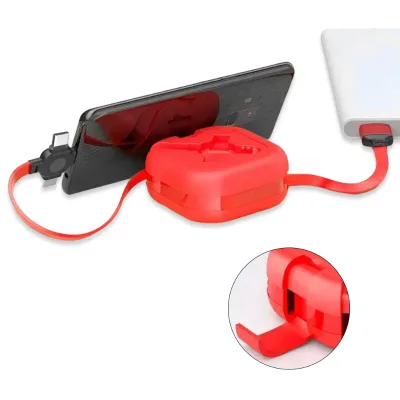
The core keyword "retractable 3-in-1 charging cable" describes a specific category of mobile accessories designed to consolidate connectivity for multiple device ecosystems into a single, space-saving unit. Based on observed product attributes, the fundamental architecture of these cables relies on a mechanical retraction mechanism housed within a compact casing. The observed specifications indicate that the physical dimensions of the housing vary, with recorded axis sizes ranging from 642cm to 641.8cm. This variation suggests that buyers must verify the exact footprint required for their target market, as the internal mechanism for the retracting function directly influences the external casing dimensions.
The "3-in-1" designation refers to the interface capabilities, which are explicitly observed to include Lightning 8pin, Micro USB, and Type-C connectors. This triad covers the vast majority of modern mobile devices, including Android and Apple ecosystems. The data transmission function is a critical technical differentiator; while some units are observed to possess an IC chip for enhanced power management, others are listed as "Without IC Chip." The presence of an IC chip is often correlated with the "Quick Charging Function" attribute, which is noted as a specific feature in certain models. Buyers must distinguish between cables that merely provide physical connectivity and those engineered to negotiate higher power delivery protocols through integrated circuitry.
The cable length is another variable specification. While some products are standardized at 1 Meter or 90CM, others offer a range of 4 to 5.9 Feet, or lengths under 4 Feet. The retraction mechanism is described as "Not Scalable" in some contexts, implying a fixed maximum extension, while other entries explicitly state "Retractable." The pull direction is observed as "Two Side Pulling in Same Time," indicating a specific mechanical design where the cable extends from both ends or a dual-pull system, which differs from single-sided retraction mechanisms found in other market segments.
Material Composition and Durability Factors
The longevity and safety of a retractable cable are heavily dependent on the materials used in its construction. The supplied facts identify specific material compositions that buyers should verify during the sampling phase. The conductor material is consistently observed as Copper, which is the industry standard for efficient electrical conductivity. However, the sheath material is noted as PVC in specific instances, while other attributes mention ABS (Acrylonitrile Butadiene Styrene) for the product housing. ABS is typically preferred for the outer casing due to its impact resistance and rigidity, which protects the internal retraction spring and gears from damage during transport and daily use.
The insulating materials are listed as Polystyrene in certain observations, though this is less common for flexible cable sheathing than PVC or TPE. Buyers should treat this as an observation of a specific product variant rather than a universal standard. The copper wire specifications provide a granular view of the internal wiring, with one observed configuration being a "4-Core Wire 55+55+16+16." This notation likely refers to the strand count and gauge of the conductors, which directly impacts the cable's current-carrying capacity and resistance. A higher core count generally supports better heat dissipation and faster charging speeds.
Environmental considerations are also present in the product attributes, with "Environmentally Friendly Wire" listed as a product advantage. This suggests that some manufacturers utilize recyclable materials or lead-free soldering processes. When evaluating suppliers, procurement teams should request Material Safety Data Sheets (MSDS) to confirm the specific composition of the PVC or ABS used, ensuring compliance with regional environmental regulations regarding hazardous substances.
Compliance, Certification, and Safety Standards
Navigating the compliance landscape for electronic accessories requires rigorous verification of certifications and standards. The provided data explicitly mentions ISO as a certification attribute, specifically noted as "ISOConductor Material:Copper." While the text does not specify the exact ISO standard number (e.g., ISO 9001 for quality management or ISO 14001 for environmental management), the presence of an ISO reference indicates that the supplier claims adherence to international management systems. Buyers must request the actual certificate documentation to verify the scope and validity of the ISO certification, as "ISO" alone is not a product safety standard.
Product standards are also observed in the context of length and packaging. One entry lists a standard of "1 Meter long," while another specifies "90CM long." These are dimensional standards rather than safety certifications. However, the "prod_standard" field also includes packaging dimensions like "1589025mm," which is relevant for logistics and shipping cost calculations. For safety, buyers should look for certifications such as CE, FCC, or RoHS, which are not explicitly listed in the provided facts but are industry expectations for electronic goods. The absence of these specific labels in the raw data means that procurement teams must treat the "ISO" mention as a starting point for due diligence rather than a complete safety guarantee.
The "Universal" attribute suggests broad compatibility, but this does not equate to safety certification. The "Data Transmission Function" implies that the cable meets certain data transfer standards, likely USB 2.0 or higher, depending on the wire gauge and shielding. Buyers should verify that the supplier can provide test reports confirming that the cable meets the necessary electromagnetic compatibility (EMC) standards for the target export markets.
Cost Drivers and Pricing Dynamics
The pricing for retractable 3-in-1 cables is influenced by a complex interplay of material costs, mechanical complexity, and customization options. The observed price range in the market is substantial, spanning from 0.2 USD to 12.25 USD. This wide variance indicates that the final price is highly dependent on the specific configuration selected by the buyer. The lower end of the spectrum likely corresponds to basic models with PVC sheathing, no IC chip, and standard packaging, while the higher end reflects units with ABS housing, integrated IC chips for quick charging, and premium packaging.
The Minimum Order Quantity (MOQ) is another significant cost driver, with observed ranges between 10 and 1000 units. A lower MOQ of 10 allows for smaller trial orders but often comes with a higher unit cost due to the setup costs for the manufacturer. Conversely, an MOQ of 1000 suggests a focus on bulk manufacturing, which typically reduces the per-unit cost. The "Customization" attribute is available, which includes options for custom colors (Red, White, Black, Green, Blue, Orange, Purple, Pink) and custom packaging (PE Bag, Color Box, Blister Package, Carton, Card Box). Customization invariably adds to the cost, particularly if it involves custom molds for the ABS housing or specific branding on the packaging.
The origin of the product is listed as Ningbo, China, or generally China. This location is a major hub for electronics manufacturing, offering competitive labor and supply chain efficiencies. However, logistics costs and lead times will vary based on the specific supplier's location within the region and their current production capacity. The "Service" attribute mentions ODM & OEM, indicating that suppliers can manufacture to a buyer's design or brand specifications, which is a key factor in determining the total cost of ownership for private label products.
Supplier Evaluation and Verification Protocols
Evaluating a supplier for retractable 3-in-1 cables requires a multi-faceted approach that goes beyond the basic product listing. The "Service" attribute of ODM & OEM suggests that the supplier has the capability to adapt to buyer requirements, but this capability must be validated. Buyers should assess the supplier's ability to handle the "Customization" requests, such as specific color matching or unique packaging designs. The "Product Packaging" options vary from simple PE bags to complex Color Boxes and Blister Packages, and the supplier's proficiency in these packaging methods will affect the final product presentation.
The "prod_packing" attribute lists "Original Packaging" as an option, which may be relevant for buyers looking to source generic stock versus branded goods. However, for most B2B procurement, custom branding is the norm. The supplier's location in Ningbo, China, is a positive indicator, as this region has a mature ecosystem for electronics manufacturing. Buyers should verify the supplier's production capacity to ensure they can meet the required lead times, especially when dealing with the "Retractable" mechanism, which requires precise assembly.
Quality control is paramount, particularly given the mechanical nature of the retraction feature. Buyers should request samples to test the "Pull Direction" mechanism, ensuring that the "Two Side Pulling in Same Time" function operates smoothly without jamming. The presence or absence of an IC chip should be verified through functional testing to confirm the "Quick Charging Function" claims. Additionally, the "Data Transmission Function" should be tested with various devices to ensure compatibility and stability.
Quality Control and Performance Verification
Quality control for these cables must address both the electrical and mechanical aspects of the product. The mechanical integrity of the retraction system is the most common point of failure. Buyers should test the cable for durability by extending and retracting it multiple times to ensure the spring mechanism does not weaken or the cable does not get stuck. The "Axis Size" variations (642cm vs. 641.8cm) should be measured to ensure consistency across batches, as dimensional inconsistencies can indicate poor quality control in the molding process.
Electrical performance is equally critical. The "Copper Wire Specifications" of "4-Core Wire 55+55+16+16" must be verified to ensure the cable can handle the required current without overheating. The "IC Chip" presence should be confirmed, as its absence may limit the cable's ability to support fast charging protocols. The "Display" attribute, observed in some listings, suggests that certain models include an LED indicator for charging status, which adds a layer of complexity to the quality control process. Buyers should test the display functionality to ensure it accurately reflects the charging state.
The "Product Advantages" such as "Environmentally Friendly Wire" should be substantiated with third-party test reports. The "Sheath Material" (PVC) and "Insulating Materials" (Polystyrene) must be tested for flammability and flexibility to ensure they meet safety standards. The "Switch" attribute, noted as "Without Switch" in some cases, implies that the cable is always active when connected, which is standard for most charging cables but should be confirmed to avoid confusion.
Long-Term Procurement and Market Considerations
Long-term procurement of retractable 3-in-1 cables requires a strategic approach to inventory management and supplier relationships. The "Product Color" options (Red, White, Black, Green, Blue, Orange, Purple, Pink) offer significant marketing flexibility, allowing buyers to target different demographics or seasonal trends. However, maintaining a diverse color inventory can increase complexity in supply chain management. Buyers should prioritize colors that align with their target market preferences to minimize dead stock.
The "Compatible with Mobile Phones" attribute, specifically "Type-C, Android," and "Type-C, Android/Apple," highlights the evolving nature of the market. As device manufacturers shift towards USB-C, the demand for Lightning connectors may eventually decline. Buyers should monitor market trends and consider diversifying their product mix to include more Type-C dominant cables in the future. The "Universal" attribute is a strong selling point, but buyers should ensure that the cable supports the latest charging standards to remain competitive.
The "prod_model" variations (WD-RR-002, WD-RR-004, lingjing usb cable, CD pattern cable) indicate a wide range of product SKUs. Buyers should establish a clear selection criteria to choose the most suitable models for their specific needs, balancing features like length, material, and price. The "Standard" of "1 Meter long" or "90CM long" should be aligned with customer expectations, as cable length is a primary factor in user satisfaction.
Finally, the "Service" of ODM & OEM offers opportunities for brand differentiation. Buyers should leverage this service to create unique product identities that stand out in a crowded market. By focusing on high-quality materials, robust mechanical design, and reliable electrical performance, buyers can build a reputation for quality and secure long-term partnerships with their customers. The "Location" of Ningbo, China, provides a stable supply base, but buyers should maintain open communication with suppliers to navigate any potential disruptions in the global supply chain.
FAQs
What certifications are available for Retractable 3-in-1 Charging Cable?
ISO certification is available for these cables, indicating adherence to international management systems. Buyers must request actual certificate documentation to verify the scope and validity of the ISO claim, as it is not a product safety standard like CE or RoHS.
How long are the Retractable 3-in-1 Charging Cable options?
Cable lengths vary from 90 centimeters to 1.1 meters, with some models reaching up to 5.9 feet. Specific standards include 1 meter and 90 centimeter lengths, while other variants offer lengths under 4 feet depending on the model configuration.
Which materials are used for the Retractable 3-in-1 Charging Cable housing?
The housing is typically constructed from ABS plastic for impact resistance, while the conductor material is copper. The sheath may be made of PVC, and some insulating materials include polystyrene, though buyers should verify specific compositions for their needs.
Can the Retractable 3-in-1 Charging Cable support data transmission?
Yes, many models include a data transmission function alongside charging capabilities. However, the presence of an IC chip varies, with some units having one for quick charging and others lacking it, which affects data negotiation and power delivery protocols.
What customization options exist for the Retractable 3-in-1 Charging Cable?
Customization is available for colors, packaging, and branding through ODM and OEM services. Buyers can choose from various colors like red, white, and blue, and select packaging types such as PE bags, color boxes, or blister packages to suit their brand requirements.
Where are the Retractable 3-in-1 Charging Cable manufacturers located?
The primary production origin is Ningbo, China, which is a major hub for electronics manufacturing. This location offers competitive labor and supply chain efficiencies, though logistics costs and lead times will vary based on the specific supplier's capacity and current production status.
How does the pull direction work for the Retractable 3-in-1 Charging Cable?
Some models feature a two-side pulling mechanism where the cable extends from both ends simultaneously. This design differs from single-sided retraction systems and requires verification during sampling to ensure the mechanical function operates smoothly without jamming.