Source Seersucker 400tc Duvet Cover for Hotels, Homes, and Guest Rooms
Explore 30 listings for the Seersucker 400tc Duvet Cover tailored for home and hotel use. Buyers can compare specifications like thread count, material composition, and customization options from verified suppliers in Jiangsu, China.
Key considerations
Products List
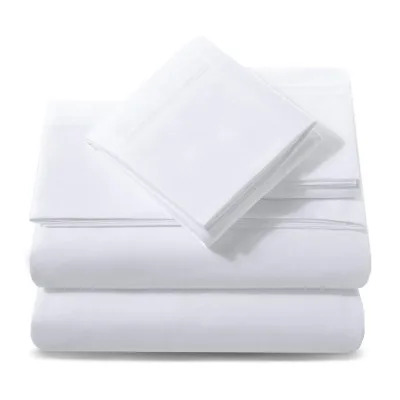
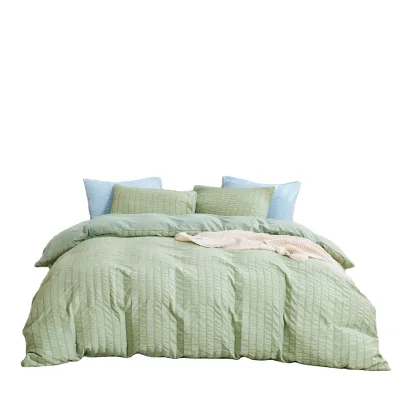


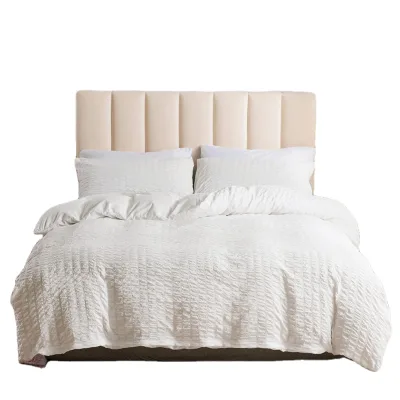


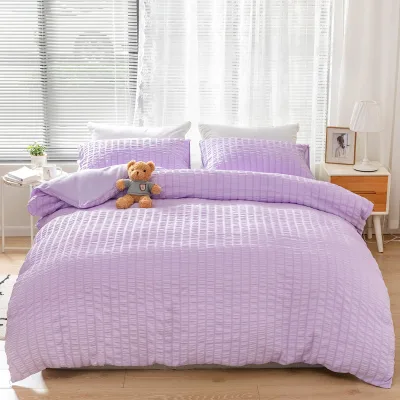
Super Soft Solid Color Seersucker Bedding Duvet Cover Set From Factory Directly
$10.00 - $17.00
MOQ: 100 Pieces

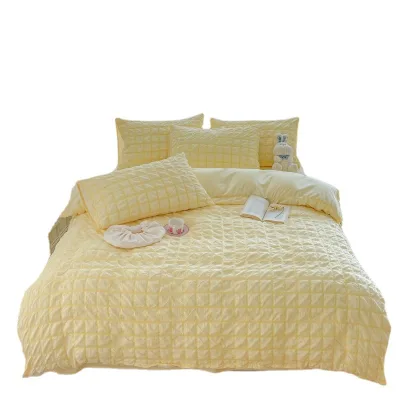
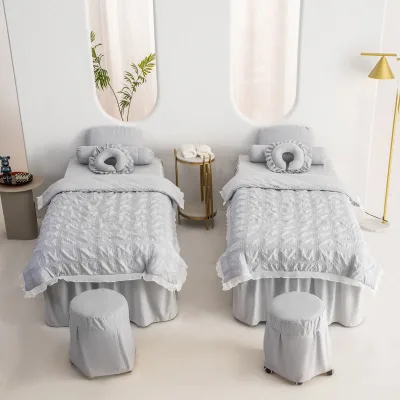
New Yarn Dye Seersucker Grid Pattern Duvet Comforter Quilt Cover Bedding Set
$5.50 - $10.50
MOQ: 100 Pieces




Comprehensive Sourcing Guide
Strategic Sourcing Guide for Seersucker 400TC Duvet Covers
The global market for high-thread-count bedding presents a complex landscape where terminology often diverges from technical reality. For buyers searching for a "Seersucker 400tc Duvet Cover," the procurement process requires a rigorous separation of marketing language from verifiable product attributes. The core keyword suggests a specific texture (seersucker) and a high thread count (400TC), yet the available market data reveals a significant divergence between these expectations and the actual specifications of listed inventory. This guide provides a disciplined framework for navigating these discrepancies, ensuring that procurement decisions are based on observed facts rather than assumed capabilities. Understanding the distinction between woven textures and thread count claims is the first step in mitigating supply chain risk and ensuring product quality.
Technical Specification Verification and Terminology Alignment
The most critical challenge in sourcing this specific item lies in the alignment of the core keyword with the actual product attributes observed in the market. A search for "seersucker 400TC" implies a fabric with a puckered, crinkled texture achieved through a specific weaving technique, combined with a high density of 400 threads per inch. However, the supplied product data indicates a prevalence of "Sateen" patterns, "Plain" styles, and thread counts of 300TC or 1000TC, with no explicit confirmation of a 400TC seersucker weave in the immediate inventory.
Buyers must verify the fabric construction method directly. The observed data lists "Woven" as a general technic and "reactive printing" as a surface treatment, but does not confirm the specific seersucker weave structure. Seersucker is typically a slubbed yarn construction that creates a textured surface without chemical finishes. In contrast, the listed products feature "100% cotton" with a "Grade A" or "Quality" designation and a "300TC" thread count. The presence of a "60*40s" yarn count in the data further suggests a specific blend of warp and weft yarns that may differ from the uniform high-density yarns required for a true 400TC sateen or seersucker finish.
When evaluating potential suppliers, the buyer must demand a physical swatch or a detailed weave diagram. The observed "Single package size" varies significantly, ranging from 24x16x7 cm to 40x30x10 cm, which often correlates with the bulk and texture of the fabric. A seersucker fabric, due to its puckered nature, may pack differently than a flat sateen. The discrepancy between the keyword "400TC" and the observed "300TC" or "1000TC" listings necessitates a strict verification protocol. Buyers should not accept a product description that claims 400TC if the technical sheet lists 300TC or if the yarn count (e.g., 60s) does not mathematically support the claimed thread density without a specific weave explanation.
Compliance, Certification, and Material Integrity
In the B2B textile sector, compliance is not merely a regulatory hurdle but a fundamental indicator of supply chain maturity. The observed product data explicitly lists "WRAP" as a certificate, which stands for Worldwide Responsible Accredited Production. This certification is a high-confidence fact that indicates the supplier adheres to strict labor standards regarding safety, health, and compliance. For buyers targeting the North American market, as indicated by the "Main Market" attribute in the data, WRAP certification is often a prerequisite for entry into major retail channels.
However, the material composition requires equal scrutiny. The data presents a mix of "100% cotton" and "CPE" (Chlorinated Polyethylene) in different listings. A duvet cover intended for home use, particularly in the "Bedroom" space, should almost exclusively be natural fibers like cotton for breathability and comfort. The presence of CPE in the material list suggests that some listings may be for waterproof or disposable covers rather than traditional bedding. Buyers must distinguish between a "100 cotton 300TC" sateen duvet cover and a synthetic alternative. The "Color fastness (grade): 3-4" observation is a critical quality metric. This rating indicates a moderate level of resistance to fading, which is acceptable for general home use but may be insufficient for high-end hotel contracts or luxury residential projects where a grade of 4-5 is often expected.
Furthermore, the "Oeko-Tex" standard is mentioned in the background context as a low-confidence item. While highly desirable for ensuring the absence of harmful substances, the lack of explicit confirmation in the high-confidence facts means buyers cannot assume this certification is present. Procurement teams must request valid Oeko-Tex certificates for every batch, rather than relying on general supplier claims. The "Grade A" designation in the data is a positive indicator of quality, but it is a subjective internal classification. It must be backed by objective test results regarding shrinkage, pilling, and tensile strength to be meaningful in a contract.
Cost Drivers and Pricing Dynamics
The pricing landscape for duvet covers is influenced by a complex interplay of material costs, thread count, finishing processes, and order volume. The observed price range of 2 to 100 USD represents a massive variance that likely stems from differences in product quality, packaging, and order quantity. A unit price at the lower end of this spectrum (e.g., $2) is likely associated with the "Disposable" feature listed in the attributes, suggesting a single-use or low-durability product, possibly made from synthetic blends or lower-grade cotton. Conversely, the higher end of the range ($100) may reflect custom packaging, higher thread counts like the observed 1000TC, or specialized designs like the "Wedding Four-piece Kit."
The "MOQ" (Minimum Order Quantity) is a significant cost driver, with observed values ranging from 1 to 3000 pieces. The specific data point of "50pcs" as an MOQ suggests that some suppliers are willing to accommodate small-batch orders, which is advantageous for startups or testing new designs. However, larger orders typically benefit from economies of scale. The "Supply Ability" of 10000 pieces per month indicates that the supplier has the capacity to handle medium-to-large volume orders without significant bottlenecks.
Buyers must also consider the "Packaging Details" as a hidden cost factor. The data lists options such as "20PCS IN ONE CARTON" with specific carton dimensions, or "Customized Box" and "Different packing different price." Custom packaging, while essential for branding, adds to the unit cost. The "Single gross weight" of 3.000 kg for a single package suggests that shipping costs will be a substantial portion of the total landed cost, especially for air freight. Sea freight is likely the only viable option for the "260*220cm" size, which is a King or Queen dimension, to keep logistics costs manageable.
Typical Applications and Market Segmentation
Understanding the intended application is vital for selecting the right product specifications. The data explicitly categorizes the "Application" as "Home" and "Hotel," and the "Room Space" as "Bedroom." This confirms that the primary market is residential and hospitality. The "Season" attribute is listed as "All-Season," which is a key selling point for a cotton duvet cover, as natural fibers like cotton provide breathability in summer and warmth in winter.
The "Usage" is further specified as "Sleeping" and "Home Textile," reinforcing the product's function as a core bedding component. However, the presence of the "Disposable" feature creates a unique segmentation opportunity. While traditional bedding is designed for long-term use, the "Disposable" attribute suggests a niche market for hospitals, hotels with high-turnover cleaning protocols, or specific event management scenarios. Buyers targeting the "North America" market must ensure that the product meets the durability expectations of that region, where "All-Season" cotton is preferred over synthetic alternatives for comfort.
The "Wedding Bedding Type: Wedding Four-piece Kit" indicates that some suppliers are also targeting the bridal market. This segment often demands higher aesthetic standards, such as the "Solid" pattern type observed in the data, and premium packaging. The "Color: White" observation is consistent with the wedding and hotel sectors, where white linens are the standard for hygiene and versatility. Buyers should verify if the "White" color is a standard offering or if custom dyeing is available, as the "reactive printing" technique suggests that color customization is possible but may require additional setup time.
Supplier Evaluation and Operational Reliability
Evaluating a supplier for a product like a seersucker duvet cover requires a deep dive into their operational capabilities. The "place of origin" is listed as "Jiangsu, China," a region known for its robust textile industry. This location suggests access to a mature supply chain for cotton and weaving machinery. The "Sample time" of "3-5 Working Days" is a strong indicator of operational efficiency, allowing buyers to quickly validate product quality before committing to a large order.
The "is_customized" attribute being "Yes" is a crucial differentiator. It implies that the supplier is flexible regarding design, packaging, and potentially fabric composition. This flexibility is essential for buyers looking to create a unique brand identity. However, customization introduces complexity. The "Packing: Customized Packing" and "Different packing different price" notes suggest that the cost and lead time will vary based on the specific requirements. Buyers must establish clear communication channels to define the exact specifications of the customization to avoid misunderstandings.
The "Model number" variations, such as "HEJTEX-DC001" and "HEJ-0170," indicate that the supplier has a diverse product catalog. This diversity is a double-edged sword; it shows capability but also requires the buyer to be precise in their ordering to ensure they receive the correct item. The "Brand name" listed as "HEJTEX" or "HEJ" suggests that the supplier may be a manufacturer with its own brand, or a trader using private labeling. Buyers should verify the legal entity behind the brand to ensure they are dealing with the actual manufacturer or an authorized distributor.
Quality Control Protocols and Long-Term Procurement
Establishing a robust quality control (QC) protocol is non-negotiable for long-term procurement success. The observed "Color fastness (grade): 3-4" provides a baseline, but buyers should insist on independent third-party testing for every production run. This testing should verify the "100% cotton" claim, the "300TC" or "400TC" thread count, and the absence of harmful chemicals beyond the WRAP certification. The "Washing Temperature: Under 40" instruction is a specific care requirement that must be clearly communicated to the end-user to prevent premature product failure.
For long-term procurement, the "Supply Ability" of 10000 pieces per month is a key metric. Buyers should assess whether this capacity is consistent or if it fluctuates based on raw material availability. The "Lead time" is not explicitly stated in the high-confidence facts, but the "Sample time" of 3-5 days suggests a relatively agile production cycle. However, for bulk orders, the lead time will likely extend significantly. Buyers should negotiate a firm lead time in the contract to ensure timely delivery, especially for seasonal peaks.
The "feature: Disposable" attribute requires special attention in long-term contracts. If the product is intended for single-use, the quality control focus should be on hygiene and packaging integrity. If it is intended for reusable use, the "Disposable" label may be a misclassification or a marketing error that needs correction. Consistency in the "Grade" (Grade A vs. Quality) is also essential. Buyers should define a clear quality acceptance criteria that aligns with the "Grade A" standard observed in the data to ensure that every shipment meets the expected performance levels.
Conclusion
Sourcing a "Seersucker 400tc Duvet Cover" requires a meticulous approach that prioritizes verified data over marketing claims. The available market data reveals a landscape dominated by 300TC sateen and 1000TC products, with specific certifications like WRAP and material compositions of 100% cotton. Buyers must navigate the discrepancies between the keyword and the actual product attributes by demanding physical samples, verifying weave structures, and confirming thread counts through independent testing. By focusing on technical specifications, compliance, cost drivers, and supplier reliability, procurement teams can secure high-quality bedding solutions that meet the demands of the North American and global markets. The path to successful procurement lies in rigorous due diligence and a commitment to transparency in every aspect of the supply chain.
FAQs
What is the thread count of the available sateen duvet covers?
The available sateen duvet covers listed have a thread count of 300TC, not 400TC. Some listings mention 1000TC for specific designs, but the core product data confirms 300TC as the standard specification for the 100% cotton items.
Which certification is verified for the textile production?
The verified certification for this production is WRAP, which stands for Worldwide Responsible Accredited Production. This indicates adherence to strict labor standards, though Oeko-Tex is not explicitly confirmed in the high-confidence facts.
Can buyers request customized packaging for these duvet covers?
Yes, buyers can request customized packaging as the is_customized attribute is marked as Yes. Options include different packing styles with varying prices, such as export cartons or custom boxes, depending on the specific order requirements.
What is the minimum order quantity for these bedding items?
The minimum order quantity observed is 50 pieces for specific listings, though the general range spans from 1 to 3000 units. Buyers should verify the specific MOQ with the supplier as it varies by product model and customization level.
How long does it take to receive a product sample?
It takes 3 to 5 working days to receive a product sample. This sample time allows buyers to quickly validate the fabric quality and specifications before committing to a larger production order.
What is the primary material composition of the duvet covers?
The primary material composition is 100% cotton with a Grade A or Quality designation. While some listings mention CPE, the standard home textile items are made of cotton to ensure breathability and comfort for bedroom use.
Which washing temperature is recommended for these cotton covers?
The recommended washing temperature is under 40 degrees Celsius. This care instruction helps maintain the fabric integrity and color fastness, which is rated at grade 3-4 for the observed products.