Source Small Apartment Storage Bed for Compact Homes, Hotels, and Studios
Find and compare 30 Small Apartment Storage Bed options from verified Chinese manufacturers. Evaluate materials like particle board and solid wood, sizes, and customization features to find the right fit for your inventory needs.
Key considerations
Products List


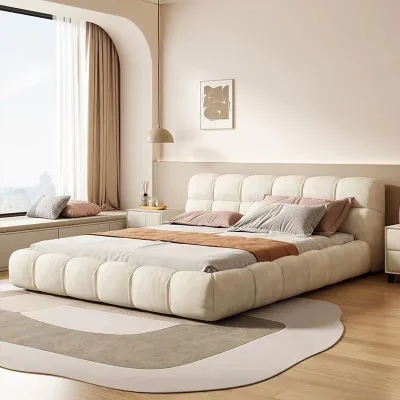


Multi-Functional Bed with Lifting and Storage Options for Small Spaces
$300.00 - $500.00
MOQ: 5 Pieces


$104.00 - $106.00
MOQ: 5 Pieces


Comprehensive Sourcing Guide
Small Apartment Storage Bed Sourcing Guide
Small apartment storage beds combine a sleeping platform with integrated drawers, lift-up slats, or under-bed compartments, making them a priority SKU for furniture importers serving compact urban housing. For B2B buyers, the category rewards disciplined sourcing: product structures vary widely between flat-pack particle board frames and upholstered solid wood designs, and the difference shows up in shipping volume, assembly labor, and after-sales claims. This guide walks through the product scope, technical verification points, compliance documentation, cost structure, supplier qualification, and long-term checks that a procurement team should complete before committing to a program order.
The listings observed in this category come from manufacturers in Chinese production clusters such as Weifang and Guangdong, under brand and model identifiers like Yamazonhome (Yamazon-B-T018) and Amac series models (Amac-0119, Amac-0112). Several listings explicitly state customization availability, OEM/ODM acceptance, and a minimum order quantity as low as one unit, which lowers the barrier for sample-stage evaluation. Use that flexibility deliberately: order samples first, verify specifications against listings, and only then scale into container quantities.
Product Scope and Observed Listing Signals
The observed range covers two distinct product families. The first is a modular storage bed built on particle board in fixed sizes of 12001900 mm and 15001900 mm, positioned for children and small apartments, with disassembly capability and modern styling. The second is a soft-package master bedroom bed in European style, listed in double size with dimensions shown in listing figures or customized, available in solid wood or wood materials, white or optional colors, and including padding with high-density foam, armrests, and safety as a stated special feature. Understanding which family fits your market is the first scoping decision.
Listing attributes also reveal what suppliers emphasize and what they leave vague. Washability is stated both ways across the category (washable and non-washable), which matters greatly for upholstered headsboards and soft-package beds. Height is listed as unadjustable and the rotary function as fixed on some models, so buyers targeting adjustable or rotating mechanisms must confirm these explicitly rather than assume. Condition is new, packing is standard or wooden box, and quality grade is stated as Grade AAA on one listing — all claims that should be treated as starting points for verification, not settled facts.
Technical Specifications to Verify
Dimensional verification is the first technical gate. The particle board storage bed is offered in 12001900 mm and 15001900 mm, which correspond to small-single and short-double formats; confirm mattress compatibility in your destination market, since standard mattress lengths differ by region and a 1900 mm platform may not accept a 2000 mm mattress without overhang or fit issues. For soft-package models where dimensions are only "as shown in the picture or customized," require a dimensioned engineering drawing before sample approval, covering overall footprint, platform height, clearance under lift mechanisms, and packaged carton dimensions for container planning.
Material and structural specifications come second. Confirm particle board thickness, density class, and edge banding quality for flat-pack models, and timber species, joinery method, and slat count for solid wood frames. For upholstered soft-package beds, verify foam density, fabric composition, seam construction, and the frame-to-upholstery attachment method. Also confirm the stated disassembly capability in practice: request assembly instructions and check whether connection hardware (cams, bolts, brackets) is replaceable and whether repeated assembly cycles are supported, since flat-pack storage beds often fail at joints rather than panels.
Compliance and Safety Documentation
One listing states certification as CE, ISO, RoHS, and CCC, but buyers should never accept a certification claim at face value. Request the actual certificates, verify their scope covers the specific product model and materials (not merely the factory), confirm issuing bodies are accredited, and check validity dates. For beds marketed for children, safety claims carry additional weight: verify that edge rounding, gap clearances, and surface coatings meet the regulatory requirements of your destination market, and ask for the underlying test reports rather than summary logos.
Material compliance deserves parallel attention. Particle board should be accompanied by formaldehyde emission documentation appropriate to your market's requirements, and upholstered models should have fabric and foam declarations covering restricted substances. Where a listing claims a special feature of "safety," ask the supplier to define precisely what that means — which mechanism, which test, which report. Buyers shipping to the EU, North America, or other regulated markets should map the applicable furniture and chemical regulations independently and request supplier evidence against each one before production.
Cost Drivers and Commercial Terms
The observed listed price range spans roughly USD 1 to 2500, which reflects the difference between component-level items and complete finished beds rather than a true spread within a single SKU. For a complete storage bed, expect cost to be driven by material choice (particle board versus solid wood), upholstery content, size format, hardware complexity of the storage mechanism, and packing configuration — wooden box packing, as stated on one listing, adds cost and weight compared to standard carton packing but reduces transit damage risk. Treat any quoted price as conditional until materials, packing, and dimensional specifications are locked in writing.
Commercial terms require equal scrutiny. Minimum order quantities in this category range from 1 to 200, so negotiate MOQ by product tier: high for standardized particle board models, low or single-piece for customized soft-package beds where the supplier prices in customization labor. Confirm what "customization" and "OEM/ODM welcome" actually include — logo placement, color options, dimension changes, or full structural redesign — and at what unit-cost penalty. Define Incoterms, payment structure, and whether tooling or sample fees apply and are creditable against subsequent orders.
Supplier Qualification and Quality Control
Qualify suppliers against the specifics of this category rather than general trading history. Origin clusters in Weifang and Guangdong indicate access to established furniture manufacturing ecosystems, but production depth varies: a supplier of flat-pack particle board beds may not control upholstery lines in-house. Ask which processes are completed at the factory and which are subcontracted, request references or transaction evidence for export orders of comparable beds, and confirm export experience to your market, since furniture-grade packaging and container loading practice materially affect arrival condition.
Build a quality control plan matched to the product's failure modes. For a pre-shipment inspection on storage beds, define checkpoints covering dimensional accuracy against the approved drawing, panel flatness and edge banding, hardware completeness and fit, drawer or lift mechanism cycling tests, upholstery stitching and foam consistency, and carton drop-test readiness. State the inspection standard, sampling level, and acceptance criteria in the purchase contract, and decide whether you will rely on factory QC, a third-party inspection, or both. For the first production run, an in-line check during assembly plus a final random inspection is a reasonable baseline.
Long-Term Procurement Checks
Plan for repeatability, not just the first order. A storage bed program succeeds only if every shipment matches the approved golden sample, so establish a retained sample, a documented specification sheet covering materials, dimensions, hardware, and packing, and a change-notification clause requiring the supplier to disclose any material or component substitution. This is especially important where listings state "color: optional" or "customized" — without a locked specification, a reorder can drift in fabric lot, board grade, or hardware finish and generate returns.
Finally, track after-sales and logistics performance as part of the supplier relationship. Monitor damage rates on arrival (a key metric for flat-pack and upholstered beds), spare-part availability for connection hardware and lift mechanisms, and the supplier's responsiveness on warranty claims. Reassess pricing periodically against material cost movements and against alternative qualified suppliers in the same clusters, and keep at least one secondary source qualified for your highest-volume model. Over successive order cycles, use accumulated inspection data — defect types, frequencies, and corrective actions — as the factual basis for volume negotiations and for deciding which models to consolidate and which to retire.
FAQs
What materials are used for small apartment storage beds?
These beds are constructed from particle board, solid wood, or general wood materials. The choice depends on the specific model, such as the Yamazonhome brand using particle board or the Amac series using solid wood. Buyers should verify the material grade, which may be listed as Grade AAA, to ensure durability and suitability for their specific storage needs.
Can small apartment storage beds be customized?
Yes, customization is available for many models. Suppliers offer options for standard sizes like 1200*1900mm or 1500*1900mm, or fully customized dimensions as shown in pictures. OEM and ODM services are welcome, allowing buyers to tailor the bed's style, color, and packaging to their specific market requirements or brand identity.
What certifications do these beds have?
Certifications vary by manufacturer and model. Some solid wood beds from Guangdong, China, hold CE, ISO, RoHS, and CCC certifications. Other models may not list specific certifications in the standard description. Buyers should request documentation for specific SKUs to ensure compliance with their local safety and environmental standards before placing large orders.
What is the typical MOQ for these beds?
The minimum order quantity can be as low as 1 piece for some suppliers, facilitating sample testing or small boutique orders. Other listings indicate an MOQ of up to 200 units. Buyers should confirm the specific MOQ with the supplier, as it often depends on whether the item is a standard stock model or requires custom manufacturing.
Where are these beds manufactured?
Manufacturing locations include Weifang City and Guangdong Province in China. Weifang is noted for models like the Yamazonhome and Amac series, while Guangdong suppliers may offer different certifications and materials. Buyers can filter suppliers by these specific origins to align with logistics preferences or regional trade requirements.
How are small apartment storage beds packed?
Packing methods include standard packing, carton packaging, or wooden boxes. The choice depends on the supplier and the fragility of the components. Wooden boxes are often used for solid wood or premium models to ensure safety during transit, while cartons are common for particle board items. Buyers should verify packing details to assess shipping costs and damage risks.