Source Triple Phase Digital Volt-Ampere Meter for Industrial, Commercial, and Residential Use
Compare 30 triple phase digital volt-ampere meters from verified suppliers in China. These devices feature digital displays, electromagnetic or transformer structures, and support applications ranging from industrial energy monitoring to residential power management.
Key considerations
Products List


Input Digital Clamp Three Phase Voltammeter Calibrator Volt-Ampere Meter
$500.00 - $745.00
MOQ: 1 Pieces

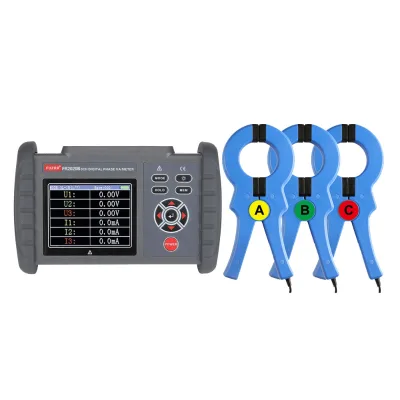
Digital 3 Clamps Phase Voltammeter Three Phase Meter AC Volt-Ampere Meter
$500.00 - $740.00
MOQ: 1 Pieces




Comprehensive Sourcing Guide
Strategic Sourcing Guide for Triple Phase Digital Volt-Ampere Meters
Understanding the Product Category and Technical Architecture
When sourcing a triple phase digital volt-ampere meter, buyers must first distinguish between general energy monitoring devices and specialized phase measurement instruments. The market offers a variety of configurations, ranging from single-phase electronic meters to complex three-phase systems designed for industrial and utility applications. The core functionality of these devices involves the simultaneous measurement of voltage, current, power factor, and phase angles across three distinct electrical phases. This capability is critical for maintaining grid stability, diagnosing power quality issues, and ensuring balanced loads in commercial and industrial facilities.
The technical architecture of these meters often relies on electromagnetic or transformer-based structures to isolate and measure high-voltage inputs safely. Some units utilize a digital display interface to present real-time data, while others may feature multifunction capabilities that include reactive power, apparent power, and active power calculations. The internal processing unit typically converts analog signals from current and voltage sensors into digital data for display and transmission. Buyers should note that the physical structure of the meter, whether it is a compact digital phase meter or a larger energy meter with terminal connections, dictates the installation method and the required mounting space.
A critical observation in the current market is the variation in power supply mechanisms. While some industrial-grade meters rely on external power sources or direct connection to the line, portable or field-test variants often incorporate built-in battery systems. For instance, specific models in the category utilize 3.7V or 8.4V lithium batteries to ensure operation in remote locations without access to mains power. The accuracy of these measurements is paramount; high-performance units often claim an accuracy class of 1% or better, ensuring that the data used for billing or load balancing is reliable.
Detailed Technical Specifications and Performance Parameters
Selecting the correct technical specifications is the most critical step in the procurement process. Buyers must verify that the meter's measuring ranges align with the specific electrical characteristics of the target installation. The voltage range is a primary constraint; standard units often support a range of 0 to 500V AC, which covers most low-voltage distribution networks. However, for higher voltage applications, specific transformers or step-down units may be required, and the meter's input impedance must be compatible with the system.
Current measurement capabilities vary significantly between models. Some devices are designed for low-current applications with ranges starting from 0.01A up to 10A, suitable for monitoring small loads or specific branch circuits. Others are engineered for higher capacity, supporting current ranges up to 10A with high precision at the lower end, such as 0.001A. The frequency response is another vital parameter. While some meters operate within a narrow band of 20 to 65Hz, others are designed for standard utility frequencies, typically covering 45 to 65Hz. Operating outside these ranges can lead to measurement errors or device failure.
The phase measurement capability is the defining feature of a "triple phase" device. These meters must accurately calculate the phase angle, typically ranging from 0 to 360 degrees, with a specified tolerance such as ±2 degrees. This precision is essential for power factor correction and load balancing. Additionally, the meter should be capable of measuring active power (W), reactive power (var), and apparent power (VA), often within a range of 0.001 to 5000 units. The working environment also imposes constraints; the device must operate within specific temperature limits, often 0 to 40 degrees Celsius, and withstand humidity levels up to 80% without degradation.
| Parameter | Typical Observed Range | Critical Verification Point |
|---|---|---|
| Voltage Range | 0~500V AC | Ensure compatibility with system nominal voltage |
| Current Range | 0.01A | Verify minimum detectable current for load monitoring |
| Frequency | 20 | Match with local grid frequency standards |
| Phase Angle | 0~360° ± 2° | Check tolerance requirements for power factor correction |
| Power Supply | 3.7V or 8.4V Lithium | Confirm battery life for portable vs. fixed applications |
| Accuracy Class | 1% | Validate against billing or critical monitoring needs |
Compliance, Certification, and Regulatory Standards
Navigating the regulatory landscape is essential for international procurement. Buyers must ensure that the selected meters meet the necessary safety and quality certifications for their target market. Common certifications observed in the industry include ISO standards, such as ISO 9001:2008 for quality management, and specific product certifications like CE (Conformité Européenne) and RoHS (Restriction of Hazardous Substances). These certifications indicate that the manufacturer adheres to specific quality control processes and environmental regulations.
The product standards themselves are equally important. While some documentation references general standards like IEC, buyers should verify the specific compliance of the unit with local electrical codes. For instance, certain models may be certified under IEC standards for safety and performance, while others might adhere to regional specifications. It is crucial to distinguish between the certification of the manufacturer and the certification of the specific product model. A device labeled with "CE" and "ISO" suggests a baseline of compliance, but the buyer must confirm that these certifications are valid for the specific application and region of use.
Furthermore, the physical dimensions and packaging standards can impact logistics and installation. Some units are packaged in wooden cases, which offer superior protection for heavy or sensitive equipment during shipping, while others use standard export cartons. The physical dimensions of the meter, such as 1969254mm or larger industrial enclosures, must be considered during the design phase of the installation panel. Buyers should also verify the origin of the product, as manufacturing locations like Shaanxi, Beijing, or Wuhan in China may have different regulatory oversight and supply chain implications.
Cost Drivers and Pricing Dynamics
The pricing of triple phase digital volt-ampere meters is influenced by a complex interplay of factors, including technical complexity, build quality, and certification status. The observed price range in the market is extensive, spanning from approximately 3 USD for basic components or accessories to 3500 USD for fully featured, high-accuracy industrial units. This wide disparity highlights the importance of defining the exact requirements before requesting quotes. A basic single-phase energy meter will naturally cost significantly less than a multifunctional triple-phase device with advanced data logging and communication capabilities.
Customization is a significant cost driver. Many suppliers offer customization options, allowing buyers to tailor the meter to specific needs, such as unique display formats, specific communication protocols, or modified physical dimensions. While customization adds value, it often increases the unit price and may affect the minimum order quantity (MOQ). The observed MOQ range is typically between 1 and 10 units, suggesting that even small-scale projects can access these products, though bulk orders may yield better pricing tiers.
Other factors influencing cost include the power supply mechanism. Units with built-in high-capacity lithium batteries, such as 8.4V/2.6ah systems, may command a premium over those requiring external power. Similarly, the accuracy class plays a role; a meter with a 1% accuracy rating is generally more expensive than a standard utility meter. Buyers should also consider the packaging and shipping costs, as units shipped in wooden cases may incur higher freight charges compared to those in standard cartons.
Typical Applications and Installation Scenarios
The versatility of triple phase digital volt-ampere meters makes them suitable for a wide array of applications. In industrial settings, these devices are frequently used for multi-functional energy metering, prepayment systems, and reactive energy management. They are essential for monitoring the efficiency of large motors, HVAC systems, and production lines where load balancing is critical. The ability to measure maximum demand and multi-rate watt-hours allows facility managers to optimize energy consumption and reduce utility costs.
For utility providers and grid operators, these meters serve as standard electric energy meters for industry and home use, providing the data necessary for billing and load forecasting. The "Phase Angel Meter" functionality is particularly useful for diagnosing phase imbalances and power quality issues in three-phase distribution networks. In field service and maintenance scenarios, portable units with built-in batteries and digital displays allow technicians to perform on-site testing and verification without the need for external power sources.
Installation methods vary based on the meter type. Some models are designed for direct connection, simplifying the installation process for low-voltage applications. Others may require terminal connections or the use of external current transformers. The theory of operation, whether electronic or electromagnetic, also influences the installation. Electronic meters, for instance, often require a stable power supply and may need specific wiring configurations to ensure accurate signal processing. Buyers must ensure that the installation environment meets the temperature and humidity requirements specified by the manufacturer to prevent premature failure.
Supplier Evaluation and Quality Assurance Protocols
Evaluating suppliers for digital volt-ampere meters requires a rigorous approach to quality assurance. Buyers should prioritize suppliers who can provide clear documentation regarding their production standards and certification status. The presence of certifications like ISO and CE is a positive indicator, but it should be verified against the specific product model. Suppliers should also be transparent about their production origins, as manufacturing locations can impact quality consistency and supply chain reliability.
Quality control processes should be a key part of the supplier evaluation. Buyers should inquire about the testing procedures used to verify accuracy, durability, and safety. While specific test results may not always be publicly available, suppliers should be willing to share general quality assurance protocols. The structure of the product, whether electromagnetic or transformer-based, should be consistent with the claimed specifications. Additionally, the durability of the casing and the reliability of the digital display are critical factors that can be assessed through sample reviews or third-party testing.
Customization capabilities are another indicator of a supplier's maturity. A supplier that offers flexible customization options, such as tailored packaging or specific model configurations, demonstrates a higher level of engineering capability. However, buyers must ensure that customization does not compromise the core performance or safety of the device. The supplier's ability to meet lead times and handle logistics, including the choice between wooden cases and standard cartons, is also a crucial consideration for maintaining project schedules.
Long-Term Procurement and Lifecycle Management
Sourcing digital volt-ampere meters is not just a one-time transaction but a long-term commitment that requires careful lifecycle management. Buyers should consider the availability of spare parts, firmware updates, and technical support when selecting a supplier. Devices with built-in batteries, for example, will eventually require battery replacement, and the availability of compatible power sources is essential for maintaining operational continuity.
The durability of the meter in harsh environments is another long-term consideration. Units designed to withstand temperatures from 0 to 40 degrees and humidity up to 80% are better suited for industrial applications. Buyers should also evaluate the potential for future upgrades or integration with existing energy management systems. As technology evolves, the ability to upgrade firmware or add communication modules can extend the useful life of the meter.
Finally, procurement strategies should account for the total cost of ownership, not just the initial purchase price. This includes maintenance costs, energy consumption of the meter itself, and the potential cost of downtime due to equipment failure. By selecting high-quality meters from reputable suppliers with robust certification and support networks, buyers can ensure reliable performance and minimize long-term operational risks. The balance between initial cost and long-term value is the key to successful procurement in this category.
FAQs
What certifications do triple phase digital volt-ampere meters typically hold?
These meters commonly hold ISO, CE, and RoHS certifications. Specific models may also comply with IEC standards and ISO9001:2008 quality management systems to ensure safety and reliability in industrial applications.
How is the power supply configured for portable units?
Portable units often utilize built-in lithium batteries for operation. Specifications include 3.7V or 8.4V systems with capacities like 2.6ah to enable use in remote locations without access to mains power.
Which measuring ranges are standard for voltage and current?
Standard voltage ranges typically cover 0 to 500V AC. Current measurement capabilities vary, with some models supporting ranges from 0.01A to 10A or 0.001A to 10A for precise low-load monitoring.
Can buyers request customization for these digital meters?
Yes, customization is available for many models to meet specific needs. Buyers can often tailor display formats, communication protocols, or physical dimensions, though this may impact the minimum order quantity.
What is the typical accuracy class for these devices?
High-performance units often feature an accuracy class of 1%. This precision is critical for billing applications and load balancing where reliable data on active, reactive, and apparent power is required.
How are these meters packaged for international shipping?
Packaging options include wooden cases or standard export cartons depending on the model. Wooden cases offer superior protection for sensitive equipment, while cartons are used for lighter or less fragile units.
Which locations are common origins for these manufacturing products?
Products originate from various Chinese locations including Shaanxi, Beijing, and Wuhan. These manufacturing hubs produce units with different specifications and certifications to serve global industrial and utility markets.