Find Ultrasonic Anemometer for Weather Stations, Aviation, and Agriculture
Source 30 verified Ultrasonic Anemometer units from Chinese manufacturers offering ISO and CE certifications. Buyers can compare models like BGT-CF2 and RK120-09, evaluating features such as IP65 ratings, RS485 output, and temperature ranges from -40°C to 100°C for diverse industrial needs.
Key considerations
Products List


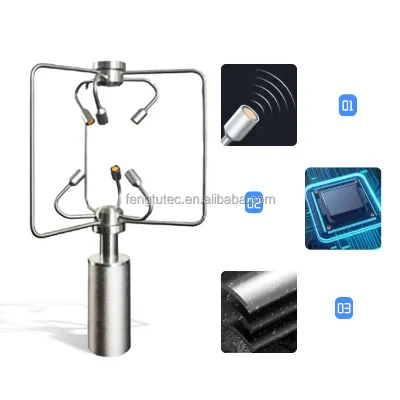
High Precision 6-in-1 Ultrasonic Weather Station Anemometer with RS485 Output
$285.00 - $295.00
MOQ: 1 Sets




Comprehensive Sourcing Guide
Strategic Sourcing Guide for Ultrasonic Anemometers
Understanding Core Technical Specifications and Performance Metrics
When sourcing ultrasonic anemometers, buyers must first distinguish between the fundamental operating principles and the specific performance parameters that define the utility of the device. The core technology relies on the measurement of wind speed and direction using ultrasonic sound waves, eliminating the need for moving mechanical parts found in traditional cup or vane anemometers. This non-contact detection method is a critical differentiator, as it inherently reduces mechanical wear and maintenance requirements. The observed product attributes indicate that these devices are designed for applications ranging from general anemometry to specialized ultrasonic speed monitoring.
A primary technical consideration is the output signal type. The market data reveals a diversity in signal processing capabilities, with many units offering analog types alongside digital communication protocols. Buyers should verify if the specific unit supports RS485 Modbus-RTU as a default, which is a standard for industrial integration, or if it offers optional 4G connectivity for remote telemetry. Additionally, the output capabilities may extend to RS232, 4-20mA, or 0-5V ranges, depending on the model. For instance, specific models like the BGT-CF1(H4) and BGT-W87X demonstrate support for multiple output formats including NMEA-0183, which is essential for marine or aviation integration. The physical size of the sensor is also a specification to note; units such as the BGT-CF2(H1) may have compact dimensions like φ66×64mm, while others might be larger to accommodate different transducer arrays.
Directional accuracy is another critical specification. High-precision units often claim a directional range of 0~360° with a tolerance of ±3° or even 1°, which is vital for meteorological stations or wind energy assessment. However, buyers must be cautious, as not all listed products possess the same level of precision. Some units may lack specific anti-jamming features, which can affect performance in electrically noisy environments. The presence of anti-jamming technology is a variable attribute; while some models are explicitly described as "Anti-jamming," others are listed as "Not Anti-jamming." This distinction significantly impacts the reliability of data in industrial settings with high electromagnetic interference.
Compliance, Certification, and Regulatory Standards
Navigating the compliance landscape is essential for ensuring that purchased ultrasonic anemometers meet international safety and quality requirements. The supply chain data indicates that certifications such as ISO and CE are present in the product listings. These certifications suggest that the manufacturing processes and product safety align with specific international standards. The ISO certification, in particular, often relates to quality management systems, ensuring that the supplier maintains consistent production standards. The CE marking indicates conformity with health, safety, and environmental protection standards for products sold within the European Economic Area.
However, buyers must verify that the specific unit they intend to purchase carries the relevant certification for their target market. The provided facts list "ISO" and "CE" as observed attributes, but they do not guarantee that every single unit in the catalog meets these criteria without verification. Furthermore, the product standards section lists specific packaging dimensions (e.g., 25X25X25 cm or 45X28X28 cm) alongside the term "ultrasonic wind sensor," which serves as a descriptive standard rather than a regulatory one. Buyers should request the actual certification documents from the supplier to confirm the scope of the ISO and CE approvals.
In addition to general certifications, the IP rating is a crucial compliance metric for environmental protection. The data shows that some units are rated IP65, indicating a high level of protection against dust and water jets, while others are simply described as "Waterproof" or having an "IP Material: Plastic" designation. The distinction between a specific IP65 rating and a general waterproof claim is significant for outdoor installations. An IP65 rating guarantees protection against water projected from a nozzle, whereas a general waterproof claim may lack the rigorous testing data to support specific water ingress resistance levels. Buyers should explicitly request the IP rating certificate to ensure the device can withstand the specific weather conditions of the deployment site, such as heavy rain or dust storms.
Cost Drivers and Pricing Structure Analysis
The pricing for ultrasonic anemometers varies widely, with observed ranges spanning from $0 to $4,714.99. This broad spectrum reflects differences in technology, build quality, output capabilities, and included features. The Minimum Order Quantity (MOQ) is another factor influencing the total cost of acquisition, with observed ranges between 1 and 10 units. For small-scale projects or prototyping, an MOQ of 1 allows for flexible purchasing, whereas larger orders may benefit from volume discounts, though specific discount tiers are not provided in the current data.
Several technical attributes directly drive the cost. Units with advanced communication options, such as optional 4G connectivity or multiple analog outputs (4-20mA/0-5V), typically command a higher price point compared to basic RS485 models. The material composition also plays a role; for example, units constructed from ASA (Acrylonitrile Styrene Acrylate) material may offer better UV resistance and durability, potentially increasing the unit cost compared to standard plastic housings. The inclusion of anti-jamming technology is another cost driver, as it requires additional circuitry and shielding to ensure signal integrity in noisy environments.
Power consumption is a subtle but important cost factor. Units with low power consumption, such as 0.2W, are advantageous for battery-operated or solar-powered remote stations, reducing the need for large battery banks or solar panels. Conversely, units with higher power requirements may increase the long-term operational costs. The warranty period, observed as 1 Year in the data, is also a cost consideration. A longer warranty period often correlates with higher initial unit costs but reduces the risk of replacement expenses. Buyers should evaluate the total cost of ownership, including potential maintenance, power requirements, and replacement costs, rather than focusing solely on the initial purchase price.
Typical Applications and Environmental Suitability
Ultrasonic anemometers are versatile instruments deployed across various sectors, primarily where accurate wind measurement is critical. The observed applications include anemometry, ultrasonic speed monitoring, and general wind speed and direction testing. These devices are particularly suited for meteorological stations, wind energy farms, and environmental monitoring networks. The ability to measure wind speed and direction without moving parts makes them ideal for harsh environments where mechanical anemometers might fail due to ice accumulation or corrosion.
Environmental suitability is determined by the operating temperature and humidity ranges. The data indicates that some models operate effectively in temperatures ranging from -40°C to +60°C or even -40°C to +100°C, making them suitable for extreme climates. The operating humidity range of 0~100% Rh suggests that these devices can function in highly humid conditions, such as coastal areas or tropical regions. However, buyers must verify the specific operating limits of the chosen model, as not all units are rated for the full -40°C to +100°C range.
The pressure resistance capability is another factor for specific applications. Some units are listed as having "With Pressure Resistance," while others are "Without Pressure Resistance." This distinction is crucial for applications involving pressurized enclosures or underwater deployments. For standard outdoor installations, pressure resistance may not be a primary concern, but for specialized industrial or marine applications, it is a mandatory specification. The illuminance range of 0~200,000 Lux (Outdoor) ±4% indicates that some units are designed to function in bright sunlight, which is essential for solar-powered stations or outdoor monitoring where glare could interfere with optical sensors, although ultrasonic sensors are generally less affected by light than optical ones.
Supplier Evaluation and Quality Control Protocols
Evaluating suppliers requires a focus on their ability to provide consistent quality and reliable support. The origin of the products is listed as China, which is a major manufacturing hub for electronic sensors. Buyers should assess the supplier's track record in exporting to their specific region and their ability to navigate customs and logistics. The packaging standard, listed as "Carton" or "Carton Package," is a basic indicator of shipping readiness, but buyers should verify the internal packaging to ensure the sensors are protected against shock and vibration during transit.
Quality control should be a priority, especially given the variability in attributes like anti-jamming and pressure resistance. Buyers should request detailed test reports that verify the performance claims, such as the temperature accuracy of ±0.3°C or the illuminance accuracy of ±4%. The presence of a "Shakeproof" attribute in some models suggests that vibration resistance is a quality feature, but this should be confirmed through independent testing or third-party certification. The warranty of 1 Year is a standard offering, but buyers should inquire about the terms of the warranty, including coverage for manufacturing defects versus wear and tear.
Supplier communication and technical support are also critical. The availability of customization options, as noted in the product attributes, indicates that suppliers may be willing to adapt the product to specific needs. Buyers should evaluate the supplier's responsiveness to technical queries and their ability to provide documentation in the required language. The connection type, whether wire or wireless, should be clearly defined to ensure compatibility with existing infrastructure. For units with optional 4G connectivity, the supplier should provide guidance on SIM card requirements and network compatibility.
Long-Term Procurement and Lifecycle Management
Long-term procurement considerations extend beyond the initial purchase to include maintenance, calibration, and end-of-life management. The non-contact nature of ultrasonic anemometers generally reduces maintenance needs, but regular calibration is still necessary to ensure data accuracy over time. Buyers should inquire about the calibration interval and the availability of calibration services from the supplier or authorized partners. The operating current and power supply requirements, such as DC5-24V or DC12-24V, should be compatible with the site's power infrastructure to avoid the need for additional power conversion equipment.
The cable length, observed as 2.5m in some models, is a factor that may require extension or modification depending on the installation layout. Buyers should verify if the supplier offers custom cable lengths or if standard lengths are sufficient for most applications. The digital display feature, noted in some models, can be useful for on-site verification, but it may also be a point of failure if the display is exposed to harsh conditions. Buyers should consider whether a remote monitoring solution is more appropriate for their needs.
Finally, the obsolescence of specific models, such as the BGT-CF1(H4) or BGT-W87X, should be considered. Buyers should ensure that the supplier has a roadmap for product updates and that spare parts will be available for the lifespan of the installation. The standard packaging dimensions and the origin of the product are also factors that may affect shipping costs and lead times over the long term. By planning for these lifecycle factors, buyers can ensure a stable and reliable supply of ultrasonic anemometers for their monitoring needs.
Comparative Analysis of Key Product Attributes
To facilitate decision-making, the following table summarizes the key attributes observed in the product listings, highlighting the variations that buyers must consider during the selection process.
| Attribute | Observed Variation | Implication for Buyer |
|---|---|---|
| Certification | ISO, CE | Verify specific scope and validity for target market. |
| Anti-jamming | Available / Not Available | Critical for noisy environments; select based on site conditions. |
| Pressure Resistance | With / Without | Essential for pressurized or underwater applications. |
| Operating Temp | -40 | Match to local climate extremes. |
| Output Signal | RS485, 4-20mA, 0-5V, 4G | Ensure compatibility with existing data acquisition systems. |
| IP Rating | IP65 / Waterproof / Plastic | Verify specific water/dust ingress protection level. |
| Material | ASA / Plastic | ASA offers better UV resistance; plastic is standard. |
| Warranty | 1 Year | Standard term; check for extended options. |
| Origin | China | Consider logistics and import regulations. |
| Customization | Available | Potential for tailored solutions if standard models fail. |
This comparison underscores the importance of detailed specification review. While the core function of measuring wind speed and direction remains constant, the specific attributes determine the suitability of the device for a particular application. Buyers should use this matrix to filter options and request detailed datasheets for the shortlisted models to confirm that all critical parameters align with their project requirements.
FAQs
What certifications do these ultrasonic anemometers hold?
The listed products hold ISO and CE certifications. These marks indicate compliance with international quality management systems and European safety standards, though buyers should verify specific documentation for their target market before purchase.
Can these sensors operate in extreme temperatures?
Yes, many models operate from -40°C to +60°C or even up to +100°C. This wide range allows deployment in harsh climates, but users must confirm the specific operating limits of the selected model for their environment.
Which output signal types are available for integration?
Available outputs include RS485 Modbus-RTU, RS232, 4-20mA, and 0-5V. Some units also support optional 4G connectivity or NMEA-0183 protocols, providing flexibility for industrial telemetry and marine applications depending on the specific model.
How is the directional accuracy defined for these devices?
High-precision units offer a 0 to 360-degree range with a tolerance of ±3° or 1°. This accuracy is critical for meteorological stations, but buyers must note that not all listed products possess the same level of precision.
What is the minimum order quantity for these sensors?
The observed minimum order quantity ranges from 1 to 10 units. This allows flexibility for small prototyping projects or larger bulk orders, though specific volume discounts are not detailed in the current product data.
Do all models feature anti-jamming technology?
No, anti-jamming capability varies by model. While some units are explicitly described as anti-jamming, others are listed as not having this feature, which impacts reliability in electrically noisy industrial environments.
What is the warranty period for these products?
The standard warranty period observed is 1 year. This covers manufacturing defects, but buyers should review specific terms regarding wear and tear or calibration services before finalizing the procurement agreement.