Source Waterproof Long Lasting Liquid Foundation for Face, Body, and Makeup
Find 30 verified options for Waterproof Long Lasting Liquid Foundation suitable for face, body, and makeup applications. Buyers can compare certifications like GMPC and ISO, ingredient types including mineral and herbal, and customization features to select the right supplier.
Key considerations
Products List


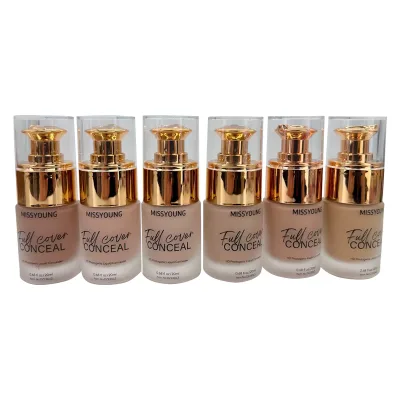
Full Coverage Face Foundation Cosmetic Long Lasting Makeup Liquid Foundation
$0.30 - $0.70
MOQ: 12000 Pieces


Comprehensive Sourcing Guide
Strategic Sourcing Guide for Waterproof Long-Lasting Liquid Foundation
Understanding Product Formulations and Technical Specifications
When sourcing a waterproof long-lasting liquid foundation, the primary technical distinction lies in the formulation type and the specific functional claims supported by the ingredient profile. Based on available market data, liquid foundations are distinct from cream-based alternatives, offering a fluid consistency that requires specific stabilization to maintain longevity and water resistance. The core technical requirement for a "waterproof" claim involves the integration of film-forming agents and specific pigment suspensions that resist emulsification upon contact with moisture.
In the current supply landscape, formulations vary significantly regarding their active ingredient composition. Buyers must verify whether the product relies on mineral-based ingredients, chemical filters, or herbal extracts. Some observed product models indicate a blend of mineral and chemical ingredients, while others specify herbal components. This distinction is critical for buyers targeting specific market segments, such as those seeking "clean beauty" solutions versus those prioritizing high-performance UV protection. The physical form is consistently identified as liquid, which necessitates packaging solutions that prevent leakage and oxidation, such as airless pumps or specialized glass and plastic containers.
The shelf life of these products is a key technical parameter that varies by formulation stability. Observed data indicates shelf lives ranging from 24 months to 36 months, with some products specifying a Period After Opening (PAO) of 12 months. This variance suggests that the preservative system and the ratio of water to oil phases differ across manufacturers. Buyers should not assume a uniform shelf life; instead, they must request stability testing reports that correlate the specific model number with its expiration timeline. Furthermore, the application area is typically defined for the face, requiring a texture that blends seamlessly without clogging pores, often targeting combination or all skin types.
Compliance Framework and Certification Verification
Navigating the regulatory landscape for cosmetic foundations requires rigorous verification of certifications, as these documents serve as the primary evidence of manufacturing quality and safety. The supply chain for liquid foundations in major manufacturing hubs, particularly in China, often references a suite of international standards. Buyers should expect to see certifications such as GMPC (Good Manufacturing Practice for Cosmetics), ISO (International Organization for Standardization), and GMP (Good Manufacturing Practice). These certifications indicate that the production facility adheres to strict hygiene and quality control protocols.
In addition to general manufacturing standards, specific regulatory approvals are often cited for different market access requirements. For instance, some product listings reference FDA (Food and Drug Administration) compliance, which is essential for selling in the United States, alongside MSDS (Material Safety Data Sheet) documentation for safe transportation and handling. The presence of these certifications is not merely a marketing claim but a prerequisite for legitimate B2B transactions. Buyers must verify that the certification documents are current and issued by accredited bodies relevant to the destination market.
The standardization of product models also plays a role in compliance. Specific model numbers, such as MBM496, LF, F8532, and F8515, are associated with distinct compliance profiles. For example, one model may carry GMPC, ISO, MSDS, and GMP certifications, while another might include FDA approval in addition to the standard set. This variation implies that the compliance status is tied to the specific product batch or formulation rather than the entire factory output. Procurement teams must request the specific certification documents for the exact model number being ordered to ensure regulatory alignment with local laws.
Cost Drivers and Pricing Dynamics
The pricing structure for waterproof liquid foundations is influenced by a complex interplay of formulation complexity, packaging requirements, and order volume. The observed price range in the market spans from $0.30 to $5.00 USD per unit. This wide variance is not arbitrary but reflects the underlying cost drivers. At the lower end of the spectrum, products may utilize standard chemical ingredients and basic packaging, such as simple paper cartons or generic plastic bottles. Conversely, the higher price points often correlate with premium formulations, such as those containing mineral or herbal ingredients, and specialized packaging like individual pack boxes or customized glass containers.
Order volume is a significant determinant of the final unit cost. The Minimum Order Quantity (MOQ) observed in the market ranges from 1 unit to 12,000 units. This flexibility allows buyers to scale their procurement based on their immediate needs and cash flow constraints. However, the relationship between MOQ and price is typically inverse; larger orders generally secure a lower unit price due to economies of scale in production and packaging. Buyers must balance the desire for a lower unit cost against the risk of inventory holding costs associated with large MOQs.
Packaging customization is another major cost driver. While standard packaging options like paper cartons are available, the option for "Be Customized Packaging by Clients" introduces additional tooling and setup costs. If a buyer requires unique branding, specific bottle shapes, or custom labeling, the initial investment will be higher, and the MOQ may increase. Additionally, the trade terms offered, such as EXW, FOB, CIF, CFR, DAP, and DDP, significantly impact the landed cost. Buyers must calculate the total cost of ownership, including freight, insurance, and duties, rather than focusing solely on the ex-factory price.
Typical Applications and Market Segmentation
Waterproof long-lasting liquid foundations are designed for a diverse range of applications, primarily targeting the face makeup sector. The functional attributes of these products extend beyond simple coverage; they are engineered to provide sun protection and durability in challenging environments. The "waterproof" feature is particularly valuable for applications involving high humidity, physical activity, or prolonged wear, such as in the entertainment industry, outdoor events, or for individuals with oily skin types.
The target demographic for these products is broad, encompassing unisex and adult consumers. Specific product attributes indicate suitability for combination skin types, while other formulations are marketed for all skin types. This versatility allows buyers to stock a single product line that appeals to a wider audience, reducing the complexity of inventory management. The inclusion of sun protection features, specifically anti-UVA/UVB capabilities, adds a functional layer that aligns with modern consumer demand for skincare-makeup hybrids.
Application areas are strictly defined as the face, requiring a formulation that is non-comedogenic and blends well with various skin tones. The body part specification confirms that these are not body foundations, which often have different viscosity and coverage requirements. The "long-lasting" claim is supported by the waterproof attribute, ensuring that the makeup remains intact through sweat and minor water exposure. Buyers should verify that the product's performance claims are backed by internal testing data, as the market is saturated with products making similar claims without substantiation.
Supplier Evaluation and Production Capabilities
Evaluating a supplier for liquid foundation production requires a deep dive into their operational capabilities and flexibility. The supply chain data indicates that production times can vary between 7 and 30 days, depending on the complexity of the order and the customization level. Buyers must align their order timelines with these production windows to avoid stockouts, especially during peak seasons. The ability to offer customized packaging is a significant differentiator, allowing brands to create unique identities without relying on generic stock.
When assessing suppliers, the range of product models available is a strong indicator of their R&D capabilities. The existence of multiple model numbers, such as F8514, F8528, F8529, BSJ-199, SZM061, Q516, and 9506, suggests a robust portfolio capable of meeting diverse formulation needs. Buyers should request samples of different models to test the texture, coverage, and longevity of the liquid foundation. Additionally, the origin of the products, consistently listed as China, implies a mature manufacturing ecosystem with access to a wide range of raw materials and packaging components.
The trade terms offered by suppliers, including EXW, FOB, CIF, CFR, DAP, and DDP, provide flexibility in logistics management. Buyers should choose the term that best aligns with their logistics expertise and risk tolerance. For instance, EXW (Ex Works) places the maximum responsibility on the buyer for transportation, while DDP (Delivered Duty Paid) offers a turnkey solution. Understanding these terms is crucial for accurate cost estimation and supply chain planning.
Quality Control and Long-Term Procurement Strategy
Maintaining consistent quality in liquid foundation procurement requires a proactive approach to quality control. Given the variability in shelf life and ingredient composition, buyers must establish clear acceptance criteria before production begins. Key quality metrics include the stability of the emulsion, the consistency of color, and the efficacy of the waterproof claim. Buyers should request batch-specific test reports that verify the product meets the specified standards, such as the 30ml or 40ml volume standards, and the 483636cm carton dimensions where applicable.
Long-term procurement strategies should focus on building a resilient supply chain. This involves diversifying suppliers to mitigate the risk of disruption and negotiating favorable terms for repeat orders. The availability of customization options allows for brand differentiation, but it also requires a clear communication channel to ensure that design changes are executed correctly. Buyers should also consider the environmental impact of their packaging choices, as the market is increasingly moving towards sustainable options.
Finally, buyers must remain vigilant regarding regulatory changes. As standards evolve, the certifications required for market entry may shift. Maintaining a relationship with suppliers who are proactive about compliance ensures that the supply chain remains compliant with international regulations. By focusing on these strategic elements, buyers can secure a reliable source of high-quality waterproof long-lasting liquid foundations that meet both consumer expectations and regulatory requirements.
FAQs
What certifications do waterproof liquid foundation suppliers typically hold?
Suppliers typically hold GMPC, ISO, MSDS, and GMP certifications for manufacturing quality. Some specific models also include FDA approval to meet US regulatory requirements. Buyers must verify these documents match the exact product model before ordering.
Can I customize the packaging for my waterproof liquid foundation order?
Yes, customization is available for packaging including individual pack boxes or client-designed containers. Standard options like paper cartons are also offered. Customization may affect the minimum order quantity and requires clear design specifications before production begins.
What is the typical lead time for producing waterproof liquid foundations?
Production time generally ranges from 7 to 30 days depending on order complexity. This timeline varies based on whether the order requires customized packaging or specific ingredient blends. Buyers should plan their inventory cycles around these production windows to avoid delays.
Which specifications are available for Waterproof Long Lasting Liquid Foundation models?
Available specifications include volumes like 30ml, 40ml, and 150ml, along with various model numbers such as F8532 and BSJ-199. Packaging dimensions like 48x36x36cm are also standard for cartons. Buyers should request specific model data to confirm exact product attributes.
What ingredients are used in waterproof liquid foundation formulations?
Formulations may contain mineral, chemical, or herbal ingredients depending on the specific product model. Some blends combine mineral and chemical components for enhanced performance. Buyers should review the ingredient list for each model to ensure it meets their clean beauty or performance requirements.
How does the price range vary for waterproof liquid foundations?
The observed price range spans from 0.3 to 5 USD per unit based on formulation and packaging. Lower prices often correlate with standard ingredients and basic packaging, while higher prices reflect premium components. Order volume also influences the final unit cost significantly.
Where are these waterproof liquid foundations manufactured?
Products are consistently manufactured in China with origins listed as Made in China. This location provides access to a mature manufacturing ecosystem and diverse raw materials. Buyers should account for shipping terms like FOB or CIF when calculating total landed costs.