Source Wood Handle Pickaxe for Farm, Garden, and Construction
Explore 30 verified listings for the Wood Handle Pickaxe, comparing steel head materials, weights from 5.0lb to 5.5lb, and packaging options like PVC bags or iron wire bundles. Buyers can evaluate specifications such as the P406 model and origin locations in Hebei and Tangshan, China.
Key considerations
Products List




Comprehensive Sourcing Guide
Strategic Sourcing Guide for Wood Handle Pickaxes
Understanding Product Specifications and Material Composition
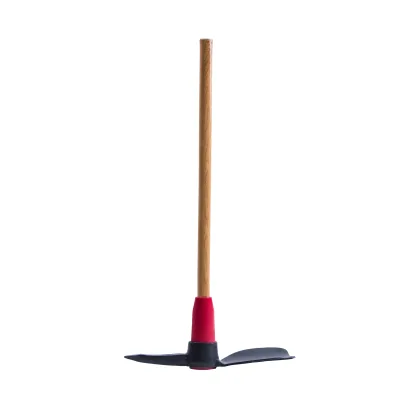
When sourcing wood handle pickaxes, the primary focus must be on the intersection of head material, handle composition, and overall weight distribution. Based on the available product data, the head material is consistently identified as steel, with specific references to "Railway Steel" suggesting a high-grade alloy suitable for heavy-duty impact. The head types observed include "Flat Tip Pickaxe" and general "pickaxe" configurations, indicating versatility in design for different soil and rock conditions. The handle material is explicitly noted as wood, a traditional choice that offers shock absorption and a natural grip, though specific wood species are not detailed in the provided facts.
Weight is a critical specification that varies across the supply base. The observed weight range spans from 5.0lb to 5.5lb, with some standards referencing a broader range of 1.8kg to 2.5kg. This variation suggests that buyers must verify the exact weight of the unit they intend to purchase, as a 5lb tool may differ significantly in balance and impact force from a 5.5lb unit. Furthermore, length specifications are present, with one observed standard of 90cm (0.9m). This dimension is crucial for ergonomics, ensuring the tool is neither too short for leverage nor too long for control. The product models identified, such as P406, P406W, P406I, 405, and 402, serve as unique identifiers for these variations. Buyers should treat these model numbers as specific designations for head shape, handle length, or weight class rather than generic terms.
Compliance, Certification, and Standard Verification
Navigating the compliance landscape for agricultural and construction tools requires careful attention to the standards and certifications listed. The product data indicates a mix of certification statuses, including "ISO" and specific references like "QB,T2095." It is important to note that some certification entries appear concatenated with color or customization data (e.g., "ISOColor:Black" or "QB,T2095-Color:Blue"), which implies that certification documents must be requested separately to verify their validity and scope. The standard "steel" is mentioned as a product standard, while other entries reference weight-based standards like "5LBS/5.5LBS" or "2.45KG."
Buyers must verify that the "Railway Steel" used in the head meets the necessary tensile strength and hardness requirements for the intended application. The presence of "Own Brand" and "Steel Elephant" as brand attributes suggests that some suppliers may offer private labeling, while others operate under established trade names. The "OEM, ODM" support indicates that customization of branding and specifications is a viable option, but this requires clear contractual agreements regarding intellectual property and quality control. The origin of the products is primarily Hebei and Tangshan, China, regions known for steel manufacturing. However, the specific "Delivery Port" is listed as Xingang, Tianjin, which is a key logistical detail for freight planning. Buyers should confirm that the supplier can provide valid certification documents that match the specific model and batch, rather than relying on general claims found in product listings.
Cost Drivers and Pricing Dynamics
The pricing structure for wood handle pickaxes is influenced by several factors, including material costs, customization levels, and order volume. The observed price range in the market is between $0.65 and $10.00 USD per unit. This wide disparity suggests that the lower end of the spectrum likely corresponds to basic, non-customized models with standard packaging, while the higher end may reflect premium steel grades, specialized head designs, or customized branding. The Minimum Order Quantity (MOQ) ranges from 100 to 4800 units, with specific observations of 500 and 1000 PCS. This variability in MOQ indicates that buyers can negotiate entry-level orders, but achieving the lowest price per unit will likely require ordering closer to the higher end of the MOQ spectrum.
Packaging also plays a role in cost. The data shows multiple packaging configurations, including "6PCS/Bundle with Iron Wire," "30PCS/PVC Bag," "Iron Wire Packing," and "Carton/Woven Bag." The choice of packaging affects the unit cost due to material expenses and labor. For instance, PVC bag packing might be more expensive per unit than simple iron wire bundling but offers better protection against moisture and corrosion during transit. Buyers should calculate the total landed cost, including packaging, by factoring in the specific packing method required for their destination market. Additionally, the "Customization" attribute is available, which can increase costs. Customized orders, whether involving specific colors like "Black" or "Blue," or specific branding, will generally command a higher price point than standard "Ordinary" specification models.
Typical Applications and Usage Scenarios
The versatility of the Wood Handle Pickaxe is evident in its listed usage scenarios, which span "Farm," "Garden," and "Construction." The scope is further defined as "Agriculture" and "Architecture," highlighting its dual utility in both rural and urban development contexts. In agricultural settings, the tool is essential for breaking up hard soil, digging trenches for irrigation, and preparing land for planting. The flat tip design is particularly effective for these tasks, offering a balance between penetration and leverage. In construction, the pickaxe is used for breaking concrete, removing old foundations, and general demolition work where precision is less critical than force.
The weight of the tool is a deciding factor for its application. A 5.0lb pickaxe might be preferred for lighter garden tasks where user fatigue is a concern, while the 5.5lb or 2.5kg variants are better suited for heavy-duty construction or breaking compacted earth. The 90cm length provides a standard reach that is comfortable for most adult users, allowing for effective swinging mechanics. However, for specialized applications, buyers should verify if custom lengths or handle materials are available, as the standard wood handle may not be suitable for all environments. For instance, in extremely wet or corrosive environments, the wood handle might require additional treatment or a different material entirely, though the current data focuses on wood.
Supplier Evaluation and Sourcing Strategy
Evaluating suppliers for wood handle pickaxes requires a focus on their manufacturing capabilities, origin, and flexibility. The primary manufacturing hubs identified are Hebei and Tangshan in China, with shipments originating from the Xingang, Tianjin port. Buyers should prioritize suppliers who can demonstrate a consistent track record in producing steel tools, given the critical nature of the head material. The presence of "Own Brand" and "OEM/ODM" capabilities suggests that many suppliers are capable of private labeling, which is beneficial for buyers looking to build their own brand identity.
When assessing suppliers, buyers should verify the consistency of their product models. The existence of multiple model numbers (P406, P406W, P406I, 405, 402) indicates a diverse product line, but it also means that specifications can vary significantly between models. A supplier offering "Customized" options may provide better flexibility, but buyers must ensure that the customization process does not compromise the quality of the steel or the integrity of the wood handle. The "Non-Customized" options are also available, offering a faster turnaround for standard orders. Buyers should request samples to verify the quality of the wood grain, the sharpness of the steel edge, and the durability of the handle attachment before placing large orders.
Quality Control and Inspection Protocols
Quality control for wood handle pickaxes must address both the metal head and the wooden handle. The head material, identified as "Railway Steel," should be inspected for hardness, tensile strength, and resistance to chipping or cracking under impact. The "Flat Tip" design must be uniform across the batch to ensure consistent performance. For the wooden handle, inspection should focus on the grain structure, the absence of knots or cracks, and the quality of the finish. The handle must be securely attached to the head, as a loose handle can be a significant safety hazard.
The observed weight variations (5.0lb vs. 5.5lb) necessitate strict weight tolerance checks during production. Buyers should establish a clear acceptance criteria for weight deviation, ensuring that the product meets the specified standard, whether it is 1.8kg, 2.45kg, or 5LB. Packaging integrity is another critical aspect of quality control. Whether the product is packed in "Iron Wire," "PVC Bag," or "Carton/Woven Bag," the packaging must protect the tool from damage during shipping. For instance, PVC bags should be sealed properly to prevent moisture ingress, which could damage the wood handle. Inspections should also verify that the color, whether "Black" or "Blue," matches the order specifications, as this is often a key requirement for branding or identification purposes.
Long-Term Procurement and Supply Chain Considerations
Long-term procurement of wood handle pickaxes involves managing the supply chain from the point of origin in Hebei or Tangshan to the final delivery port in Xingang, Tianjin. Buyers should consider the lead times associated with different order sizes, as the MOQ ranges from 100 to 4800 units. Larger orders may require longer production times, especially if customization is involved. The availability of "Customized" support suggests that suppliers can adapt to changing market demands, but this requires early communication and planning.
Sustainability and material sourcing are also becoming increasingly important. While the current data does not specify the type of wood used, buyers should inquire about the source of the wood to ensure it is harvested sustainably. The use of "Railway Steel" is a positive indicator of durability, but buyers should also consider the environmental impact of the steel production process. Finally, buyers should maintain a flexible relationship with suppliers to accommodate fluctuations in demand. The ability to switch between "Customized" and "Non-Customized" orders, or to adjust packaging from "Iron Wire" to "Carton," can help buyers manage inventory levels and respond to market changes effectively. By focusing on these long-term considerations, buyers can build a resilient supply chain for wood handle pickaxes that ensures consistent quality and availability.
FAQs
Can I order wood handle pickaxes with custom branding?
Yes, customization is available for this product line. Buyers can request OEM or ODM support to apply their own brand name or specific design features. This option requires clear contractual agreements regarding intellectual property and quality control before production begins.
What is the typical weight range for these tools?
The observed weight range spans from 5.0lb to 5.5lb. Some standards also reference a broader range of 1.8kg to 2.5kg. Buyers must verify the exact weight of the unit they intend to purchase as a 5lb tool differs significantly in balance from a 5.5lb unit.
Which certifications are available for these pickaxes?
Available certifications include ISO and specific standards like QB,T2095. Some entries appear concatenated with color data, so certification documents must be requested separately to verify their validity. Buyers should ensure the supplier provides valid documents matching the specific model and batch.
What is the minimum order quantity for these tools?
The minimum order quantity ranges from 100 to 4800 units. Specific observations show MOQs of 500 and 1000 pieces. Achieving the lowest price per unit will likely require ordering closer to the higher end of the MOQ spectrum rather than the entry-level options.
How are these pickaxes typically packaged for shipping?
Packaging options include 6 pieces per bundle with iron wire, 30 pieces per PVC bag, or carton and woven bags. The choice of packaging affects the unit cost due to material expenses and labor. Buyers should calculate the total landed cost including the specific packing method required for their destination.
Where are these wood handle pickaxes manufactured?
Products originate primarily from Hebei and Tangshan in China. Shipments depart from the Xingang, Tianjin delivery port. Buyers should confirm that the supplier can provide valid certification documents that match the specific model and batch rather than relying on general claims found in product listings.
What are the main usage scenarios for this tool?
Usage scenarios span farm, garden, and construction applications. The scope covers both agriculture and architecture, making the tool versatile for breaking hard soil or demolition work. The flat tip design is particularly effective for these tasks, offering a balance between penetration and leverage.