Source AC Grey Tungsten Electrode for Welding, Electronics, Aviation
Find 30 listings for AC Grey Tungsten Electrode suitable for welding, electronics, and aviation applications. Buyers can compare specifications, impurity levels, and pricing from verified Chinese manufacturers.
Key considerations
Products List




Comprehensive Sourcing Guide
Strategic Sourcing Guide for AC Grey Tungsten Electrodes
The global welding industry relies heavily on the precision and reliability of consumable electrodes, particularly for alternating current (AC) applications where arc stability and tungsten emission characteristics are critical. When sourcing an "AC Grey Tungsten Electrode," buyers must navigate a complex landscape of material science, international standards, and supplier capabilities. The term "grey" in this context often refers to the visual appearance of specific tungsten oxide blends or surface treatments, though industry documentation frequently categorizes these by color codes such as purple, yellow, green, or blue to denote specific alloying elements. This guide provides a disciplined framework for procurement professionals to evaluate suppliers, verify technical compliance, and manage long-term supply chain risks associated with high-performance tungsten electrodes.
Technical Specifications and Alloy Composition
The fundamental differentiator for any tungsten electrode is its alloy composition, which dictates its performance under AC current. For AC welding, the electrode must maintain a stable arc and resist contamination. The supplied product data indicates that specific models utilize distinct impurity additions to achieve these properties. For instance, the WE3 model is characterized by the addition of Yttrium Oxide (Y2o3) in a quantity range of 1.80-2.20%, often associated with a purple color code. Similarly, the WL15 model incorporates Lanthanum Oxide (La2o3) at 1.30-1.70%, typically identified by a yellow color code. While the specific keyword "grey" is not explicitly mapped to a single impurity percentage in the provided facts, the presence of Thorium Dioxide (Tho2) at 1.8-2.20% (Red code) and other variants like WP (Green) and WL20 (Blue) suggests a broad spectrum of alloyed options available in the market.
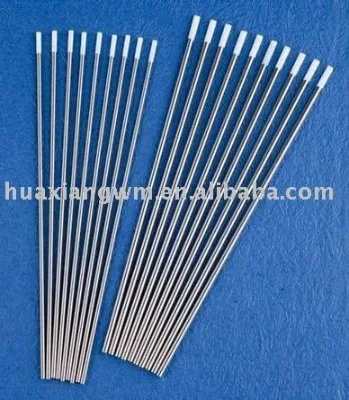
Buyers must verify the exact diameter and length specifications against their welding equipment requirements. The data confirms that standard dimensions include Dia(1.08*4.8mm)*L(150/175mm) for specific models, while other listings offer a broader range of (1.0-100)*L(mm) or Dia(1-10mm)*L. The physical form is consistently described as "Round," with surface finishes ranging from "Polished Ground Black" to "Ground Polished." The "Grey" designation may also relate to the surface treatment or the specific oxide blend used in non-alloy grades, which are noted to have a purity of >99.95%, compared to alloy grades which may have >99.5% purity. Understanding these nuances is essential, as the wrong alloy can lead to arc instability, excessive electrode consumption, or contamination of the weld pool.
Compliance with International Standards and Certifications
Procurement of industrial welding consumables requires strict adherence to recognized standards to ensure safety and weld integrity. The provided facts highlight that products often comply with AWS A5.12(Ewp), a critical standard for tungsten electrodes used in gas tungsten arc welding (GTAW). Additionally, some listings reference ASTM and GB standards, indicating that suppliers may cater to both American and Chinese domestic markets. When evaluating a supplier, buyers should request documentation proving compliance with these specific standards rather than relying on generic claims.
Certification status is another vital component of compliance. The data indicates that some suppliers hold ISO9001:2000 certification, which validates their quality management systems. However, buyers should note that ISO9001:2000 is a specific version of the standard; current market expectations often lean toward newer iterations like ISO9001:2015. Therefore, procurement teams must verify the exact version of the certificate and ensure it covers the specific manufacturing processes for tungsten electrodes. The absence of a specific certification in a supplier's listing should not automatically disqualify them, but it necessitates a deeper audit of their internal quality control procedures.
Cost Drivers and Pricing Dynamics
The price of tungsten electrodes is influenced by several factors, including raw material costs, alloying elements, and manufacturing complexity. The observed price range in the market spans from $0.10 to $1,190, a variance that reflects differences in product type, quantity, and packaging. The lower end of the spectrum likely corresponds to standard, non-alloyed tungsten rods or bulk purchases, while the higher end may represent specialized alloys, custom dimensions, or small-batch orders with premium packaging.
The Minimum Order Quantity (MOQ) is a significant cost driver, with observed ranges from 1 to 1,000 units. Suppliers with lower MOQs may charge a premium per unit to cover setup and handling costs, whereas high-volume buyers can leverage economies of scale to reduce the unit price. Packaging also impacts cost; options include simple cartons, wooden cases, or specialized boxes with foam inserts for export. The choice of packaging must balance protection requirements with cost efficiency, especially for international shipments where wooden cases may incur additional regulatory or freight charges. Buyers should request detailed cost breakdowns to understand how alloy content and packaging contribute to the final price.
Typical Applications and Performance Requirements
Tungsten electrodes are versatile tools used across a wide array of industries. The supplied data lists applications in chemical, medical, industrial, electronics, and aviation sectors. The specific type of electrode chosen depends heavily on the welding process and the material being joined. For AC applications, electrodes with thorium or rare earth oxides are often preferred for their ability to sustain a stable arc on aluminum and magnesium alloys. The "Grey" designation might imply a specific surface finish or oxide blend optimized for general industrial use or specific surfacing applications.
The functional capabilities of these electrodes extend beyond simple arc initiation. Some products are described as having functions such as "Gravity Electrode," "Surfacing Electrode," "Hardfacing Electrode," and "Low Hydrogen Type Electrode." This suggests that the market offers specialized electrodes for hardfacing operations, moisture-proof applications, and high-efficiency iron powder welding. Buyers must match the electrode's functional profile to their specific welding tasks. For instance, a "Moisture-Proof Electrode" would be essential for environments with high humidity, while a "High Efficient Iron Powder Electrode" might be selected for high-deposition rate applications.
Supplier Evaluation and Origin Verification
Identifying a reliable supplier requires a thorough evaluation of their origin and manufacturing capabilities. The data indicates that products originate from China, with specific mentions of Zhuzhou City, Hunan, as a production hub. Zhuzhou is historically known for its tungsten and carbide industries, making it a logical source for these materials. However, buyers should not assume that all products from this region meet the same quality standards. Verification of the specific factory location and their production history is crucial.
When evaluating suppliers, buyers should look for evidence of "Professional" advantages, such as advanced manufacturing processes or specialized expertise in tungsten alloying. The availability of customization is a key differentiator, allowing buyers to tailor electrode dimensions and compositions to their specific needs. Packaging options, such as "Wooden Boxes for Export" or "Carton with Foam Inside," also indicate the supplier's attention to detail and ability to handle international logistics. Buyers should request samples to verify the physical attributes, such as the "Polished Ground Black" surface, before committing to large orders.
Quality Control and Long-Term Procurement Considerations
Ensuring consistent quality is paramount in long-term procurement. The purity of the tungsten is a critical quality metric, with some grades boasting >99.5% and others >99.95%. Buyers must verify that the purity levels stated by the supplier are consistent with the requirements of their welding processes. Surface treatment is another area where quality control is essential; the "Polished Ground Black" finish is designed to improve arc stability and reduce contamination, and any deviation from this specification could compromise weld quality.
Lead times are a critical factor in supply chain planning. The observed delivery time ranges from 7 to 15 days, which suggests a relatively efficient supply chain for standard products. However, buyers should account for potential delays due to customization requests or logistical challenges. The ability to meet these lead times consistently is a strong indicator of a supplier's operational maturity. Furthermore, buyers should establish clear communication channels for quality issues and returns, ensuring that any non-conforming products can be addressed promptly.
| Feature | Standard Specification | Buyer Verification Point |
|---|---|---|
| Material | Tungsten (Non-alloy or Alloy) | Verify purity (>99.5% or >99.95%) |
| Impurity | Y2o3, La2o3, Tho2 (Specific %) | Confirm exact percentage range (e.g., 1.8-2.20%) |
| Color Code | Purple, Yellow, Green, Blue, Red | Match color to required alloy type |
| Standard | AWS A5.12(Ewp), ASTM, GB | Request certificate of compliance |
| Dimensions | Dia(1-10mm)*L, or specific models | Verify exact diameter and length |
| Surface | Polished, Ground, Black | Inspect sample for finish quality |
| Origin | China (e.g., Zhuzhou City) | Confirm factory location and audit |
Conclusion
Sourcing AC grey tungsten electrodes requires a meticulous approach that balances technical specifications, compliance requirements, and supplier reliability. By understanding the nuances of alloy compositions, verifying adherence to standards like AWS A5.12, and evaluating the supplier's capacity for customization and quality control, buyers can secure a supply chain that supports their welding operations effectively. The wide range of available options, from standard non-alloy rods to specialized hardfacing electrodes, offers flexibility but demands careful selection. Ultimately, the success of the procurement process depends on the buyer's ability to validate claims against the supplied facts and industry best practices, ensuring that every electrode delivered meets the rigorous demands of modern industrial welding.
FAQs
What impurities are added to AC grey tungsten electrodes?
Specific models add Y2o3, La2o3, or Tho2 depending on the variant. For instance, the WE3 model contains 1.80-2.20% Y2o3, while WL15 includes 1.30-1.70% La2o3. These impurities determine the color code and arc stability for alternating current applications.
Which standards do these tungsten electrodes comply with?
Products often comply with AWS A5.12(Ewp), ASTM, and GB standards. Buyers should verify specific documentation for compliance rather than relying on generic claims. Some listings also reference ISO9001:2000 certification for quality management systems.
How are these electrodes typically packaged for export?
Packaging options include cartons, wooden cases, or boxes with foam inserts. Specific models may use wooden boxes for export to ensure protection during shipping. The choice of packaging often balances protection requirements with cost efficiency for international logistics.
Can buyers request customization for these electrode models?
Yes, customization is available for specific product requirements. Buyers can tailor dimensions and compositions to their needs, such as specific diameters or lengths. This flexibility allows for precise matching with existing welding equipment and processes.
What is the typical delivery time for these products?
The observed delivery time ranges from 7 to 15 days for standard products. Buyers should account for potential delays due to customization requests or logistical challenges. Consistent lead times indicate a supplier's operational maturity and supply chain reliability.
Where are these tungsten electrodes manufactured?
Products originate from China, with specific mentions of Zhuzhou City, Hunan. This region is historically known for its tungsten and carbide industries. Buyers should verify the specific factory location to ensure quality standards are met.