Source Active Ceiling Speaker for Hotels Schools and Churches
Find 30 Active Ceiling Speaker options from verified suppliers in Guangdong. Compare specifications like power output, frequency response, and mounting methods for use in hotels, schools, and churches.
Key considerations
Products List


$4.40 - $4.80
MOQ: 1 Pieces

$1.70 - $1.80
MOQ: 1 Pieces


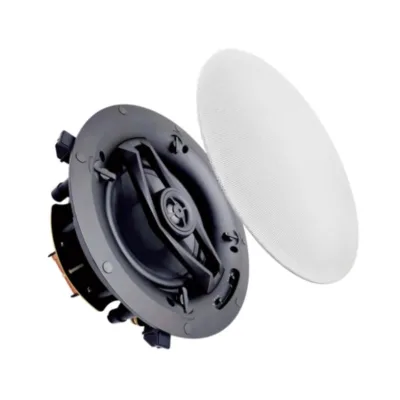


High Fidelity Ceiling Speaker with Crossover Network & Clear Powerful Sound
$23.00 - $38.00
MOQ: 100 Pieces



Comprehensive Sourcing Guide
Strategic Sourcing Guide for Active Ceiling Speakers
Understanding the Technical Landscape of Active Ceiling Audio
When sourcing active ceiling speakers, buyers must first distinguish between passive and active configurations, as this fundamental difference dictates the entire supply chain and installation strategy. An Active Ceiling Speaker integrates an amplifier directly within the enclosure, eliminating the need for external power amplifiers and reducing the cabling complexity typically associated with passive systems. This integration is critical for commercial and residential applications where space is constrained and aesthetic cleanliness is paramount. The supplied market data indicates a clear divergence in product structures, with some listings explicitly defining the structure as "Floorstanding Speaker" or "Wall Speaker," while others confirm the "Ceiling Speaker" type. However, a crucial observation in the current supply pool is the presence of "Passive" type listings alongside "Active" amplification types. This suggests that while the market offers active solutions, buyers must rigorously verify the "Amplification Type" attribute for every specific SKU to ensure the product matches the "active" requirement.
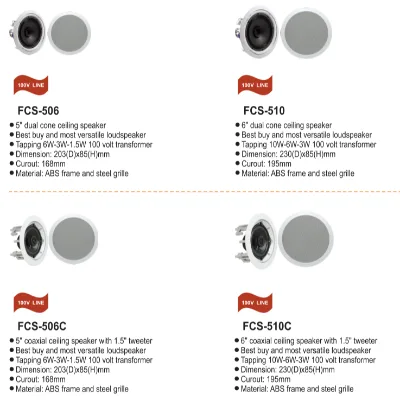
The technical specifications for these units often center on power handling and frequency response. Observed data points to an output power range of 1.5W to 3W and up to 6W, which is typical for distributed audio systems where multiple units are deployed to cover large areas. The frequency response is noted in the range of 110-18KHz, indicating a design focus on mid-to-high frequency clarity rather than deep bass reproduction, which is standard for ceiling-mounted units due to acoustic limitations in that orientation. The speaker unit itself is frequently described as a 5-inch full-range dual cone woofer, a configuration that balances size constraints with sound projection. Buyers should also note the line input capabilities, which are listed as 100V or 70V in some contexts, though this is more common in passive high-voltage systems. For active units, the power source is often listed as "Other," requiring clarification on whether the unit requires a dedicated low-voltage DC supply or if it draws power directly from the mains via an internal power supply. The dimension of 203mm in diameter with a cutout size of 168mm represents a standard form factor for retrofitting into existing suspended ceilings, while the depth of 85mm is a critical metric for ensuring the unit fits within the plenum space above the ceiling tiles.
Compliance, Certification, and Safety Standards
In the B2B procurement of electronic audio equipment, compliance with international safety and environmental standards is non-negotiable. The supply data reveals a robust set of certifications, including CE, FCC, RoHS, CB, and CCC. These certifications serve as evidence that the manufacturer has subjected the product to rigorous testing for electromagnetic compatibility, electrical safety, and restriction of hazardous substances. The presence of the CCC (China Compulsory Certification) standard is particularly relevant for products intended for the Chinese domestic market, while CE and FCC are essential for entry into European and North American markets, respectively. The CB scheme facilitates global acceptance by providing a single test report that can be used to obtain national certifications in multiple countries, streamlining the import process.
Buyers must verify that the specific model number they intend to purchase carries the full suite of certifications required for their target region. For instance, while the data lists "CE, FCC, RoHS, CB" as available, it is not guaranteed that every unit in a mixed shipment will possess all these marks. The "Protection" attributes listed, such as "High Temp, Overload & Short-C," suggest internal safety mechanisms designed to prevent fire hazards or equipment failure under stress. However, these are operational features that must be validated against the specific safety standards. The "Standard" field also mentions "CE, ROHS, FCC, CCC, CB," reinforcing the expectation that compliant products should meet these benchmarks. Procurement teams should request the specific test reports or certificates of conformity for the exact model number, such as the LTH-903 or LTH-8315TS, rather than relying on general manufacturer claims. This verification process is vital for avoiding customs delays and ensuring the product can be legally installed in regulated environments like schools, airports, and churches.
Cost Drivers and Pricing Dynamics
The pricing structure for active ceiling speakers is influenced by several variables, including the level of integration, the quality of components, and the scale of the order. The observed price range in the market spans from $1.1 to $200, a significant variance that reflects the difference between basic, entry-level units and high-end, feature-rich models. The lower end of this spectrum likely corresponds to simpler designs with basic amplification and minimal features, while the upper end may include units with advanced DSP (Digital Signal Processing), touch controls, or premium build materials. The "Selling Units" attribute indicates that these products are often available as single items, which is beneficial for small-scale projects but may result in higher per-unit costs compared to bulk orders.
The Minimum Order Quantity (MOQ) is another critical cost driver, with observed ranges from 1 to 500 units. For buyers with large-scale deployment needs, such as hotel chains or educational institutions, negotiating an MOQ closer to the lower limit of 1 can be challenging unless the supplier offers a tiered pricing structure. The "Supply Ability" of 1000 pieces per month suggests that while the supplier can handle moderate volumes, extremely large orders may require production scheduling or multiple shipments. The "Deliver Time" of 2-25 days adds a logistical cost variable; shorter lead times may command a premium, while longer lead times allow for better inventory planning but increase the risk of project delays. Buyers should also consider the "Packaging Details," such as "12PCS/Carton," as this affects shipping efficiency and potential damage rates during transit. The "Weight" of 0.5kg per unit is relatively light, which helps minimize shipping costs, but the "Dimension" of 203(D)*85(H)mm must be accounted for in volumetric weight calculations.
Typical Applications and Usage Scenarios
Active ceiling speakers are versatile solutions designed for a wide array of environments where discreet audio distribution is required. The data explicitly lists usage scenarios including Home Theatre Systems, Karaoke, Portable Players, Mobile Phones, Stage/DJ, Hotels, Schools, Airports, Departments, and Churches. This broad applicability stems from the "Flush mount in-ceiling quick and secure installation" method, which allows the speaker to blend seamlessly into the ceiling architecture. In commercial settings like airports and hotels, the "Type" of ceiling speaker ensures that announcements and background music are distributed evenly without visual clutter. The "Structure" of a closed enclosure is particularly important for these environments, as it prevents sound leakage and maintains acoustic privacy.
The "Adjusting Method" of Touch-Control adds a layer of user convenience, allowing for volume adjustments or source selection without the need for physical knobs or remotes, which is ideal for public spaces where durability and ease of use are priorities. However, the "Usage" list also includes "Radio," which may be a feature of specific active models that include built-in tuners, though the "Radio function" attribute in some listings is marked as "No," indicating that this is not a universal feature. Buyers must align the product's capabilities with their specific application needs. For instance, a school environment might prioritize the "Warranty" period and "Factory History" of over 10 years to ensure long-term reliability, while a home theatre setup might focus more on the "SPL(@1W/m)" of 92dB and the "Sound Channel" configuration. The "Customized" attribute being "Yes" and "Customization" being "Available" offers an additional avenue for tailoring the speaker to specific acoustic requirements or branding needs, which is a significant advantage for large-scale corporate or institutional projects.
Supplier Evaluation and Factory Capabilities
Selecting the right supplier is as critical as selecting the right product. The supply data highlights several key attributes for evaluating potential partners, including "Factory History" of more than 10 years and "Factory Ability" in OEM and ODM services. A decade of experience suggests a mature manufacturing process and a track record of reliability, which reduces the risk of production errors or quality inconsistencies. The ability to offer OEM (Original Equipment Manufacturer) and ODM (Original Design Manufacturer) services indicates that the supplier can adapt products to meet specific branding or technical requirements, a valuable capability for buyers looking to differentiate their offerings.
The "Place of Origin" is listed as Guangdong, China, and Guangzhou, Cn, which are major hubs for electronics manufacturing. This concentration of industry expertise often translates to a robust supply chain and competitive pricing. However, buyers should verify the "Port of dispatch," which is noted as Huangpu, to ensure that logistics align with their import strategy. The "Brand Name" varies across listings, with "FTD" and "Qqchinapa" appearing in the data, suggesting that the market includes both established brands and private label manufacturers. This diversity allows buyers to choose between buying under a recognized brand name or developing their own private label. The "Warranty" periods vary, with some listings offering 5 years and others 3 years, which serves as a direct indicator of the manufacturer's confidence in their product's longevity. Buyers should prioritize suppliers that offer longer warranty terms and clearly defined support channels. Additionally, the "Customized" and "Customization" attributes being available suggest that the supplier is flexible and willing to engage in collaborative development, which is essential for complex B2B projects.
Quality Control and Long-Term Procurement Considerations
Ensuring consistent quality in active ceiling speakers requires a proactive approach to quality control and long-term relationship management. The "Protection" features, such as resistance to high temperatures, overload, and short circuits, are internal safeguards that must be validated through third-party testing. Buyers should request detailed test reports that verify these protection mechanisms function as advertised under various stress conditions. The "SNR" (Signal-to-Noise Ratio) range of 81-90dB is another quality metric that buyers should verify; a higher SNR generally indicates clearer audio with less background hiss, which is crucial for high-fidelity applications.
Long-term procurement considerations extend beyond the initial purchase to include the "Deliver Time" and "Supply Ability." A supplier with a consistent supply ability of 1000 pieces per month can support ongoing maintenance and expansion projects, whereas a supplier with erratic production capacity may lead to project delays. The "Packaging Details" of cartons must be robust enough to protect the speakers during international shipping, especially given the "Dimension" and "Weight" of the units. Buyers should also consider the "Model Number" consistency; the data lists models like FCS-506, LTH-903, and LTH-8315TS, and it is vital to ensure that the specific model ordered remains in production for the duration of the project lifecycle to facilitate future replacements or expansions. Finally, the "Usage" diversity implies that the speakers must be durable enough to withstand varying environmental conditions, from the humidity of a church to the high-traffic environment of an airport. Regular quality audits and clear communication channels with the supplier are essential to maintain these standards over time.
FAQs
What is the output power range for these active ceiling speakers?
The output power ranges from 1.5W to 3W and up to 6W depending on the specific model. This power handling is typical for distributed audio systems where multiple units cover large areas without requiring high individual wattage.
Which certifications do the active ceiling speakers typically hold?
These units commonly hold CE, FCC, RoHS, CB, and CCC certifications. These marks indicate compliance with international safety and environmental standards required for markets in Europe, North America, and China.
How long is the delivery time for Active Ceiling Speaker orders?
The delivery time typically ranges from 2 to 25 days after order confirmation. This lead time allows for production scheduling and shipping logistics from the Guangzhou, Guangdong manufacturing hub.
Can buyers customize the active ceiling speakers for specific projects?
Yes, customization is available for active ceiling speakers to meet specific branding or technical needs. Suppliers offer OEM and ODM services, allowing for tailored solutions for large-scale institutional or corporate deployments.
What is the standard cutout size for installing these ceiling speakers?
The standard cutout size for installation is 168mm in diameter. This dimension fits standard suspended ceiling grids, with the overall unit measuring 203mm in diameter and 85mm in depth.
Which warranty periods are offered for these active ceiling speakers?
Warranty periods vary between 3 years and 5 years depending on the specific product listing. A longer warranty often indicates the manufacturer's confidence in the product's durability and long-term reliability.