Source Aluminum Projection Projector Light for Outdoor, Industrial, and Advertising
Find 27 Aluminum Projection Projector Light options featuring IP67 waterproofing, remote control, and RGB capabilities. Compare models with 15W to 300W power ratings, varying luminous flux, and diverse heat dissipation methods for industrial and advertising applications; compare the available evidence and request quotations based on your requirements.
Key considerations
Products List


Comprehensive Sourcing Guide
Aluminum Projection Projector Light Sourcing Guide
Procurement of aluminum projection projector lights requires distinguishing between industrial floodlighting and specialized advertising illumination, as the market offers distinct product categories under this keyword. Buyers must verify whether the listing describes a dual-head industrial unit designed for high-lumen output or an RGB advertising light featuring rotary gobo capabilities. The observed product data indicates a split between general industrial lighting solutions and specific advertising applications, necessitating a clear definition of the intended use case before engaging suppliers.
The material composition is a critical differentiator, with listings explicitly citing aluminum alloy or pure aluminum bodies for superior heat dissipation. This construction supports high-efficiency conduction technology, which is essential for maintaining performance in environments ranging from -40°C to +65°C. Sourcing teams should prioritize suppliers who can demonstrate the structural integrity of these aluminum housings, as the material directly influences the longevity of the LED components and the overall thermal management of the fixture.
Product Scope and Observed Listing Signals
The current market inventory reveals a wide variance in power ratings, ranging from compact 15W units to high-output 300W industrial projectors. Buyers will encounter specific model numbers such as HJT-L516 and ST series units, each tailored for different luminous flux requirements, with outputs observed between 18,500 and 29,500 lumens. This diversity suggests that a single supplier may offer multiple tiers of products, requiring careful selection based on the specific illumination intensity needed for the target application.
Listing signals also highlight functional variations, including remote control capabilities, waterproof ratings of IP65 or IP67, and specific color temperature ranges. Some units are designed for RGB emitting colors with rotating gobos, while others focus on high-efficiency heat conduction for continuous industrial operation. Procurement professionals must cross-reference these observed features against project requirements to ensure the selected unit supports the necessary dimming, voltage input, and environmental protection standards.
Technical Specifications to Verify
Verifying the input voltage range is essential, as listings show variations between AC 220V and a broader AC 100-240V range. Buyers must confirm that the selected unit matches the local grid infrastructure to prevent operational failures or the need for additional transformers. Additionally, the working lifetime claims vary significantly, with some products citing 30,000 hours and others up to 50,000 hours, requiring validation of the LED bead quality and driver reliability to ensure the claimed lifespan is achievable in real-world conditions.
Thermal management and luminous efficiency are equally critical technical parameters that define the operational stability of the projector. The observed data points to a lamp bead efficiency of 60 to 100 lm/W, with heat dissipation achieved through fins, fans, or high-efficiency conduction technology. Buyers should request detailed thermal testing data to confirm that the aluminum body effectively manages heat in the specified operating temperature range, preventing premature degradation of the light source and maintaining consistent color rendering.
Compliance and Safety Documentation
Safety compliance is a non-negotiable aspect of sourcing, with observed certifications including CE, RoHS, and ISO standards. These documents verify that the electrical components and materials meet international safety and environmental regulations, which is particularly important for projects in regulated markets. Procurement teams must ensure that the supplier provides valid, up-to-date certificates for the specific model being purchased, as certification status can vary between different product lines within the same factory.
Beyond electrical safety, documentation regarding the lamp beads and overall product construction must be scrutinized for authenticity. Some listings mention imported OSram lamp beads, a detail that significantly impacts performance and longevity. Buyers should request batch-specific test reports or material safety data sheets to confirm the origin and quality of these components, ensuring that the advertised performance claims regarding color temperature and luminous flux are backed by verified supply chain data.
Cost Drivers and Commercial Terms
The price range for these units is extensive, spanning from approximately $0.70 to $4,450, driven primarily by power output, feature complexity, and brand reputation. High-power industrial units with advanced thermal management and RGB capabilities command premium pricing, while basic floodlights remain more affordable. Buyers must analyze the cost-per-lumen ratio rather than the total unit price to determine the true value proposition, ensuring that the investment aligns with the specific illumination needs of the project.
Commercial terms such as Minimum Order Quantity (MOQ) and customization availability also influence the total cost of ownership. Observed MOQs range from 1 to 100 units, offering flexibility for small-scale trials or large-scale deployments. Suppliers often accept OEM and ODM requests, allowing for tailored solutions, but these customizations may introduce additional lead times and costs. Procurement strategies should balance the desire for customization with the need for cost efficiency and timely delivery.
Supplier Qualification and Quality Control
Supplier qualification should focus on the manufacturing location and the consistency of their production standards. The observed data indicates origins in Fujian and Guangdong, China, regions known for lighting manufacturing but requiring rigorous vetting for quality control. Buyers must assess the supplier's ability to maintain consistent quality across different batches, particularly regarding the aluminum casting process and the assembly of the LED drivers and heat sinks.
Quality control protocols must extend to the final product testing, including checks for waterproof integrity and electrical safety. Given the varying IP ratings observed, from IP65 to IP67, suppliers should provide evidence of successful ingress protection testing for the specific models in question. Establishing a clear quality assurance framework that includes pre-shipment inspections and sample testing is essential to mitigate the risk of receiving units that do not meet the specified performance or durability standards.
Long-Term Procurement Checks
Long-term procurement success depends on verifying the warranty terms and the supplier's commitment to after-sales support. The observed warranty periods range from one to two years, which serves as a baseline indicator of the manufacturer's confidence in their product durability. Buyers should negotiate extended warranty options or service level agreements that cover potential failures in the LED drivers or heat dissipation systems, ensuring minimal downtime for critical lighting installations.
Finally, ongoing performance monitoring is necessary to validate the claimed lifespan and efficiency of the aluminum projection lights. Buyers should establish a feedback loop to track actual operating hours and maintenance requirements against the supplier's specifications. This data-driven approach allows for the refinement of future procurement strategies, ensuring that the selected products continue to meet the evolving needs of the project while maintaining the high standards of reliability and efficiency expected in industrial and advertising lighting applications.
FAQs
What is the IP rating for waterproof aluminum projection lights?
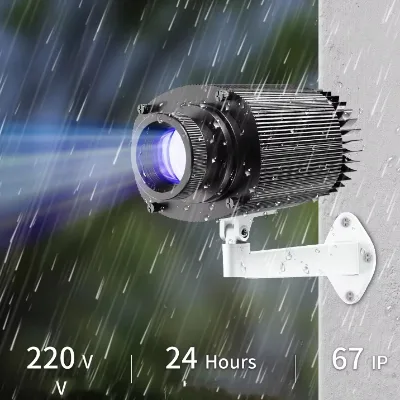
The Aluminum Projection Projector Light features an IP67 rating for superior waterproof protection. This ensures reliable operation in outdoor environments and harsh weather conditions. Some variants also offer IP65 ratings, providing robust dust and water resistance for industrial and advertising applications where durability is essential.
Can these lights be customized for specific branding needs?
Yes, customization is available for these aluminum projection projector lights. The supplier accepts OEM and ODM custom orders, allowing for tailored specifications. Buyers can request specific lighting solutions services, including lighting and circuitry design, to meet unique project requirements and branding standards effectively.
What is the expected working lifetime of the LED source?
The LED light source has a working lifetime of 50,000 hours. This long lifespan ensures consistent performance and reduces maintenance frequency. The high-efficiency heat conduction technology helps maintain stability, making it suitable for continuous use in industrial lighting and advertising applications over extended periods.
Which certifications do these aluminum projection lights hold?
These aluminum projection projector lights hold CE, RoHS, and ISO certifications. These credentials verify compliance with international safety and environmental standards. Buyers can rely on these certifications for quality assurance when sourcing products for global markets, ensuring the equipment meets regulatory requirements for electrical safety and material restrictions.
What power options are available for these projector lights?
Power options range from 15W to 120W for standard models, with industrial variants offering 100W, 200W, or 300W. The input voltage supports AC 220V or AC 100-240V. This flexibility allows users to select the appropriate wattage for specific illumination needs, from small advertising displays to large industrial projects.
How is heat dissipation managed in these aluminum lights?
Heat dissipation is managed using high-efficiency heat conduction technology and aluminum alloy construction. The design incorporates fins and fans to optimize thermal performance. This approach prevents overheating, ensuring stable operation within the specified working temperature range and extending the overall lifespan of the LED components and internal circuitry.