Source Automatic Clay Brick Unloading Machine for Construction, Chemical, Metallurgy
Compare 30 listings for the Automatic Clay Brick Unloading Machine designed for brick production lines. Buyers can evaluate models like Brictec and MPJ-3T, which feature hydraulic pressure or vacuum extruder methods, and offer high efficiency with global shipment options.
Key considerations
Products List


Automatic Clay Bricks Production Line Unloading and Packing System for Brick Factory
$200000.00 - $800000.00
MOQ: 1 Sets


Heavy Duty Industrial Automatic Brick Unloading Machine for Clay Brick Plant
$3000.00 - $15000.00
MOQ: 1 Pieces
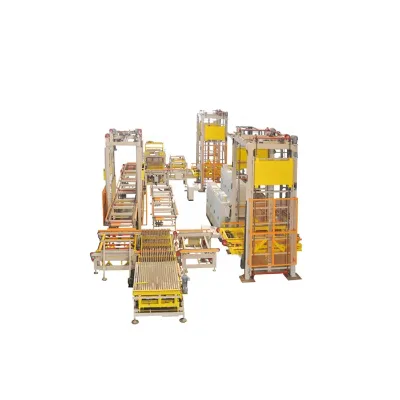


Automatic Brick Clamping Machine Brick Holding Machine Clay Brick Making Machine
$30000.00 - $60000.00
MOQ: 1 Sets

Clay Brick Machine Brick Holding Machine Auto Brick Making Machinery
$30000.00 - $60000.00
MOQ: 1 Sets

Clay Brick Making Machine Automatic Brick Holding Machine Plate Loaded Machines
$3000.00 - $10000.00
MOQ: 1 Sets


Comprehensive Sourcing Guide
Strategic Sourcing Guide for Automatic Clay Brick Unloading Machines
Understanding the Operational Scope and Core Functionality
The procurement of an Automatic Clay Brick Unloading Machine represents a critical investment in modernizing brick manufacturing workflows. Unlike manual handling systems, these machines are engineered to automate the transition of finished bricks from the kiln or molding stage to the palletizing or storage phase. The supplied product data indicates that the core processing capability for these units is often categorized under "Brick Production Line" or specifically as "Brick Molding Machine" and "Brick Cutting Machine" systems, suggesting a high degree of integration within the broader manufacturing ecosystem. The primary observation is that these systems are designed for "Automatic Grade" operation, ensuring that the labor-intensive nature of traditional brick handling is eliminated.
Buyers must recognize that the "Automatic" designation in this context implies a fully mechanized workflow that minimizes human intervention. The systems are described as having "High Efficiency" and "High Capacity," which are essential metrics for facilities aiming to scale production without a proportional increase in workforce. The raw material input for the bricks being handled is consistently identified as "Clay" or "Clay Coal," and the machines are built to accommodate these specific material properties. The unloading process is often supported by advanced methods such as "Vacuum Extruder" technology or "Hydraulic Pressure" systems, depending on the specific model configuration. This variety in processing methods suggests that the unloading machine must be compatible with the upstream molding or extrusion technology employed by the facility.
Technical Specifications and Model Variations
When evaluating the technical specifications of automatic clay brick unloading machines, buyers will encounter a range of model identifiers and dimensional standards. The observed product data lists several specific model numbers, including "Brictec," "MPJ-3T," "XTDJ-1," and "XDJ-1T." These identifiers are not merely labels but represent distinct engineering configurations tailored to different production volumes and brick sizes. For instance, the standard brick size referenced in the data is "24011553" mm, which aligns with international standards, while other configurations support larger dimensions such as "400100200 mm" or "400200200 mm," with some models offering "Customized" sizes to meet specific project requirements.
The physical dimensions of the machinery itself are also critical for facility planning. One observed standard dimension for the equipment is "2980x2360x3930mm," while other references mention standards of "3.5M/4.6M." These figures indicate the footprint and height requirements for the installation site. The construction material is predominantly "All Steel," ensuring durability and resistance to the abrasive nature of clay and brick dust. The "Condition" of the equipment is listed as "New," and the "Quality" is generally rated as "Excellent" or "Good," though buyers should verify these claims through independent inspection. The "Size" is noted as "Standard" in some contexts but "Customized" in others, highlighting the flexibility available in the market.
| Model Identifier | Primary Processing Method | Brick Size Compatibility | Material Construction |
|---|---|---|---|
| MPJ-3T | Hydraulic Pressure | 24011553 mm | All Steel |
| XTDJ-1 | Vacuum Extruder | 400100200 mm | All Steel |
| XDJ-1T | Hydraulic Pressure | 400200200 mm | All Steel |
| Brictec | Automatic Line | Customized | All Steel |
Compliance, Certification, and Quality Standards
Navigating the compliance landscape for industrial machinery requires a rigorous verification of certifications and standards. The supplied data explicitly mentions "ISO" and "Certification_ISO9001: 2000" as observed attributes. While the text notes "ISO9001" in a low-confidence background section, the explicit mention of "ISO" and the specific year "2000" in the high-confidence facts suggests that quality management systems are a key selling point. However, buyers must not assume that every listed product automatically satisfies all international safety or environmental standards without direct verification. The presence of "CE" certification is noted in the background data but should be treated as a claim requiring confirmation rather than a guaranteed attribute.
Quality assurance is further reinforced by the "Guarantee" period, which is observed to be "1 Year" for many units. This warranty period is a standard metric for assessing supplier confidence in their product longevity. The "Quality" attribute is consistently described as "Excellent" or "Good," but these are subjective observations that must be backed by objective test results or third-party audits. Buyers should verify that the "Automatic Grade" operation meets specific safety protocols and that the "All Steel" construction adheres to relevant structural integrity standards. The "Standard" attribute often refers to "Customized" or specific model standards like "MPJ-3T," indicating that compliance is often model-specific rather than a blanket feature across all inventory.
Cost Drivers and Pricing Dynamics
The financial landscape for sourcing automatic clay brick unloading machines is characterized by significant variability. The observed price range in the market spans from $850 to $800,000 USD. This wide disparity is driven by several factors, including the complexity of the automation, the capacity of the machine, the level of customization, and the specific model technology employed. The "Price" attribute is frequently listed as "Negotiable," indicating that the final cost is often determined through direct discussion between the buyer and the supplier rather than a fixed catalog price.
Several key cost drivers influence the final quotation. First, the "Customized" nature of the equipment is a major factor; machines built to specific dimensions or integrated with unique "Brick Cutting" or "Molding" processes will command a higher price than standard "Off-the-Shelf" units. Second, the "Capacity" and "Efficiency" ratings directly correlate with cost; higher capacity machines designed for "High" output volumes require more robust engineering and materials. Third, the inclusion of "After-Sale Service" and "Technicial Service" is often bundled into the price, with some suppliers offering these services as "Included" while others may charge separately. The "Shipment" cost, which is noted as "Global," can also significantly impact the total landed cost, especially when dealing with large, heavy steel structures.
Typical Applications and Industry Integration
Automatic clay brick unloading machines are versatile assets deployed across various sectors where brick production is a core activity. The "Application" data points to "Chemical," "Construction," and "Metallurgy" industries, suggesting that these machines are not limited to traditional residential or commercial construction but are also integral to industrial manufacturing processes. In the construction sector, the machines facilitate the rapid movement of bricks from production lines to storage or transport, ensuring a steady supply for large-scale projects.
The integration of these machines into the production line is seamless, as they are designed to work with "Clay" and "Mud Soil" raw materials. The "Method" of operation, whether "Vacuum Extruder" or "Hydraulic Pressure," allows for precise handling of bricks that may have varying moisture contents or structural strengths. The "Exported" status of these machines to "25 Countries" indicates a global demand and adaptability to different regulatory and operational environments. Furthermore, the presence of "Agent" networks in regions such as "Nepal, India, Bangladesh, Egypt, and Venezuela" suggests that these machines are particularly valuable in emerging markets where labor costs are rising and efficiency is becoming a priority.
Supplier Evaluation and Procurement Strategy
Evaluating suppliers for automatic clay brick unloading machines requires a focus on reliability, service capability, and transparency. The "After-Sale Service" and "Technicial Service" are critical differentiators; suppliers that explicitly state these services are "Included" or "Yes" offer a higher level of support. The "Guarantee" of "1 Year" is a baseline expectation, but buyers should inquire about the scope of this guarantee and what it covers in terms of parts and labor. The "Location" of the supplier, often cited as "China" or specifically "Henan," provides insight into the manufacturing hub, which can influence lead times and logistics.
Buyers should verify the "Customization" capabilities of the supplier. While some products are listed as "Non-Customized," others offer "Available" customization, allowing for tailored solutions. The "Product" type is consistently "Brick," but the specific configuration, such as the "prod_model" or "prod_standard," must align with the buyer's production needs. The "prod_packing" method, often described as "Container" or "Standard Export Package," is essential for ensuring the equipment arrives in pristine condition. Additionally, the "Labor-Intensive" attribute is noted as "No," confirming that the machine is designed to reduce manual labor, a key benefit for modern facilities.
Long-Term Procurement and Operational Considerations
Long-term success with automatic clay brick unloading machines depends on strategic planning beyond the initial purchase. The "Condition" of the machine being "New" is a starting point, but the long-term durability relies on the "All Steel" construction and the quality of the "Automatic" components. Buyers should consider the "Efficiency" and "Capacity" ratings as indicators of the machine's ability to scale with future production demands. The "Shipment" to "Global" markets implies that spare parts and technical support must be accessible internationally.
The "Customized" nature of the equipment also means that future modifications or expansions may be required. Buyers should assess the supplier's ability to provide upgrades or additional modules as production needs evolve. The "Agent" network in specific countries can be a valuable resource for local support, ensuring that technical issues are resolved quickly. Finally, the "Price" being "Negotiable" allows for flexibility in the procurement process, enabling buyers to secure favorable terms based on volume or long-term partnership potential. By carefully evaluating these factors, buyers can ensure a sustainable and efficient investment in automatic clay brick unloading technology.
FAQs
What is the automatic grade of these brick machines?
The machines operate at an automatic grade, eliminating labor-intensive manual handling. This automation ensures high efficiency and capacity for continuous brick production lines using clay or mud soil raw materials.
Which certifications do the brick production machines hold?
The equipment holds ISO certification, with specific models referencing ISO9001:2000 standards. Buyers should verify that these quality management systems apply to the specific unit being purchased for compliance.
Can the brick size be customized for specific projects?
Yes, customization is available for brick sizes such as 400*100*200 mm or 400*200*200 mm. Some models support standard sizes like 240*115*53 mm, while others allow for fully customized dimensions.
How is the price determined for these automatic machines?
The price is negotiable and varies significantly based on capacity and customization levels. Costs range from $850 to $800,000 USD depending on the specific model and included after-sale services.
What warranty is provided for the brick molding equipment?
A one-year guarantee is typically included for the new condition machines. This warranty covers the equipment to ensure reliability, though specific terms may vary by supplier and model configuration.
Where are these brick production lines manufactured?
The products originate from China, specifically from the Henan region. Global shipment is available, with agents located in countries like Nepal, India, and Egypt to support international distribution.
What raw materials can these machines process effectively?
These machines are designed to process clay, clay coal, and mud soil raw materials. The construction uses all steel to handle the abrasive nature of these materials during the molding and cutting processes.