Source Automatic Robot Bag Palletizer for Food Beverage Packaging
Find and compare 30 Automatic Robot Bag Palletizer for Food and Beverage applications. Evaluate models with 4-axis or 6-axis configurations, varying load capacities, and ISO/CE certifications to match your production line needs.
Key considerations
Products List


Robot Palletizer System Carton Palletizing Machine Packing Palletizing Machine
$96000.00 - $105000.00
MOQ: 1 Pieces


4-Axis Robot Palletizer for Handling in Food and Beverage Industries
$20000.00 - $22000.00
MOQ: 1 Sets


Advanced Automated Robot Palletizer for Efficient Bag and Box Handling
$2999.00 - $12999.00
MOQ: 1 Sets

High-Efficiency Automated Palletizing Robots for The Food and Beverage Industry
$20000.00 - $50000.00
MOQ: 1 Pieces

Palletizing Robots: Industrial Palletizing Robots for Bags and Cartons
$20000.00 - $50000.00
MOQ: 1 Pieces


Industrial Robots for Bagging, Stacking, Palletizing, Unloading, and Packaging
$20000.00 - $50000.00
MOQ: 1 Pieces


Automated Robotic Bag Palletizer 4 Axis Robot Palletizer for Rice Bag
$8950.00 - $20000.00
MOQ: 1 Pieces


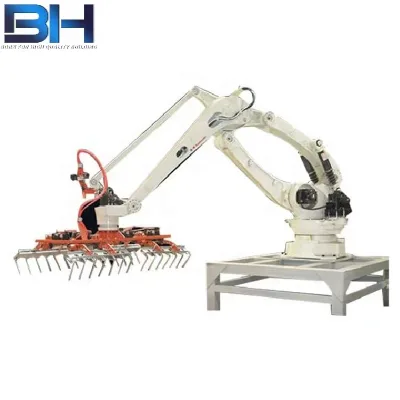
CE Certificated Robot Paletisation Robotic Palletizing Palletizer for Paper Bags
$35000.00 - $38000.00
MOQ: 1 sets

Robotic Canned Food Palletizer and Depalletizer Automatic Palletizer and Depalletizer
$20000.00 - $150000.00
MOQ: 1 Sets

Industrial Robot Automatic Palletizing Robot for Beverage Boxes Picking Palletizer
$8000.00 - $20000.00
MOQ: 1 Pieces


Comprehensive Sourcing Guide
Automatic Robot Bag Palletizer for Food and Beverage Sourcing Guide
Selecting the right automated palletizing solution for food and beverage operations requires a careful balance of mechanical capability, control precision, and operational reliability. The market offers a diverse range of robotic systems, from single-layer arrangements to complex multi-layer configurations, each designed to handle specific packaging formats such as cartons, films, bottles, cans, and bags. Buyers must navigate this variety by focusing on the core requirements of their production line, ensuring that the chosen machine aligns with both current throughput needs and future scalability. This guide provides a structured approach to evaluating these systems, emphasizing verification of technical specifications, compliance standards, and supplier capabilities to mitigate procurement risks.
The decision to implement an automatic robot bag palletizer is often driven by the need to reduce manual labor, improve safety, and increase consistency in high-volume environments. However, not all robotic palletizers are created equal; differences in degrees of freedom, drive modes, and control algorithms significantly impact performance. By understanding the observed listing signals and technical parameters available in the current market, procurement teams can make informed decisions. This guide focuses on evidence-based verification steps, helping buyers distinguish between generic offerings and specialized solutions that meet the rigorous demands of the food and beverage industry.
Product Scope and Observed Listing Signals
The current market for automatic robot palletizers in the food and beverage sector exhibits a wide range of configurations, primarily categorized by layer capacity and application type. Listings frequently distinguish between Single Layer Palletizers and Multi Layer Palletizers, with some specialized units designed as Arrangement Palletizers for specific box handling tasks. These machines are typically engineered to handle a variety of applicable products, including boxed items, cartons, films, and bags, making them versatile for different packaging lines. Buyers should carefully review the "Applicable Product" and "Suitable Object" fields to ensure the machine’s mechanical design matches their specific packaging format, whether it involves delicate film packs or heavy-duty cartons.
Observed listing data indicates that these systems are predominantly manufactured in China, with specific origins noted in regions like Feicheng, Taian, and Shandong. The product models vary significantly, with identifiers such as KLMMD30D, KW1030D-1800, and TY-CD-1 suggesting distinct design architectures. Furthermore, the observed price range spans from approximately $2,999 to $150,000, reflecting the disparity between basic single-layer units and advanced multi-axis robotic systems. This wide variance underscores the importance of not relying solely on price as an indicator of quality; instead, buyers must correlate cost with specific technical attributes like degrees of freedom, load capacity, and production efficiency to determine true value.
Technical Specifications to Verify
When evaluating the technical core of a robot palletizer, the degrees of freedom and drive mode are critical determinants of flexibility and speed. High-end models often feature 6-axis configurations with electric drive modes, enabling complex movements and precise placement in tight spaces, while other units may operate on 4-axis systems suitable for simpler, repetitive tasks. The control mode, such as Continuous Path Control, is essential for ensuring smooth motion and accurate positioning, particularly when handling fragile food products. Buyers should verify that the robot’s kinematic structure aligns with the required pallet patterns and that the electric drive system offers the necessary torque and speed for their specific throughput requirements.
Load capacity and physical dimensions are equally vital for ensuring the machine can handle the heaviest packages without compromising stability or safety. Observed specifications include load capacities ranging from 220kg to 180kg, with body weights varying significantly based on the machine’s robustness. For instance, some models are rated for a working radius of 3200mm, which dictates the reach and coverage area of the palletizing zone. Additionally, the production efficiency, noted in some listings as 700-800 times per hour, provides a benchmark for throughput, but buyers must verify if this rate is consistent under full load conditions and across different packaging types.
Pallet size compatibility and conveyor height are practical constraints that must be integrated into the facility layout. Standard pallet sizes such as 11001100mm and 12001200mm are commonly supported, but buyers must confirm that the machine’s gripper or handling mechanism can adapt to these dimensions without modification. Conveyor height is another critical interface point; observed data mentions heights around 1100mm, which must match the upstream packaging line to ensure seamless material flow. Mismatches in these physical parameters can lead to bottlenecks or require costly retrofitting of existing infrastructure, so precise verification of these interface specifications is mandatory before purchase.
Compliance and Safety Documentation
Safety and regulatory compliance are non-negotiable aspects of industrial automation, particularly in food and beverage environments where hygiene and worker safety are paramount. Buyers should insist on machines that carry recognized certifications such as ISO and CE, which indicate adherence to international quality management and European safety standards. These certifications are not merely formalities; they reflect a manufacturer’s commitment to rigorous design and testing protocols. Procurement teams must request valid certification documents and verify their authenticity, ensuring that the equipment meets the specific regulatory requirements of the destination country and industry sector.
Beyond formal certifications, the operational safety features of the robot palletizer must be thoroughly reviewed. This includes the presence of safety guards, emergency stop mechanisms, and interlock systems that prevent operation when access doors are open. In food processing facilities, the materials used in the robot’s construction should be compatible with cleaning agents and resistant to corrosion, although specific material grades should be confirmed with the supplier. Buyers should also inquire about the machine’s condition, with most listings indicating "New" status, but verifying that all safety components are installed and functional upon delivery is essential to prevent accidents and ensure regulatory compliance.
Cost Drivers and Commercial Terms
The total cost of ownership for an automatic robot palletizer extends beyond the initial purchase price, encompassing installation, training, and after-sales support. Observed listings indicate a minimum order quantity (MOQ) of 1, suggesting that these machines are often treated as capital equipment rather than bulk commodities. The price range of $2,999 to $150,000 reflects the complexity of the system, with higher costs associated with 6-axis robots, advanced control systems, and custom configurations. Buyers should analyze the cost breakdown to understand what is included, such as software licenses, initial programming, and commissioning services, to avoid hidden expenses.
Commercial terms regarding warranty and after-sales service are critical for long-term operational continuity. Most suppliers offer a one-year warranty, but the scope of this warranty should be clearly defined, covering parts, labor, and potentially travel expenses for engineers. Some providers offer engineers available to service machinery overseas, which is a significant advantage for international buyers. However, buyers must verify the availability of spare parts and the response time for technical support. Understanding the power capacity requirements, such as 3.0kVA or 11kVA, is also important for calculating operational costs and ensuring the facility’s electrical infrastructure can support the machine.
Packaging and logistics are additional cost factors that should be negotiated upfront. Products are typically packed in wooden cases or wood cases to protect the machinery during transit, but the dimensions and weight of these packages will impact shipping costs. Buyers should confirm who is responsible for export packaging standards and whether the packaging includes moisture-proof or shock-absorbing materials, especially for shipments to regions with varying climate conditions. Clear agreement on these terms prevents disputes and ensures that the machine arrives in optimal condition, ready for immediate installation.
Supplier Qualification and Quality Control
Evaluating the supplier’s capability is as important as evaluating the machine itself. Buyers should prioritize manufacturers with a proven track record in the food and beverage automation sector, as they are more likely to understand the specific challenges of hygiene, durability, and high-speed operation. The origin of the machine, often noted as Feicheng, Taian, or Shandong, can provide insights into the regional manufacturing ecosystem, but buyers must verify the supplier’s actual production capacity and quality control processes. Requesting factory audits or third-party inspection reports can provide objective evidence of the supplier’s manufacturing standards and consistency.
Quality control should extend to the pre-shipment inspection phase, where buyers can verify that the machine meets all agreed-upon specifications. This includes checking the degrees of freedom, load capacity, and control system functionality. Buyers should also inquire about the customization options available, as many suppliers offer tailored solutions for specific packaging lines. However, customization can introduce complexity and potential delays, so it is essential to have clear technical drawings and approval processes in place. Ensuring that the supplier provides comprehensive documentation, including operation manuals, maintenance guides, and electrical schematics, is crucial for smooth integration and long-term maintenance.
Long-Term Procurement Checks
Long-term success with an automatic robot palletizer depends on the availability of ongoing support and spare parts. Buyers should establish a clear agreement with the supplier regarding the availability of critical components, such as grippers, controllers, and motors, for at least five to ten years. This ensures that the machine can be maintained without significant downtime or the need for expensive replacements. Additionally, buyers should verify the supplier’s ability to provide software updates and technical assistance, which are essential for optimizing performance and adapting to new packaging formats.
Training and knowledge transfer are also key factors in long-term procurement. Buyers should ensure that their maintenance and operation teams receive thorough training on the robot’s control system, troubleshooting procedures, and safety protocols. Some suppliers offer remote support or on-site training, which can be valuable for building internal expertise. By investing in comprehensive training and establishing a strong relationship with the supplier, buyers can maximize the return on investment and ensure the reliable operation of their automated palletizing system for years to come.
FAQs
What automatic grades are available for robot palletizers?
The available automatic grades include Automatic and Full-Automatic configurations. These systems are designed to handle food and beverage products efficiently while maintaining high production standards for industrial applications.
Which certifications do these robot palletizers hold?
These machines hold ISO and CE certifications to ensure safety and compliance. Buyers can rely on these verified standards when selecting equipment for their production lines in various international markets.
Can the machines be customized for specific needs?
Yes, customization is available to meet specific operational requirements. This flexibility allows buyers to tailor the palletizer to their unique production lines and product handling needs effectively.
What is the warranty period for the equipment?
The standard warranty period provided is one year for the machinery. This coverage ensures that buyers receive support for potential issues during the initial operational phase of the equipment.
How many degrees of freedom do the robots have?
The robots feature either 4-axis or 6-axis degrees of freedom depending on the model. This configuration allows for precise movement and control during the palletizing process for various product types.
Where are these machines manufactured and shipped from?
The machines originate from Feicheng, Taian, Shandong, China. This location serves as the primary production hub for these industrial automation solutions destined for global distribution.
What is the production efficiency of the palletizer?
The production efficiency ranges from 700 to 800 times per hour. This high throughput capability ensures that the machine can handle large volumes of boxed or bagged products efficiently.