Source Coin Operated Mini Claw Machine for Arcade, Mall, and Home
Explore 30 listings for the Coin Operated Mini Claw Machine suitable for arcades, shopping malls, and home entertainment. Buyers can compare specifications like voltage, weight, and customization options to find the right supplier.
Key considerations
Products List


Indoor Amusement Coin Operated Arcade Toy Mini Claw Machine Gift Machine
$289.00 - $320.00
MOQ: 1 Pieces


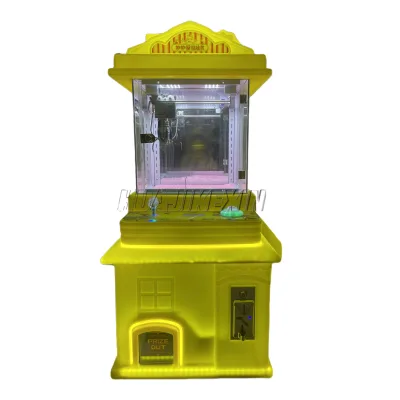


Coin Operated Mini Claw Machine for Indoor Playground and Arcade Center
$2912.00 - $3176.00
MOQ: 1 Pieces
Comprehensive Sourcing Guide
Strategic Sourcing Guide for Coin Operated Mini Claw Machines
Understanding the Technical Landscape of Miniature Arcade Units
When sourcing a coin-operated mini claw machine, buyers must first distinguish between the various mechanical configurations and physical footprints available in the current market. The term "mini" often implies a compact footprint suitable for boutique retail spaces, arcades with limited square footage, or high-traffic commercial zones where a full-sized arcade cabinet would be impractical. Based on observed product data, these units typically feature a "Three-Claw" mechanism, a configuration that offers a distinct gameplay dynamic compared to single-claw variants. This design often increases the difficulty of the prize retrieval, which can be a strategic choice for operators aiming to manage prize inventory while maintaining player engagement.
The physical dimensions of these machines vary significantly depending on the specific model and intended prize volume. Observed specifications indicate a range of sizes, with some models measuring approximately L55W32H155cm, while others, such as those designed for larger prizes or different internal mechanics, may reach dimensions like L85W79H198cm. A critical observation for procurement is the variance in standard dimensions; some listings reference a standard of L83W80H240cm, while others cite L90W80H200cm. Buyers must verify the exact external dimensions against their available floor space, as the difference between a 1.5-meter and a 2.4-meter height can determine whether a unit fits under standard commercial ceilings or requires a dedicated alcove.
Weight is another critical technical specification that impacts logistics and installation. The observed weight range for these units spans from 25kg for lighter, perhaps more portable models, up to 100kg for heavier, more robust industrial-grade cabinets. A unit weighing 100kg requires specialized handling equipment for installation and a reinforced floor structure to support the load during operation. Conversely, a 25kg unit may be easier to relocate but might lack the internal ballast required for high-traffic commercial environments. The material composition also plays a role in durability; observed materials include ABS Plastic and Tempered Glass for the cabinet, as well as Hardware and Acrylic for internal components. These materials suggest a balance between aesthetic appeal and resistance to wear and tear.
Compliance and Certification Verification Protocols
In the B2B procurement of coin-operated gaming equipment, verifying compliance with international safety and environmental standards is non-negotiable. The electrical nature of these machines necessitates rigorous certification checks to ensure they meet the safety requirements of the target market. Observed product data frequently lists certifications such as RoHS (Restriction of Hazardous Substances), ISO (International Organization for Standardization), and CE (Conformité Européenne). The presence of the CE mark is particularly significant for buyers targeting European markets, as it indicates the product meets EU safety, health, and environmental protection requirements.
However, buyers must exercise caution when interpreting certification claims. While some listings explicitly state "CE,CCC" (China Compulsory Certification), others may only list "CE" or "RoHS,CE." It is essential to request valid, up-to-date certification documentation from the supplier rather than relying solely on product descriptions. The CCC mark is specific to the Chinese market, and its presence does not automatically guarantee compliance with European or North American standards. Similarly, while RoHS compliance is a standard baseline for electronic goods, buyers should verify the specific version of the directive (e.g., RoHS 2 or RoHS 3) to ensure the product is free from restricted hazardous substances like lead, mercury, and cadmium.
Voltage compatibility is another critical compliance factor. The observed data indicates a standard voltage of 220V for many of these units. This is the standard mains voltage in most of Europe, Asia, and parts of Africa. However, if the procurement target is a market operating on 110V, such as the United States or Japan, the machine will require a step-down transformer or a specific voltage variant. Relying on a 220V unit in a 110V environment without proper electrical modification can lead to equipment failure or safety hazards. Buyers must explicitly confirm the voltage rating and the type of plug required before finalizing an order to avoid costly retrofits or shipping returns.
Cost Drivers and Pricing Structure Analysis
The pricing of coin-operated mini claw machines is influenced by a complex interplay of factors, including build quality, customization options, and the complexity of the internal mechanics. The observed price range in the market spans from $100 to $3,176 USD. This wide disparity suggests that the market is segmented into distinct tiers: entry-level units for small businesses or home use, mid-range commercial models, and high-end custom-built machines. The lower end of the price spectrum likely corresponds to simpler designs with basic electronics and standard packaging, while the higher end may reflect advanced features, premium materials, or extensive customization.
One of the primary cost drivers is the level of customization. The product data indicates that "Customization" is available for many models, with some listings specifying "Customized" while others note "Non-Customized." Customization can significantly increase the unit price, as it involves additional engineering, mold creation, and assembly time. Buyers seeking a unique aesthetic or specific branding may need to budget for these extra costs. Conversely, standard models with "Color: as Pictures" or generic designs will generally be more affordable and have shorter lead times.
The Minimum Order Quantity (MOQ) also plays a pivotal role in the total cost of ownership. Observed MOQ values range from 1 to 10 units. An MOQ of 1 allows for single-unit testing or small-scale deployment, which is ideal for startups or pilot programs. However, buyers purchasing in bulk (e.g., 10 units) may benefit from economies of scale, potentially lowering the per-unit cost. It is important to note that while the price range is broad, the specific price for a given unit depends heavily on the configuration selected. Buyers should not assume that a higher price automatically equates to better quality; rather, they should evaluate the price against the specific technical specifications and material quality provided.
Typical Applications and Operational Environments
The versatility of coin-operated mini claw machines makes them suitable for a diverse range of commercial applications. The observed product attributes indicate that these machines are designed for "Children and Adult" audiences, with a specific age recommendation of "6+" for certain models. This broad appeal allows them to be deployed in various settings, from family entertainment centers and shopping malls to standalone boutiques and arcades. The "Three-Claw" design, in particular, is well-suited for environments where the operator wants to create a challenge that encourages repeated play, thereby increasing revenue per machine.
The physical size of the machine dictates its optimal placement. Smaller units, such as those with dimensions around L55W32H155cm, are ideal for boutique retail spaces where floor space is at a premium. These "Single Mini Boutique Doll Machines" can be placed near checkout counters or in window displays to attract impulse buyers. Larger units, with heights exceeding 2 meters, are better suited for dedicated arcade zones or large commercial lobbies where they can serve as a focal point. The "Lucky Cat" and "EP-G025 Children's Doll Machine" models, for instance, are designed to be visually appealing and functional in high-traffic areas.
Furthermore, the power consumption of these machines is a consideration for long-term operational costs. Observed power ratings range from 100W to 250W. While these figures are relatively low compared to other arcade equipment, the cumulative effect of running multiple units 24/7 can impact electricity bills. Buyers should factor in the power rating when calculating the total cost of ownership, especially for large deployments. The "Racing Game Machine" and "Gift Game Machine" classifications also suggest that these units can be adapted for different themes, allowing operators to align the machine's aesthetic with the surrounding environment or promotional campaigns.
Supplier Evaluation and Quality Assurance Standards
Evaluating a supplier for coin-operated mini claw machines requires a rigorous assessment of their manufacturing capabilities, quality control processes, and after-sales support. The product data indicates that the origin of these machines is primarily "China," with specific mentions of "Guangdong, China (Mainland)" as a production hub. While this region is known for its robust manufacturing ecosystem, buyers must verify the specific factory's reputation and track record. A reputable supplier should be able to provide detailed information about their production line, quality control protocols, and the materials used in construction.
Quality control should extend beyond the final product inspection to include the packaging and shipping process. Observed packaging methods include "Wooden Case Packaging," "Bubble Pack+Well Paper+Stretch Films+Strong Wood F," and specific packing sizes like 10.550.47m. These details suggest that suppliers are aware of the need to protect the machines during transit, especially given their varying weights and fragility. Buyers should request photos of the packaging process and verify that the wooden cases meet international shipping standards to prevent damage during long-haul transport.
Warranty and after-sales support are critical components of the supplier evaluation. The observed data mentions a "1 Year Warranty" for certain models, which is a standard baseline for the industry. However, buyers should clarify the scope of this warranty, including what components are covered, the process for claiming repairs, and the availability of spare parts. A supplier that offers a comprehensive warranty and a responsive support team is more likely to ensure the long-term reliability of the machines. Additionally, the "Condition: New" status should be verified to ensure that the machines are not refurbished or used units being sold as new.
Long-Term Procurement and Maintenance Considerations
Sourcing coin-operated mini claw machines is not a one-time transaction but a long-term investment that requires ongoing maintenance and strategic planning. The durability of the machine depends on the quality of its internal components and the frequency of use. The "Hardware and Acrylic" materials observed in the product data suggest a focus on durability, but regular maintenance is still required to ensure optimal performance. Buyers should establish a maintenance schedule that includes cleaning the glass, checking the claw mechanism for wear, and inspecting the electrical components for any signs of overheating or damage.
The customization options available in the market also offer opportunities for long-term brand alignment. If a buyer chooses a "Customized" model, they can integrate their brand logo or specific color schemes into the machine's design. This can enhance brand visibility and create a cohesive look across multiple locations. However, customization also introduces complexity in terms of spare parts and future repairs. Buyers should ensure that the supplier can provide replacement parts for custom components to avoid downtime.
Finally, buyers should consider the scalability of their procurement strategy. Starting with a single unit (MOQ 1) allows for testing the machine's performance in a real-world environment before committing to a larger order. If the initial unit performs well, the buyer can scale up to a bulk order, potentially negotiating better pricing and terms. The ability to choose between "Chinese or English" versions of the machine's interface is also a strategic consideration for international deployments, ensuring that the user experience is localized for the target market. By carefully evaluating these factors, buyers can make informed decisions that maximize the return on investment and ensure the long-term success of their coin-operated mini claw machine operations.
FAQs
What certifications do coin operated mini claw machines typically have?
These machines typically hold RoHS, ISO, and CE certifications. Some listings also include CCC marks, but buyers must verify valid documentation for their specific target market before purchasing.
Can I customize the appearance of a Coin Operated Mini Claw Machine?
Customization is available for many models, allowing for unique branding or aesthetic changes. However, some units are sold as non-customized standard designs, so confirm this option with the supplier.
What is the voltage requirement for these coin operated mini claw machines?
The observed standard voltage is 220V, which suits most European and Asian markets. Buyers targeting 110V regions must request specific voltage variants or transformers to ensure safe operation.
How much does a Coin Operated Mini Claw Machine weigh?
Weights vary significantly, ranging from 25kg for lighter portable models up to 100kg for robust industrial cabinets. Heavier units require specialized handling equipment and reinforced floor structures for installation.
What is the minimum order quantity for a Coin Operated Mini Claw Machine?
The minimum order quantity ranges from 1 to 10 units depending on the supplier and model. Single-unit orders allow for testing, while bulk purchases may offer better economies of scale.
Which claw type is standard for these coin operated mini claw machines?
The three-claw configuration is a common design feature observed in these units. This setup often increases gameplay difficulty to help operators manage prize inventory while maintaining player engagement.
What materials are used to construct a Coin Operated Mini Claw Machine?
Cabinets are typically made from ABS plastic and tempered glass, with internal components using hardware and acrylic. These materials balance aesthetic appeal with durability for high-traffic commercial environments.